
I tried the new “apps to make friends” (more and more popular) and I’ll tell you how it went
In a city like Rome, a third of the houses are inhabited by a single person. Of course, many are older, but there are also younger people. Who, in certain phases of life, risk finding themselves on Saturday with the day off and no one to call. It happens around the age of thirty, in particular, when you have remained single, by choice or by fate, and your days have become misaligned with those of your friends, between marriages and children. But not only that: it also happens to very young people, lost in the dispersive post-university context, or to those who, now adults, are recovering from divorces or professional moves. How do you get out of it, then? Well, leaving the house.
However, since making friends at the next table has now become an exotic concept – veterans as we are of years and years of relationships cultivated online -, the new “apps” for making friends come to our aid: platforms in full growth, useful for managing one’s loneliness with awareness and without shame, but also – more simply – for escaping from the routine of friendships that do not make us satisfied. In short, if you feel alone, know that you are not alone. And, if you don’t believe me, at least believe the New York Timeswho some time ago wrote: “Whoever invests in the business of solitude will become very rich”.
What apps exist (and the first rule to keep in mind)
Precisely in those digital spaces that, for years, have replaced real ones, today opportunities are therefore arising to meet people in person. There are platforms like Comehome And WeMeettrue sector leaders, which offer a vast range of events, but also smaller but more sector-specific events. Dinners, aperitifs, trips to the museum, trekking, painting courses on canvas, on ceramics, on any existing surface: all, absolutely all, events designed to bring together strangers, lost in a more “mobile” society than before, both from a relational and working point of view. A way to meet new friends but also, more simply, to find someone who shares the same interests. All of this, obviously, divided into age groups, between 20 and 60 years old.
And already here, therefore – even before reviewing the platforms – we encounter the first rule: that is, carefully choose the app and the event to participate in, so that it matches your passions as much as possible. At a table with strangers, in fact, there will always be a disorienting “salad effect”, due to the inevitable mix of new and different personalities who find themselves for the first time around the same table: on the one hand it will be galvanizing, but on the other it is advisable to immediately identify a “social glue” that unites us with others.
The embarrassment? It’s always there
Then there is another premise to make. And it’s about the topic of embarrassment. As we know, in fact, loneliness carries with it a still very strong social stigma, built on the pillars of self-judgment but also on the awkwardness of having to suddenly move among strangers. Yet, I assure you, all this will pass in just a quarter of an hour. As? First of all because, to my great amazement, I discovered that team spirit begins even before the event (I realized this when, one afternoon, I attended an event in the middle of a park, located precisely in the middle of nowhere, and I got there thanks to a chain of car rides organized among the participants, without which I would have ended up in some ditch). Furthermore, and above all, at the events there are also the so-called “hosts”, or the “conductors” of the event: incredibly sociable figures who move in the world just like us but are dramatically more enthusiastic about life.
In the main cities, you will almost certainly find “WeMeet” and “Comehome”
So once we’ve overcome the first hurdle, let’s start reviewing the existing apps and what they offer. The two most structured companies in the area, present in many cities, are Comehome and Wemeet. The first was a pioneer of the genre, in Italy, where it presented itself, in 2017, with “the slightly crazy aim of organizing live events between strangers” (at the time it was perhaps crazy, yes, but today we would say visionary). WeMeet, on the other hand, was launched last year by the giant WeRoad, the famous tech travel scaleup that is already making thousands of millennials travel: in just 9 months it has collected over 130,000 downloads, with many loyal fans. If WeMeet focuses on 30-40 year olds, in Comehome it is easier to find older people. In the case of both, however, the offer is vast, from breakfasts to cultural visits to thematic workshops.
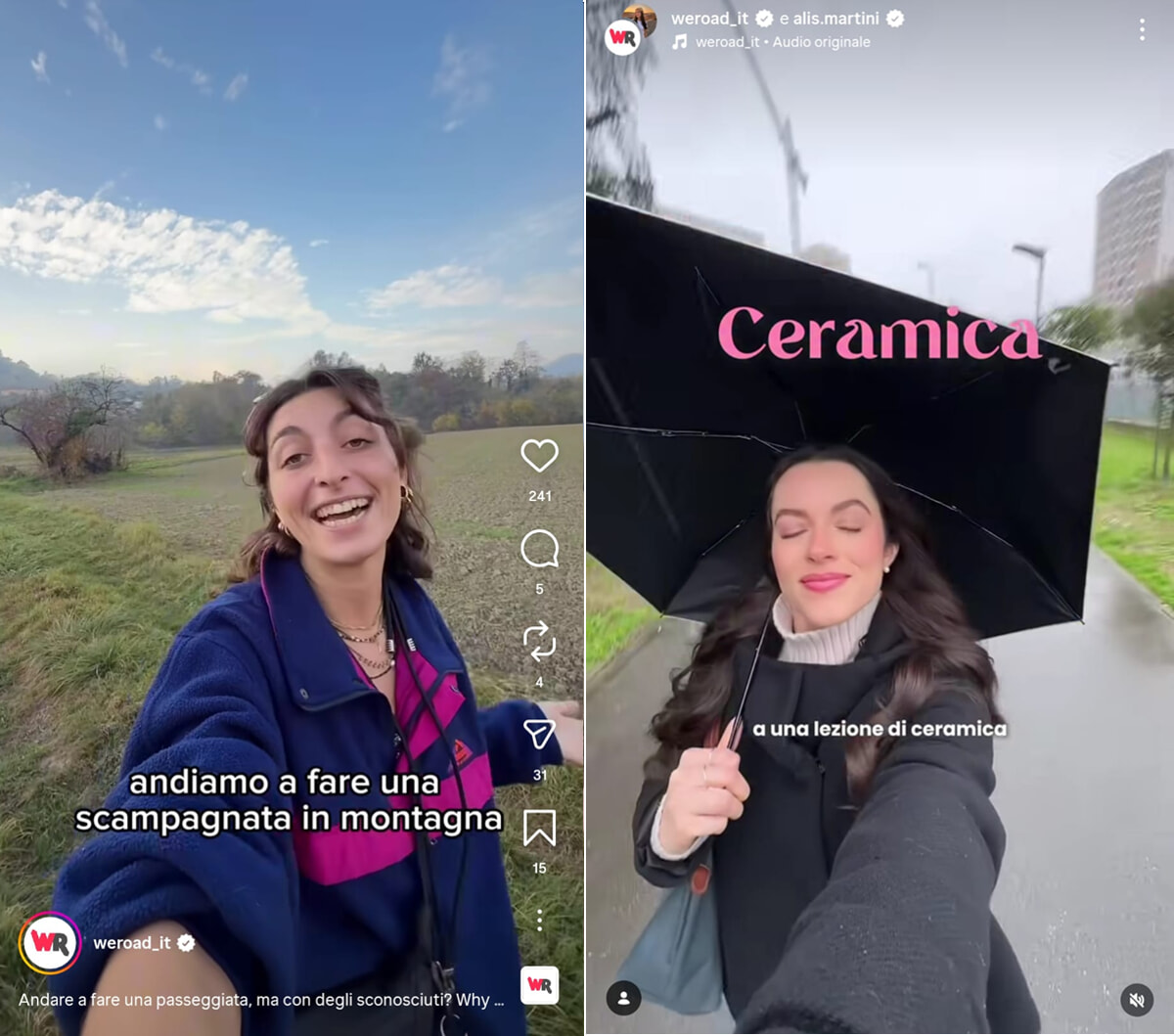
The cultural visit: why choose it (and who you will find there)
At cultural visits, generally, you meet two types of people. On the one hand there are those who are there to really broaden their circle, after a breakup or other unexpected events in life. On the other hand, those who are not “looking for friends” in the strict sense, but a bit of company to do things they wouldn’t do alone. Ylenia, 34 years old, an engineer, is in the first group: she arrived in Rome from Agrigento to follow her partner, but after the end of the relationship she found herself without a network. He knows that finding new, true friends will take time and luck – finding a friend is often more complicated than finding a love – but in the meantime, whatever happens, an exhibition in the center organized by WeMeet is already a way to get out of your comfort zone and take an experience home. Rocco, 55 years old, a computer scientist, is in the second group: “My interests do not coincide with those of my peers”, he says. With two children at home, he then underlines that he would never participate in events such as aperitifs: “There is often the hidden aim of conquering someone.” He smiles.
Dinners, karaoke and other innocent escapes: some advice
Indeed, a few evenings later, during dinner in a Thai restaurant, more mischievous glances pass by secretly. But it’s part of the game: expanding the circle also involves this. Lonely hearts or not, the first piece of advice when attending dinners and aperitifs is simple: arrive early, so as to begin to “study” the participants and choose who to sit next to. In fact, unlike trekking, where there is a continuous exchange, at the table you risk finding yourself stuck next to the wrong person for three hours.
Finally, speaking of escape, there are events that are worth attending even just for the sake of doing something that, in everyday life, you would never do (beyond the goal of “friendship”, in short). When would you ever find yourself thinking about chakras in a salt cave? Probably never. But that’s exactly the point: it’s the furthest thing from the working week. And the brain, every now and then, just needs to escape.
The Camillo’s and the (realized) dream of recreating the ‘bar’: “If you pass by, you always find someone”. It’s the Gen Z community
Moving away from macro-apps and then moving onto more generational communities, but well rooted at a local level, there is the story of The Camillo’s, beautiful as only grassroots initiatives can be. In fact, while the platforms mentioned so far were born as real entrepreneurial projects, here the personal drive came first and then met, almost magically, the social need.
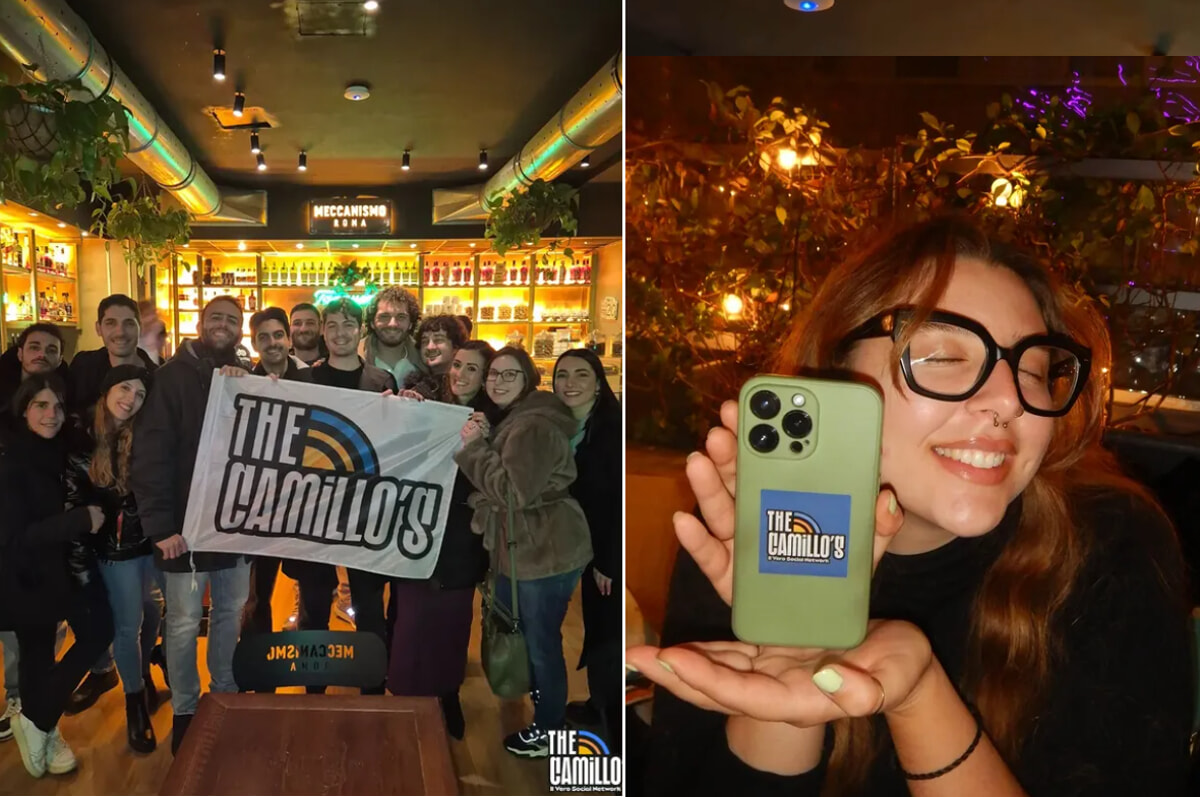
The project was born in particular from an idea by Paolo Catenaccio and Matteo Filosa, two off-site workers under 30 who live in Furio Camillo, in Rome, and who there felt the lack of a space for aggregation: the fault, they say, of a “dispersed” age such as the post-university period and, among other things, of the push towards isolation towards which smartphones induce. Thus they set up a real “failed community” again: dozens of young people who are now in contact and who have a club in the area as their headquarters. “They have recreated the concept of the neighborhood bar of the past”, says Daniele, one of the most frequent visitors: “Every Tuesday you know that, if you don’t have much to do, you can come here and you will always find someone to chat with. Last week there were 200 of us”. The tables are created by an algorithm developed by Matteo, an engineer by profession: “It is designed to balance age and gender”, they explain. And then there’s a chat to exchange tips on Rome, things to do, impossible rents and public transport. Final objective: to create a real square, the Piazza dei Camilli. “We are the real social network,” they say. And they are right.
Roma In Rosa and Amicamì, the all-female communities: “Women feel safe here”
On the same wavelength is the story of Marianna Gaito, born in 1992, from Salerno, who a year and a half ago found herself in Rome alone with a great passion: art exhibitions. So she launched an appeal on TikTok to find new friends with similar interests. And, since then, he has met two thousand women. “Today we are a real all-female community”, she says, “we hold eight events a month and I take care of organizing them, investing my free time in them”. Among the events of “Roma In Rosa”, this is the name, in addition to guided tours, also karaoke and real friendly speed date. “The next objective? Training meetings with professionals: psychologists, sexologists, finance experts”, she adds, “I am a convinced feminist and I think that activism should also be done in these places”. Finally, the ambition to broaden the audience: “At the beginning, mostly women between the ages of 30 and 45 wrote to me; today, however, there are many twenty-year-olds, but also fifties and sixty-year-olds. It’s them that I would like to speak to too: I’m sure that even my grandmother, who is 93 years old, would like to make new friends.”
Six hundred kilometers away, in Milan, there is a mirror initiative: Amicamì. It was founded by Marta Storino, who in 2022 published an appeal looking for new friends: in one night she received one hundred responses. Today the community has grown to the point where it has become his full-time job. “The best thing? There are girls who, thanks to us, have come out of toxic relationships and have rebuilt their lives”, she says, “here, in fact, women feel safe, no one is left behind”. Among the events organised, there is also New Year’s Eve, because we know: parties are the occasions when you feel most alone. But not anymore today.
View this post on Instagram
