
The Italian salaries They are among those who have lowered the most in Europe than inflation. If it is true that in Europe there are lower average salaries than ours – and yes, there are more highly higher -, we are still below the European average.
As we had already analyzed, the Media gross salary in Italy is of 31,856 euros The year, with variations that depend on various factors: on qualifications to the workers’ genre, from the geographical area to the size of the company. IMPORTANT: with medium salary it is not clear that everyone in Italy earn on average this figure, but that by adding all the salaries – from the highest, which are up to a few, to the lowest, perceived by many – and dividing the total for the number of workers, that is the value that is obtained.
While in Italy, according to Eurostat and OECD data, it average gross monthly salary In 2023 it is approximately 2,729 eurosthe European average is 3,155 euros: Italian workers therefore earn on average 429 euros less per month Compared to the European average, with an annual gap of over 5,000 euros on 12 months. From country to country there are therefore differences, with countries where, as mentioned, they earn still lower figures: to understand, however, if the salaries are sufficient for a dignified life compared to the costs, you must also keep in mind the cost of living and inflation. By relating these values, we will be able to calculate the purchasing power and understand if, high or low, the salaries are adequate compared to the cost of living in our country.
The lowest and highest salaries in Europe: the RALs in comparison
Second Eurostat data referring to average salaries In 2023 in the European Union, the salary annual full (full-time) average is of 37,863 euros. The salary medium monthly gross For a full -time worker he varies from 1,125 euros in Bulgaria to 6,755 euros in Luxembourg, with one EU average of 3,155 euros per month. A comparison of these first data highlights a difference between the countries of Western and northern Europe and those of Eastern and Southern Europe.
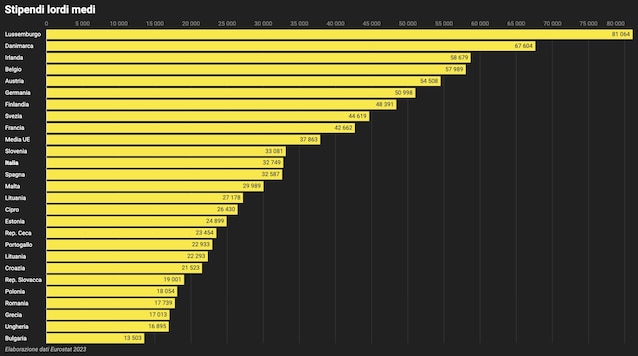
If we also include the Swiss (which was not the member of the Union), based on the OECD data that analyze the countries beyond the borders of the European Union, we find it in the lead, with 8.104 euros per month of gross monthly salarythe highest in Europe, followed by that of Norway (5,027 euros), the Netherlands (4,629) and the United Kingdom (4,220 euros, always not EU). Above 5,000 euros, with 5,624, there is still Denmark; Above 4,000 euros there are Ireland, Belgium, Austria, Germany and Finland. And then there are countries such as Romania, Greece, Hungary and Poland, in which RALs remain around 1,500 euros.
However, it is not enough to look at gross wages, given that in each country there is a different taxation at work – which in Italy is among the highest in Europe – and Therefore we must see the net wages.
The comparison between the net wages of European countries
Always according to Eurostat data (referring to 2024), in Italy A single and children -free worker who works full-time perceives on average a Net annual salary of 24,797 euros. We are just below the European average, with countries such as Spain, Greece, Portugal and others that see even more reduced figures. However, comparing it with Switzerland, which goes beyond 85,000 euros net, or Germany, almost 40,000, the distance is evident.

Another factor of which we must take into account, however, for a fair confrontation between countries is that of real wages, which must also be calculated Based on the cost of living: If in fact we compare Italy’s net salary of Italy with that of Bulgaria we will see that the second is just over a third of the first, but also that in Bulgaria there is a lower cost of living than Italy, and therefore the salary will give a better purchasing power.
The cost of living, real wages and purchasing power (PPS)
The cost of living It is the overall amount of money necessary to support a certain standard of living in a certain place and period of time, that is, it measures how much it costs to live in a certain geographical area. It typically includes costs for accommodation (rent or mortgage), power supply (food and drinks), transport, goods and essential services (clothing, utilities, health, education, leisure), local and national taxes.
The indicator that is used by Eurostat to make this comparison is the “PPS”, “Purchasing power standard”in Italian “Standard of purchasing power”. It is aartificial measurement unitused to compare the purchasing power of different countries, removing the effect of price differences. In practice, prices change from country to country and in some places more euros are needed, in others less. The PPS serves to “equalize” the differences, to understand which country is truly richer or where the salary has more value.
Compared to the nominal salary, which is the figure that can be read in the paycheck, the royal salary It is the salary expressed in terms of purchasing power, that is how many goods and services They can really be purchased with your salary, taking into account inflation (i.e. the general increase in prices). They are obtained by dividing the nominal salary by the general level of prices.
A practical example, with purely instrumental figures: we place that in 2022 your salary was 2000 euros per month, with inflation at 0%, here the nominal and real wages coincide. If in 2024 your salary (nominal salary) has remained stable for 2000 euros per month, but with an inflation of +10%, then with that money you can buy 10% less than goods and services, because the real salary will have decreased.
The inflation and decrease of real wages in Italy
In general, wages are and are growing in almost all OECD countries, but in real terms many of them are lower than the levels of the beginning of 2021, before there was the increase in inflation that is followed by pandemic: the OECD indicates that real wages in Italy at the beginning of 2025 were 7.5 % lower than the beginning of 2021 prices and cost of living, with the passage of two economic crises and Covid, making us poorer.
And here is the primacy – negative – of Italy: our country has in fact recorded The most significant drop in real wages among all the main economies of the OECD. A negative record in terms of reducing purchasing power for Italian workers. Italian salaries have a lower purchasing power than the average of the European Union: 24.051 against 27,530.

According to Eurostat 2023 data, in Europe we are in 15th place on 32 countries, always below the European average. From 2000 to 2023, the annual net wages of single workers in Italy have grown much less. From the most recent surveys, using the PPS, the average Italian salary, calculated in 2,772 ppsis lower than about 15% compared to the average of European countries, in particular, 45% lower than the German one, 18% compared to the French one and 2% compared to the Spanish one.

From January 2021 to February 2025 the inflation brought an increase in prices of almost 18%while the wages have grown only by 8.2%, that is, less than half. From the 2008 crisis, real wages, calculated net of inflation, even lowered by 8.7%. According to the data of theNational Labor Observatory We are among the countries where salaries have lost more value since that year, for a series of reasons. Because of the economy that suffered the damage of pandemic and wars; due to a productivity of work that has not grown; Because compared to other countries we have less educated and qualified workers; In part, again, due to the unions that renegottois the contracts, with timing so long that employees often work with expired contracts, while the salaries rise, but still remain inadequate At the growth of prices – think, at the beginning of the first quarter of 2025, one of an employee out of three of the private sector was still covered by a expired collective agreement.
According to the OECD forecasts, the growth of real wages It should remain modest in the next two years. Nominal wages in Italy should increase by 2.6% in 2025 and 2.2% in 2026. These increases are significantly lower than most of the OECD countries, but should still guarantee Italian workers small earnings in real terms, given that inflation should reach 2.2% in 2025 and 1.8% in 2026. To trace the European average, however, there is still a long way to do.
