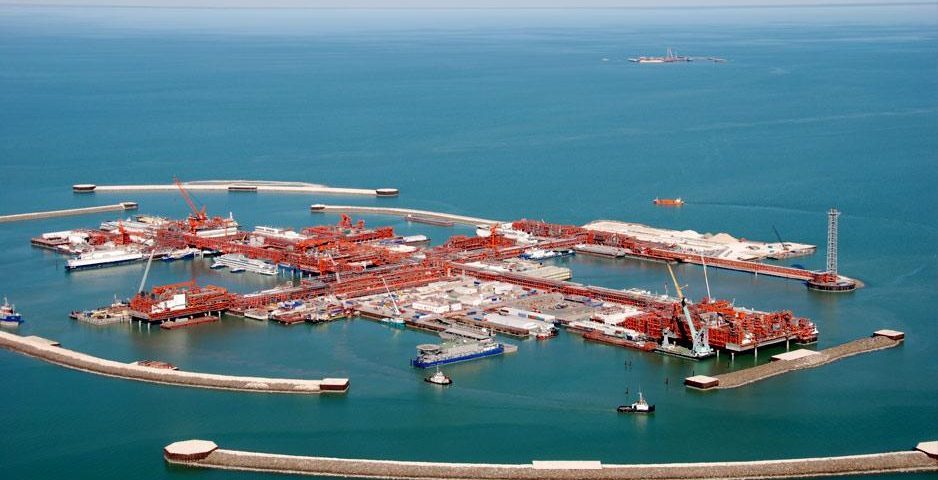
The oil field Of Kashagan Fields (Kazakhstan) represents to date one of the most significant discoveries of the last half century in the oil sector. With his 38 billion barrels of crude oil”in place” (present on site) is among the largest offshore fields – on the seabed of territorial or international waters – discovered in recent decades. To extract it, however, the engineering challenges are enormous. Let’s see them together.
The ice mining project
As already mentioned, that of Kashagan Fields (Kazakhstan), is today among the largest and most significant oil deposits ever discovered. In fact, they hide well beneath the surface 38 billion barrels of oil of which recoverable would be approximately between 9 and 13 billion barrelsThe engineering challenges to extract it, however, are enormous.
We start first from ice. The Caspian Sea, in fact, being a very shallow sea, freezes 5 months a year. In order to overcome this problem, which would prevent the use of normal platforms, special structures and infrastructures have been created, such as D island, to essentially act as a primary operational base for crude oil extraction. Around these artificial islands, made of limestone material, a series of structures are built which are able to protect the island from the ice in the process of forming. Special boats with a specially reduced draft, designed in Finland, capable of breaking the ice as they pass, are then used.
Another challenge, much more difficult to face, is the high concentration of hydrogen sulfide in oil, given that this gas is not only highly toxic but also corrosive to steel. The problem is solved by installing pipelines made of toInternally coated carbon steel (cladding) with a Nickel-Chromium-Molybdenum alloy called Inconel 625.
Another problem is the very high pressure to which the oil is located, which makes drilling and extraction anything but simple. The oil is in fact located at a depth of 4,200 meters, with a pressure estimated at around 800 bar. The high pressure problem is solved in an ingenious way. In fact, instead of igniting the excess gas, the same gas comes reintroduced into the depositin such a way as to maintain constant pressure and therefore facilitate the extraction of crude oil. A series of are then employed giant compressorsamong the largest ever built, in order to push the gas even to higher pressures than those inside the field itself.
Project management and critical issues
The project is entirely managed by NCOC (North Caspian Operating Company) which includes within it other giants such as KazMunaiGaz (Kazakhstan), Eni, Shell, ExxonMobil, TotalEnergies (all with approximately 16.8%), as well as CNPC (China) e Inpex (Japan). The field was discovered in 2000, and oil extraction officially began in 2013. Due to the presence of the gas that we have already talked about in the previous paragraph, extraction was almost immediately interrupted, and then resumed around 2016, when coated steel began to be used to avoid corrosion.
The project, however, brings with it some critical issues, especially regarding the local flora and fauna. Various associations report that the birth rate of the Caspian Seal and the Beluga Sturgeon has decreased, although to date there is no certain evidence regarding a direct link between this phenomenon and mining operations.
