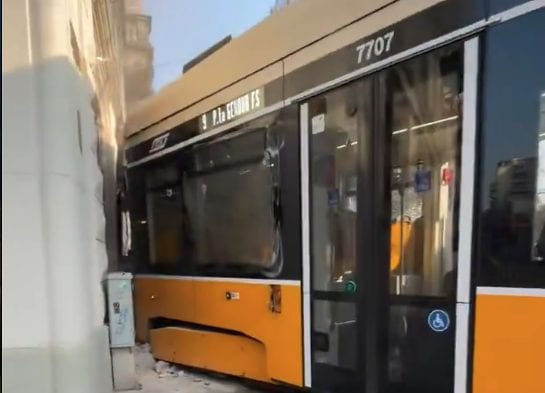
A tram derailed in Milan ending up crashing into a building causing at least one victim and 38 seriously injured: according to the first information available, the accident occurred in viale Vittorio Veneto – right in the center – around 4.15pm today, February 27, with the vehicle of line 9 which came from Piazza della Repubblica and was heading towards Piazza Oberdan, with terminus Porta Genova.
According to what was reported by Corriere della Serabefore leaving the tracks the tram had reached the intersection with via Lazzarettowhere there is an exchange that also allows ato the left: the means of transport should have continued straight and instead he would have took the curve «at high speed”, ending up colliding with a building and knocking down a traffic light and smashing the windows of a restaurant, as confirmed by some present.
One person is dead and at least 8 people were seriously injuredwith some of them remaining stuck under the tram, transported to Niguarda Hospital. I immediately intervened on the scene rescuedwith 6 ambulances and 5 medical vehicles in code red, as well as the Fire Brigade.
At the moment, however, the causes have not yet been clarified by the authorities: it is not clear whether the problem can be traced back to atram or rail faultor if the driver had to make a sudden maneuver to avoid people on the tracks.
The tram was one of the new models Tramlink, designed and manufactured by the Swiss Stadler. In particular, the protagonist of the accident is amodel 7701 unitwhich entered service on line 9 only at the end of January. It’s a tram 25.4 meters long capable of reaching a maximum speed of 60 km/h (self-limited to 50 km/h). Its main peculiarity consists in being a two-way vehiclethat is, capable of proceeding in both directions by reversing the direction of travel thanks to the two driving cabins at the ends of the vehicle.
