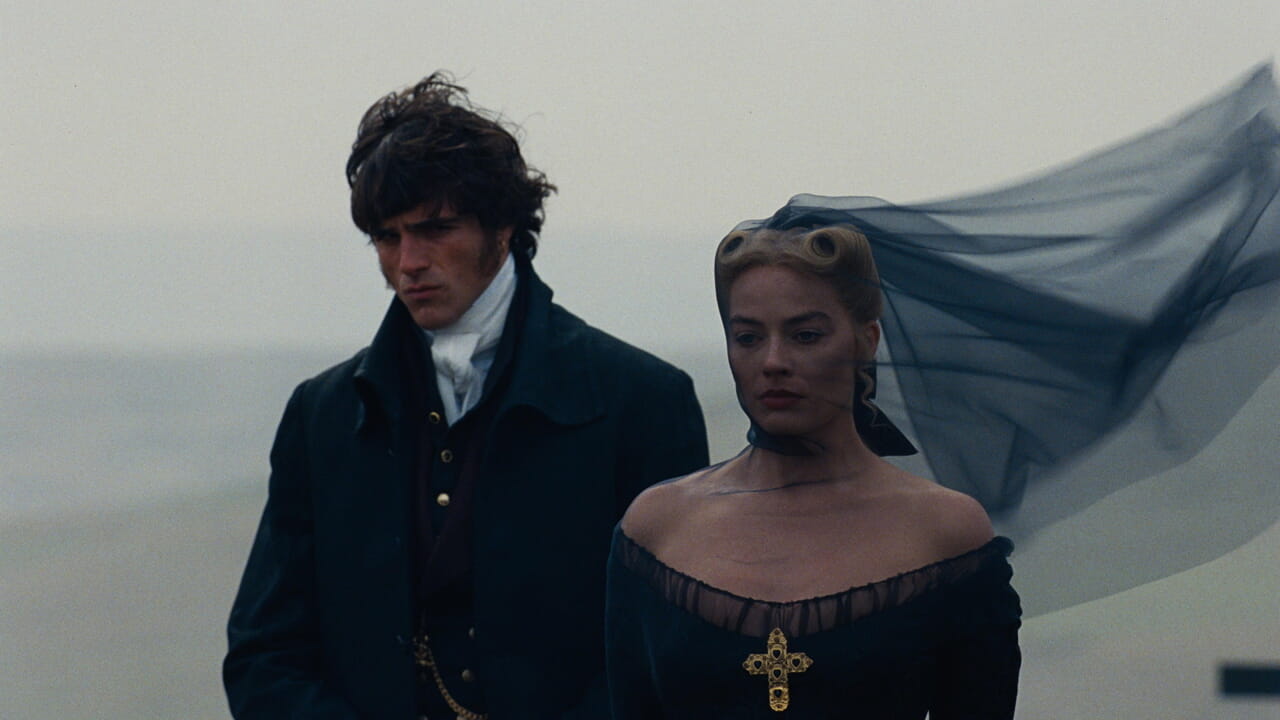
In short, what is this film “Wuthering Heights” that everyone is talking about
“Wuthering Heights” is a candidate to be one of the titles that will leave a mark in 2026. Emerald Fennell gives us her own version, very free and very particular, of Emily Brontë’s famous novel, elaborating its themes and meanings in a radical and audacious way. The end result is a period drama that both elevates and destroys the classic canons of the genre.
“Wuthering Heights” – The plot
“Wuthering Heights” starts with a hanging. So, just to clarify. Little Catherine, daughter of the choleric and alcoholic Mr. Earnshow (Martin Clunes), assists her and, after the death of her little brother, has placed young Nelly (Hong Chau) at her side as a semi-guardian. A few days later, the father surprises everyone by bringing a vagrant into the desolate mansion, effectively adopting him. Catherine will give him the name: Heathcliff. The two become inseparable, closed in that small universe, that English moorland of the early 19th century which Fennell portrays as a mixture of historical realism and gothic fantasy in strong, indeed very strong, colours. Years pass and Catherine (Margot Robbie) and Heathcliff (Jacob Elordi) begin to look at each other differently, especially him, treated like a beast of burden by the owner of the house. But when the rich, or rather very rich, Edward (Shazad Latif) and Isabella Linton (Alison Oliver) arrive as neighbors, that little world in which they had been confined breaks down, with consequences that will completely change the course of the two’s lives. The rivers of their existences are destined to cross again, between desire, pain, passion and revenge.
When it came out in 1845, Brontë’s novel was not initially a great success. Indeed, critics indicated it as an immoral and scandalous work. Over time, however, it has become one of the great masterpieces of English literature, a symbol of the author’s genius, the symbol of a different declination of the topoi of romanticism. Emerald Fennell, after having caused quite a sensation with her “Saltburn”, which was preceded by the brilliant “A Promising Woman”, returns once again to obsession, classism, unspeakable desires and women. It takes something from the original novel, a lot or a little, it depends on how you look at it, but Fennell certainly cannot be accused of excessive reverence and fidelity, as she arms herself with the beautiful photography of Linus Sandgren, the costumes of Jacqueline Durran, the sets by Helen Scott and drags us into a place-non-place. This is the England of mud, rot, dirt and decay, but also of beauty, of powerful nature, of Cinderella palaces. Paradoxically, it is precisely the Rodopi fairy tale that comes to mind the most, with its pastel colours, that contrast between before and after a spell, which however has the tones of anguish.
A feverish, sensual and desperate duet
“Wuthering Heights” has the tone, the dialogues, the soul of the period drama, but all of this is used by Fennell to destroy its sacredness, its nobility. Which, after all, was also what Brontë actually already did in her time, behind the veneer of banal love melodrama. Jacob Elordi works really well below and above the lines, outlining the almost vampiric transformation of his Heathcliff. The true Prince Charming was that dirty, generous, sensitive sharecropper, destroyed by a rejection, who returned in the guise of a man of the world, charming and resolute, but with a soul rotted by a desire for revenge, possession and domination that soon led to pathology. There is a lot of talk about toxic masculinity, “Wuthering Heights” shows us its eternal, fascinating side, desired by a female world that the director does not absolve at all. Margot Robbie perhaps arrived a little too late to this role, but her stage presence and verve are unleashed in all their power, as she alternates between tears and smiles, truth and lies. Weak, inconstant, as selfish as his better half with whom he stages a magnificent seduction duel, he learns at his own expense how much courage is needed in love.
“Wuthering Heights” is perhaps ten minutes too long, but despite this, also thanks to a perfectly guided supporting cast, it manages to make sense of every irreverence and change that Fennell makes to the original text. Fewer characters, fewer events, but above all a sexuality that is much more obvious, carnal, although wrapped in the guise not of naturalness, but of a sense of guilt, of the illicit, of the unnatural. No one is innocent, no one is the only one guilty in this tragedy where manipulation, gender violence, the old patriarchal society also forcefully enters, which however has sown its evil in the modern one, in the conception of the two sexes. Heathcliff and Catherine are two clichés that still walk among us today, glorified by that narrative that Fennell destroys, minute by minute. Heartbreaking ending, beautiful because it is capable of bringing everything back to the common denominator, to the need to recover the purity of feeling such as altruism, generosity, clarity, rather than performance or obsessive competition. Without a doubt his best film, and it is likely that he will be able to proudly have his say at the next round of Academy Awards.
Rating: 8
undefined
