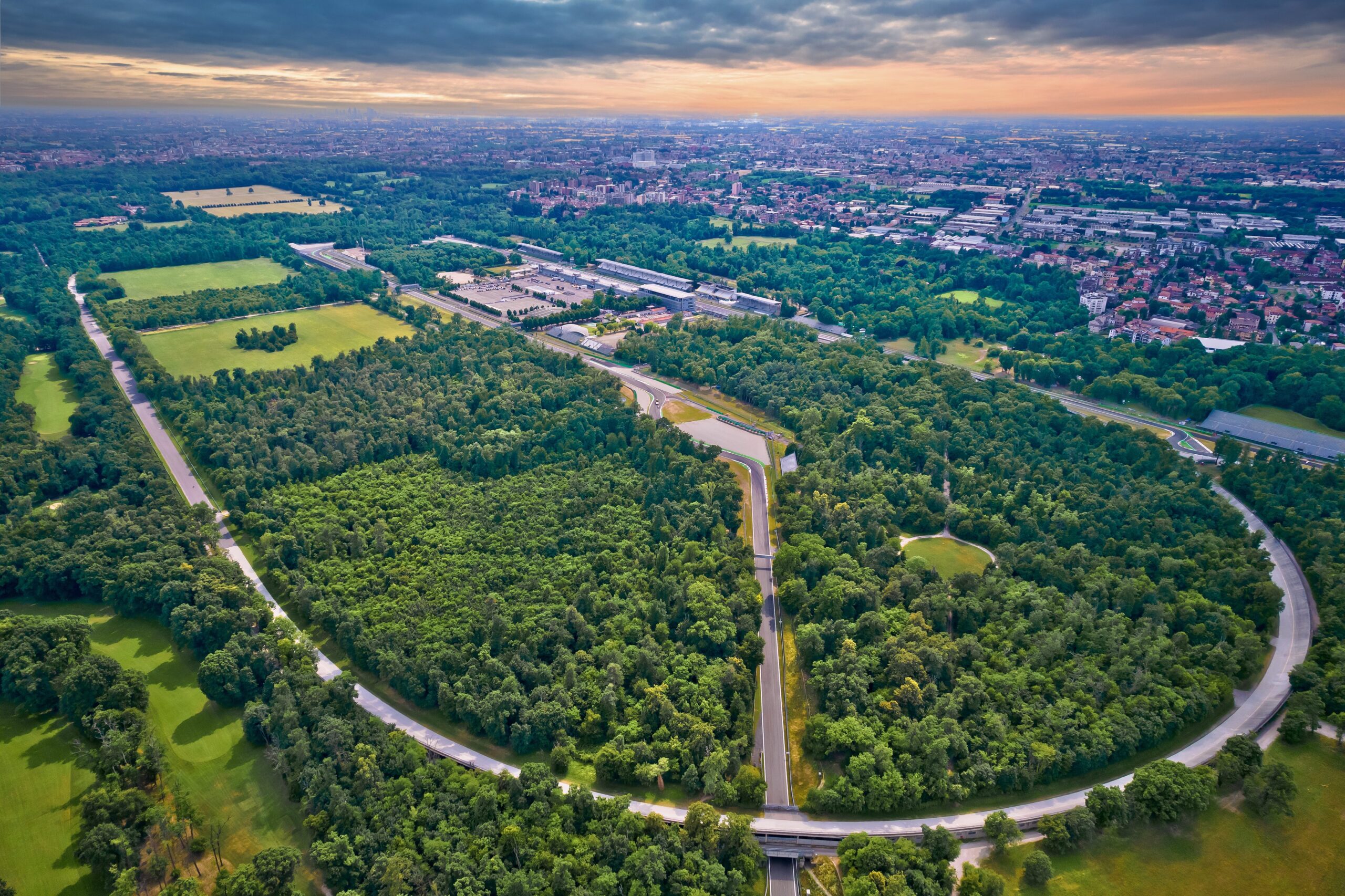
The Monza circuit It is the fastest track in the entire Formula 1 World Championship, also known as “Temple of speed”: here the single -seater can touch (and to overcome) i 350 km/h. In 2005 Kimi Räikkönen recorded the absolute speed record In a Formula 1 race reaching i 370 km/h At the wheel of the McLaren MP4-20.
Inaugurated in 1922, Monza hosted all the editions of the Italy GP except that of 1980when Formula 1 moved to Imola for safety works on the Brianza circuit, and will also be the scene of the Italy of Italy on Sunday 7 September 2025 at 15:00. The route is long 5793 meters and the pilots will complete 53 rpm For a total distance of 307,720 km. The long straights force the teams and the single -seaters to release all the horses available (even here only 10 HP can apply about 0.19s to the tour) to look for the highest possible speeds, all this accompanied by a structure from very low aerodynamic loadthe lowest of the whole season.
In 2020 Lewis Hamilton recorded the record for the fast lap in qualifying by stopping the time trial on the time of 1’18 “887 at an average speed of 264.362 km/h, The highest ever recorded in the history of F1. We analyze in detail the Brianza circuit and what are the challenges for the pilots and for the stables.
The records, victories and poles of the Monza National Highthoder
During his 74 editionsthe Italian Grand Prix has given pages of unforgettable history, becoming the scene of indelible moments and records that still make the ‘Temple of speed’ today a unique circuit in the Formula 1 calendar. Here are the most important to know:
- Pilots with multiple victories: They share the scepter two icons of this sport such as Michael Schumacher and Lewis Hamilton (5), followed by illustrious drivers such as Juan Manuel Fangio, Stirling Moss, Ronnie Peterson, Nelson Piquet, Alain Prost and Rubens Barrichello (3).
- More winning stables: Ferrari excels, which has won 20 times here, followed by McLaren (11), of little more detached we find Mercedes (7) and Williams (6).
- Pole position: Lewis Hamilton leads this ranking with 7 conquered poles, followed by Juan Manuel Fangio and Ayrton Senna (5).
- Pilots with multiple podiums conquered: Michael Schumacher and Lewis Hamilton (8), Fernando Alonso and Sebastian Vettel (6).
- Pilots with multiple laps in the race: Fernando Alonso (984), Kimi Räikkönen (889), Rubens Barrichello (886), Lewis Hamilton (870), Michael Schumacher (839).
- Record lap in the race: 1’21 “046 signed by Rubens Barrichello in 2004 with Ferrari
- Record round in qualifying: 1’18 “887 recorded by Lewis Hamilton in 2020 with Mercedes
- Speed record: in 2005 Kimi Räikkönen reached the race i 370 km/h while Juan Pablo Montoya touched the 372.2 km/h During a test always aboard an McLaren.
Among the curiosities that over the years have affected Monza, particular is that of the 1971 Grand Prix: Peter Gethin he won with only 0.01 seconds ahead of Ronnie Petersen, while the first five arrived less than 0.61 seconds. Instead he dates back to 59 years ago, in 1966 The last victory of an Italian driver in Monza, when he triumphed was Ludovico Scarfiotti On Ferrari. On this track, also, in 2008 a young driver named Sebastian Vettel he conquered his first victory in F1 at the age of 21 years and 72 days With the Italian Scuderia Toro Rosso and also became the youngest pilot to have ever won on this track.
Long straight and curves: the characteristics of the speed time
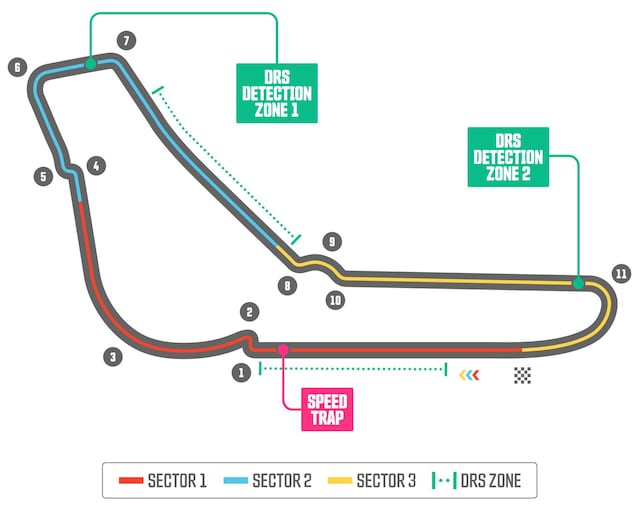
The route counts 11 curvesof which 7 on the right and 4 on the left. Despite the few guided sections, according to the data provided by Brembo, the track leads to a high stress i brakes. The stresses on the braking system, to give an example, on a scale from 1 to 5, in Monza the difficulty is of 4. To make the most of the very long straights, the single -seaters mount a very low aerodynamic load. However, this translates into very violent detachedespecially in the three variants – Rectifile, Roggia and Ascari – where the brakes are put on tough test. For this reason in Monza it is essential to have, in addition to a powerful power unit, a lot traction and an excellent braking balance.
In total there are alone six braking pointsbut their intensity is such that the system is used for about 10 seconds aroundor the 14% of the race time. On the contrary, it is estimated that approximately 80% of the Giro is covered with a completely wide open gas.
The first sector starts from the straight of the finish line, long 1350 meters And it is traveled in full gas for 15 seconds. Immediately afterwards the most violent braking of the whole World Cup arrives that leads to First variant where the single -seaters arrive there at over 330 km/he face a closer of 90 ° chicane on the right and then left to about 80 km/h. All this takes place in just over 2 secondswith the pilots who exert a force of 135 kg on the brake pedal and a deceleration of 4.3 g.
After the variant, you launch yourself to the Large curve – or Biassono curvea very long fold on the right, with almost 300 meters of radius, which the pilots face in full acceleration and prepare to face another key point, the Variant of the Roggiathe second chicane of the circuit. Here too he brakes very strong for over 300 km/h to go around the 110-120 km/h. The sequence is the opposite of the first variant: first curve to the left, then to the right. It is a delicate point, because the curbs are very aggressive and can unbalance the single -seater.
Once the roggia is over, you enter the stretch of Lesmo curves. The first, the Lesmus 1is a curve to the right to be faced with about 180 km/h: Here you need precision, because making mistakes the trajectory means losing speed for the rest of the sector. After a short straight comes the Lesmus 2even closer, always on the right, to go around 160 km/h. It is essential to get out strong because it carries on the long straight that follows.
We then pass through the Serraglio curvea very fast fold on the left, almost imperceptible for the pilots, which is completely done in full. From there you get to the spectacular Ascari variant: a very rapid sequence of three curves (left-right-left). Here you already enter above the 200 km/hand the difficulty is to find the right balance: aggression on the curbs is needed, but also fluidity in order not to lose momentum on the next straight.
Finally, after having traveled almost all the long straight opposite to the pits, you get to the Parabolic (now named after Michele Alboreto), the symbol of Monza. It is a very long fold on the right, with entrance from about 330 km/h and a braking that leads the pilots to go around the 180 km/h in the initial part. The radius of the curve, however, gradually expands, allowing you to accelerate more and more until the outgoing gas opens. Those who manage to manage this stretch well launches on the main straight with the maximum speed, ready to complete the lap or attempt an overtaking.
The overtaking are possible thanks also to Two DRS areas: One on the main straight and the other between lesmus 2 (curve 7) and the variant of Ascari (curve 8). It should be noted that from the starting grid to the first detached, the distance is of 620 metersthus giving pilots additional overtaking ideas.
Degradation tires and pit lane very long: the strategies at the Monza circuit
The Monza circuit is one of those slopes where the tires They do not suffer particularly, above all because of the long straights and the few curves in support. However, you must pay attention first of all to thermal degradationwith so few guided strokes it will not be easy to bring the mixes, in particular the front ones, in the right temperature window. To this is added the new asphalt Which made his debut in 2024, which in very hot race conditions such as that of last year when the mantle reached 54 °, brought many problems on the wear of the tires. Other factors that could give a few more scratches to the tires are the lateral forces in the points such as the large curve and the parabolic, the outgoing traction from the two chicane and from the stability in braking.
As for the strategies to be adopted, the fastest is the strategy a a stopeven considering that the Monza pit-lane is one of the longer Of the whole World Cup (280 meters) and consequently the time taken to carry out a pit-stop is very high. For the weekend of the GP of Italy 2025, Pirelli chose the same compound of Mescole used in the 2024 race: C3 as Hard, C4 as media And C5 as soft.
The track, reshapered last year, in the meantime has “settled”, and this should reduce the risk of graining – A phenomenon in which small pieces of rubber come off from the tire and remain attached to the tread, creating an irregular surface that loses grip and performance.