
The circuit of Interlagos it is located approximately 25km from the Brazilian metropolis of Sao Paulo. The track takes the name of Interlagos as its location sees it positioned in the middle of to two artificial lakes: the Guarapiranga and the Billings which in the past were used to bring water to the city of São Paulo. On Sunday 9 November 2025 at 18:00 the pilots will have to travel i 71 laps scheduled for the race over a total distance of 305,879 km. The race record lap on the Interlagos circuit belongs to the Finn Valtteri Bottas which in the 2018 edition stopped the clock on1’10″540 with the Mercedes at an average speed of 223 km/h.
Why is he called José Carlos Pace? History of the circuit
The Autódromo José Carlos Pace, named after the Brazilian pilot who tragically died in a plane crash in 1977, was inaugurated in 1940 with the original name of Autódromo de Interlagos. Since 1973 it has been the historic home of the F1 Brazilian Grand Prix, with the exception of the editions between 1980 and the 1989 competed on the track of Jacarepaguá in Rio de Janeiro. After the 2020 break due to the pandemic, the race has returned to Interlagos permanently since 2021. In total, the Interlagos circuit has hosted 41 Grand Prixbut only them last four they took on the name of the city of Paulista. Like many circuits, it has changed skin more than once over the years, the very first layout of the track was long 8kmthen it was shortened and made safer thanks to significant renovations completed in 1990.
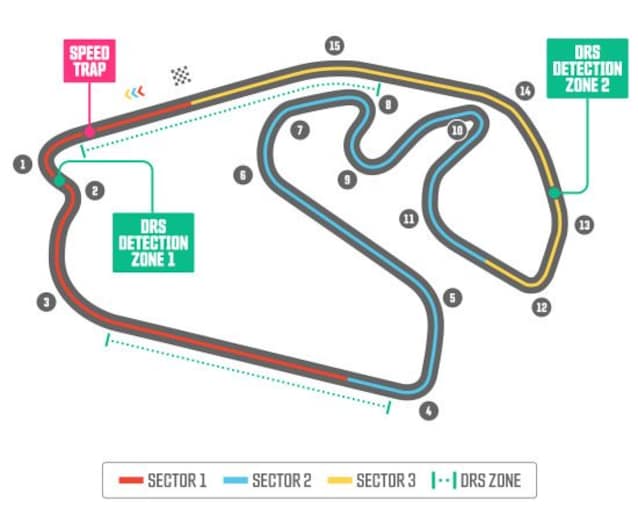
The Brazilian track measures today 4309 meters and they are present 15 curves of which 5 on the right and 10 on the left. The track ranks fourth among the shortest of the Formula 1 World Championship behind those of Monte Carlo, Zandvoort and Mexico. Furthermore, it is the second highest circuit in terms of altitude after the one in Mexico City, here in Brazil we will race at 800 m above sea level. High severity regarding power uniton this track the pilots remain with the throttle wide open for a long time 70% of time over a total lap. The composition of the track has two straights: the main one 1240 meters to travel in approximately 15 seconds which leads to turns 1 and 2 “S do Senna” and the secondary one that leads to long turn 4 820 meters. It’s not a layout that places a lot of stress on you brakes, solicited only for the 17% of time on a lap.
Statistics and records of the Brazilian circuit
Over the years, the Interlagos race has often seen some of the most “dramatic” moments in motorsport being written right here. This is where in the 2008 one of the most iconic finales of modern Formula 1 took place: Felipe Massa he crossed the finish line as world champion with Ferrari, but a few seconds later Lewis Hamilton he overtook Timo Glock at the last corner, taking the title (the first of his career) from him just one point.
In this section we will consider only the numbers and records linked to the editions held on the Interlagos circuittherefore excluding those races on other Brazilian tracks such as Jacarepaguá. Let’s now look at some of the most significant data about this historic racetrack:
- Drivers with the most victories: at Interlagos the most successful driver is Michael Schumacher with well 4 wins. Behind him we find Sebastian Vettel, Lewis Hamilton and Max Verstappen quota 3.
- Most successful teams: among the teams, however, the one stands out Ferrari with 9 successesahead of McLaren (8), Red Bull (7), Mercedes (6), Williams (4).
- Pole position: different story regarding the qualifications, where there is no absolute dominator. In fact, at the top of the ranking we find Ayrton Senna, Mika Häkkinen, Felipe Massa, Rubens Barrichello and Lewis Hamilton, all at 3 pole positions.
- Drivers with the most podiums achieved: Michael Schumacher (10), Fernando Alonso (9), Kimi Raikkonen, Lewis Hamilton (7), Max Verstappen (6).
- Drivers with the most laps completed in the race: Fernando Alonso (1351), Michael Schumacher (1233), Lewis Hamilton (1162), Kimi Raikkonen (1116), Jenson Button (1038).
- Record lap in the race: 1’10″540, set by Valtteri Bottas in 2018
- Record lap in qualifying: 1’07″281, signed by Lewis Hamilton in 2018
Speaking of the starting grid, there is an interesting statistic: out of 41 editions held so far, 18 times (43.90%) the victory went to the driver who started from pole position, while in 13 occasions (31.71%) The driver who started second won. Demonstrating how much qualification matters on this circuit, in the 41 editions held at the Autódromo José Carlos Pace, only in 17 occasions (41%) the driver who started from pole position managed to win the race. Furthermore 6 cases out of 10therefore, the victory went to whoever started furthest back.
Furthermore, heart-pounding finishes are certainly not a rarity at Interlagos. The smaller margin of victory dates back to 2002when Michael Schumacher he crossed the finish line with barely 0.588 seconds of advantage. The German also holds the opposite record: in 1994 won with beyond a margin lapone of the last times it happened in Formula 1. In the last ten appointmentsthe average gap between first and second at the finish line was 7.076 seconds.
An “onboard” ride in Interlagos, between endless straights and the iconic “S do Senna”
The Interlagos circuit has a significant difference in altitude that reaches i 40 meters from the exit of turn 12 until you reach the first braking section which leads to turns 1-2, the iconic ones “S do Senna”. The tour begins on main straightuphill, where the single-seaters reach peaks higher than 330 km/h before tackling the curve 1the most demanding braking point of the entire circuit, you brake just 40 meters from the apex point for 2.39 secondsapplying approximately 139 kg of pressure on the brake pedal. The deceleration hits 4.6gwith the car going down to 123 km/h of minimum speed in third gear.
After passing Descida do Lago, where you brake about 90 meters from the chord point to 1.91 secondscoming down from 333 km/h to 175 km/hthe route enters the most technical and guided section. There curve 5 it is a fast uphill bend that prepares for the stretch of Ferradura (turn 6) and of Laranjinha (turn 7)two curves for medium-fast travel. Here the pilots maintain a speed of approx 225 km/h in the 6 And 237 km/h in the 7both in sixth gearwith peaks of 4.2 g of lateral acceleration.
The final sector begins with the turn 10 (Mergulho)a downhill left to be faced with full controlled acceleration, followed by the curve 11almost imperceptible but useful for setting the turn 12 (Junção). This is one dry leftaddressed in fourth gear about 138 km/hwith braking a 70 meters from the chord point. It’s a corner that’s crucial for lap time: good traction at the exit determines the speed all the way up the next climb. In fact, the famous one starts from here Subida dos Boxesthe uphill stretch towards the finish line that crosses the Curve from Arquibancada (turn 13)a long left bend traveled at full throttle beyond 290 km/hin constant support. The lap ends on the main straight, still uphill.
The track, with two long DRS zones that have produced over 70 overtakes in 2024, puts the power unit to the test, forcing drivers to use high gears for much of the lap.
Tire strategy and management on the Interlagos track with the weather uncertain
For the 2025 edition of the Sao Paulo Grand Prix, Pirelli has opted for a choice of harder compounds compared to 2024: C2, C3 and C4 will be respectively Hard, Medium And Soft. It’s a return to a more conservative approach, designed to limit degradation on a notoriously challenging track for riders rear tires. The Interlagos circuit, with its banked corners and frequent changes in gradient, tends to quickly overheat the rear axleespecially in the central section. In turns 6 and 7, driven at over 220 km/h, and in the following “Pinheirinho”, the traction required on exit increases the risk of graining And thermal weartwo phenomena that in 2024 had already clearly manifested themselves during the dry sessions on Friday.
Despite the recent resurfacing, the reduced roughness and the presence of numerous bumps favor a thermal rather than mechanical degradationdifficult to keep under control during long stints. For this reason, Pirelli has chosen a more robust range, capable of extending the “performance life” and to broaden the strategic window. There Interlagos pit lanelong 392 metersinvolves an average loss of 21–22 seconds (including stopping), a fact that pushes teams to limit stopping, but in case of Safety Car (present in 52% editions since 1993) can turn an early pit stop into a crucial tactical advantage.
At Interlagos also the weather forecast is an integral part of the show, in fact it is estimated that from 2000 onwards, the Grands Prix held at the Autódromo José Carlos Pace have seen rain as the protagonist in approximately 30% of editionstestifying to the weather variability that makes the Brazilian race even more unpredictable. Furthermore, November coincides with the rainy season in Sao Paulo, and forecasts indicate a high risk of sudden showers for the race. Asphalt temperatures can also vary by over 15 °C between one session and another, significantly influencing the pressures and operating window of the tyres.
