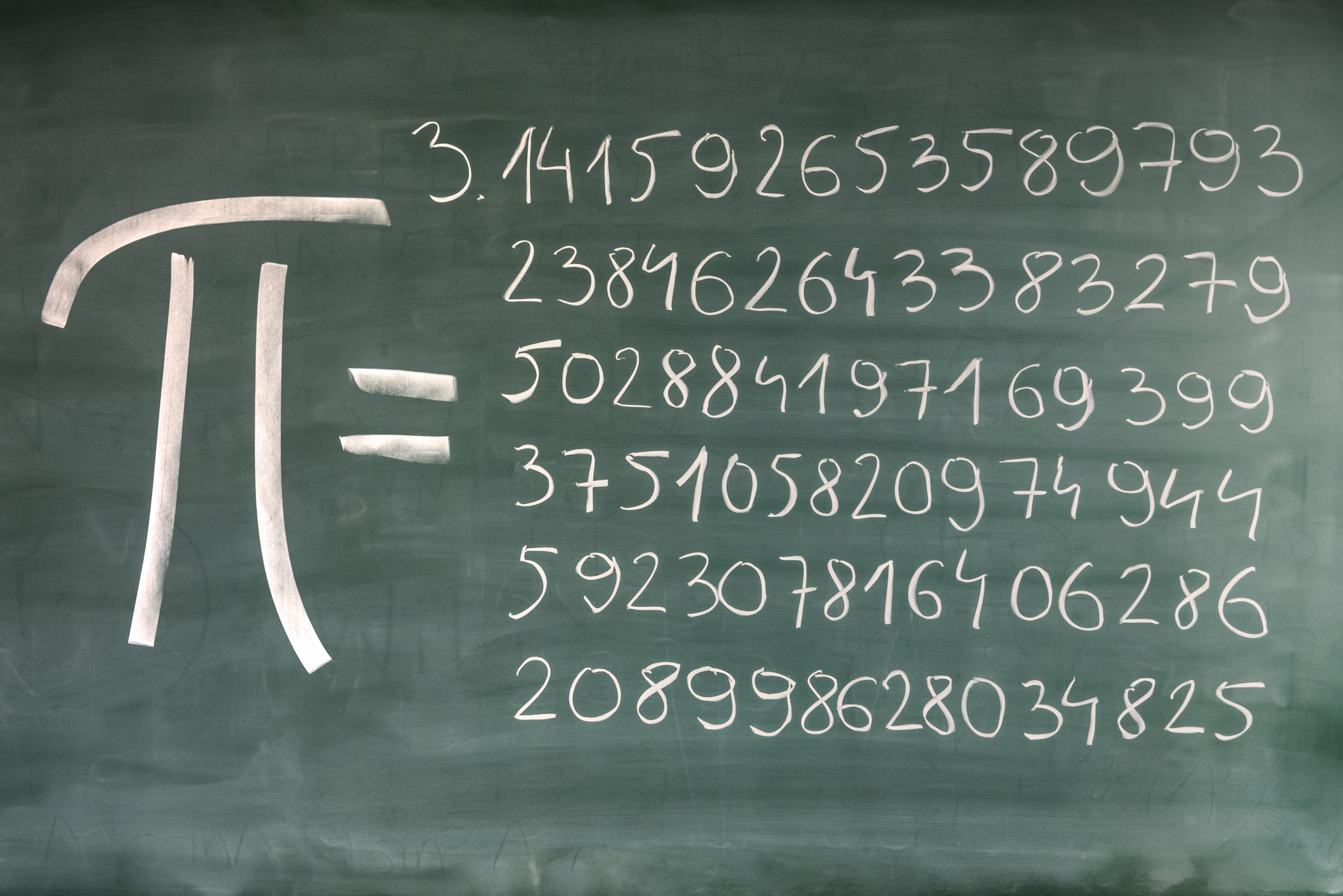
We often hear that within the infinite digits of pi π contain all imaginable combinations of digits of any length. This means that, if we encode any writing by associating a number with each letter, we can find it within the decimal digits of pi. In short, sooner or later, within the famous constant π, we will find it Divine Comedyall of Shakespeare’s writings and, why not, an unpublished novel that contains the story of our lives told in detail.
But is it really like that? We actually don’t know. It’s very likely, but it’s never been proven. Let’s try to understand what it means.
The pi π it is a very famous mathematical constant which is defined as the ratio between the perimeter and the diameter in any circumference. This means that, whatever spherical or circular object we consider – be it a ball, a ring, a coin or even the Sun – if we calculate the ratio between the circumference and the diameter we will obtain π, i.e. 3.14. Or rather, 3.14 is the two-digit approximation that we all know, but in reality pi is a number that… never ends! This is because the decimal digits of π are infinite, but not only that: they never repeat.
Pi is in fact a irrational numberthat is, it is part of that family of numbers that cannot be written as a fraction of two integers and has infinite digits after the decimal point that never repeatthat is, it is not periodic. This does not mean that pair 11, for example, appears only once. Being non-periodic means that there is no point in time when the digits after the decimal point restart from the first. For example 0.142857142857142857… it is a number with infinite digits after the decimal point, but it is periodic, in fact we can see that the sequence 142857 repeats itself infinitely. This number is in fact rational, that is, it can be written as a fraction, and in fact it is precisely the decimal expression of the fraction 1/7.
To date we have managed to calculate the first ones 100 trillion digits of pi and, for now, their order seems to be absolutely random, and the combinations of figures contained are truly very many. We can have fun searching for everything we want within the decimals of π: our date of birth, our name, our tax code. There are several sites that allow us to search for this information within the π. For example, for fun, I found my date of birth (17 April 1993, coded as 170493) and even my nickname (“meri”, coded as 12 (m) 04 (e) 17 (r) 08 (i) ).
Well then, if the digits of π are infinite, and are never repeated, is it true that, if I encode the divine comedy in numbers, or any other work, I can find it inside pi? It’s not really like that. I mean, it’s possible, but we don’t know. This is because π is an irrational number, but we are not sure that it contains all possible combinations of all imaginable possible lengths. The numbers made in this way are called normal numberscontain all combinations in the world with the same frequency.
An example of a normal number is this:
0.123456789101112131415…
that is, a number that contains all natural numbers, from 1 to infinity, concatenated one after the other. This number goes on forever and inside there will surely be all the combinations in the world, including the codified Divine Comedy, or the complete story of your life. But this number, said Champernowne numberit’s a number we constructed.
No, pi is a mathematical constant that appears in nature and appears in many fields. First of all, it is in any spherical object, as we have already said. In short, it’s one mathematical constant that manifests itself in realityin nature, and which seems to have the characteristics of a normal number, so it is likely that it contains all the possible combinations imaginable, all the information in the universe, but we cannot know for sure, we haven’t proven it. And in mathematics, everything is proven.
