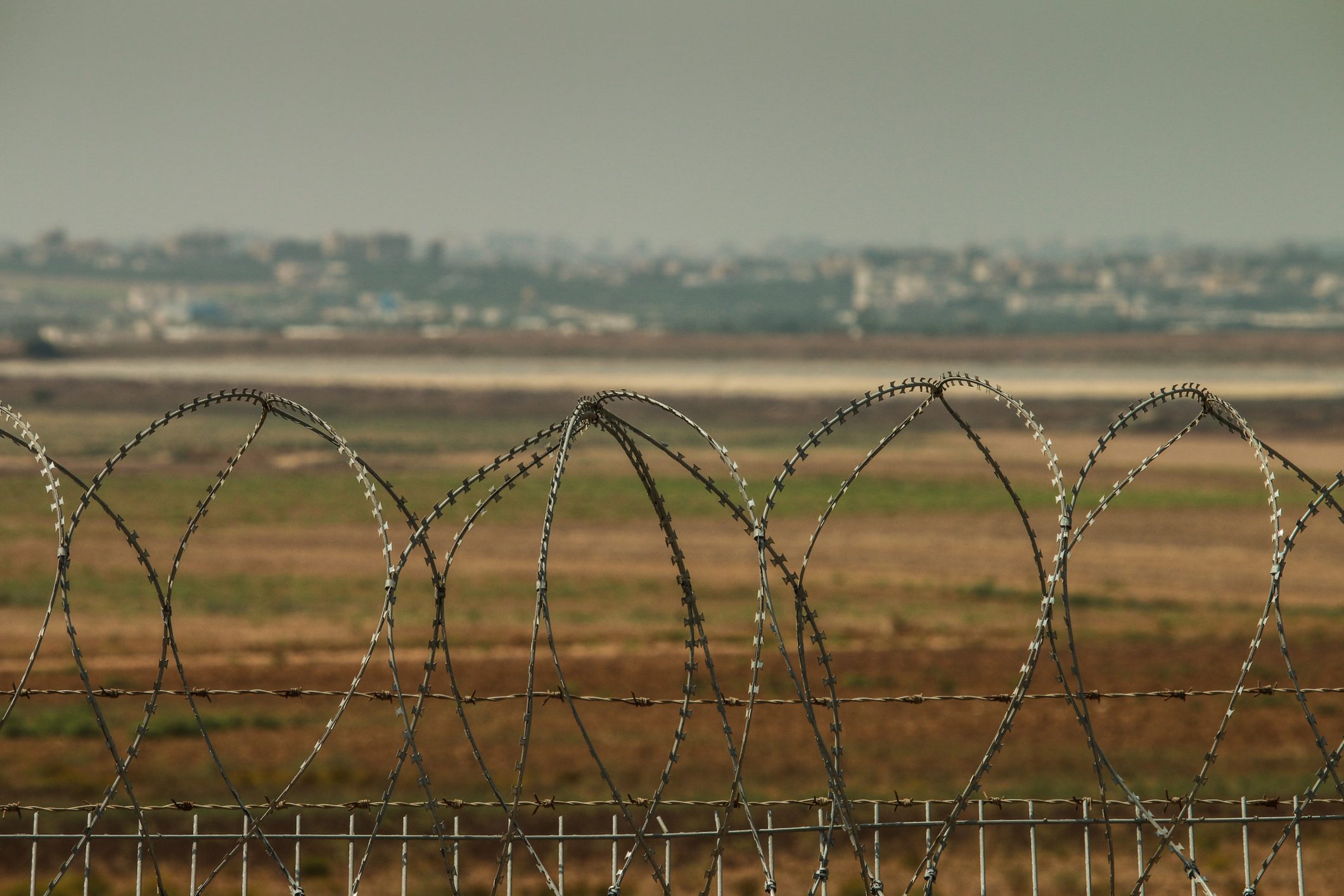
From 21 August the Israeli authorities have started occupy the entire strip of Gaza: But what does occupation mean? In the practical act, employment would mean passing from lighter to direct control of the territory. The purposes declared by Israel refer to the desire to defeat Hamas, but since the Jewish state has never made a secret of wanting to prevent the birth of a Palestinian state, the idea that Netanyahu’s plan to take control of the whole strip will be transmitted to the annexation of the strip. The annexation and transfer of its citizens to employed territories, however, are illegal for international lawas recently reiterated by the International Court of Justice.
What are the territories occupied by Israeli troops: the situation
The Palestinian territories occupied by Israel, for years, are the Gaza Strip And The West Bank.
The latter was divided into three areas following the Oslo agreements, but most of the territory (60%) is Under total Israeli control (settlements, natural resources and administration) and the two remaining areas have seen frequent military operations of the Idf for years (the last in January 2025, “Iron Wall”, with the occupation of the refugee camps of Jenin and Nur Shams). Only on August 20 the government of Tel Aviv approved a plan of settlement between Jerusalem Est and Ma’alo Adumim, which could divide the West Bank in two, attesting to its power again in the area.
But returning to the Gaza Strip, on which all eyes have been focused for two years: this tiny portion of the territory has been officially governed by Hamas since 2007, although – especially in the territories of the North – it has seen the expropriation of land with the force several times by the Israeli settlers, without Hamas could actually claim the aforementioned lands. Furthermore, since then, the strip is below blocking and control (controlled influx of goods and people both from sea and from the ground) Israeliwhich exerts full control over its borders, including airspace. The block, which transformed the strip into a fate of open -air prison, briefly created one serious humanitarian crisiswhich gradually worsened following October 7, 2023.
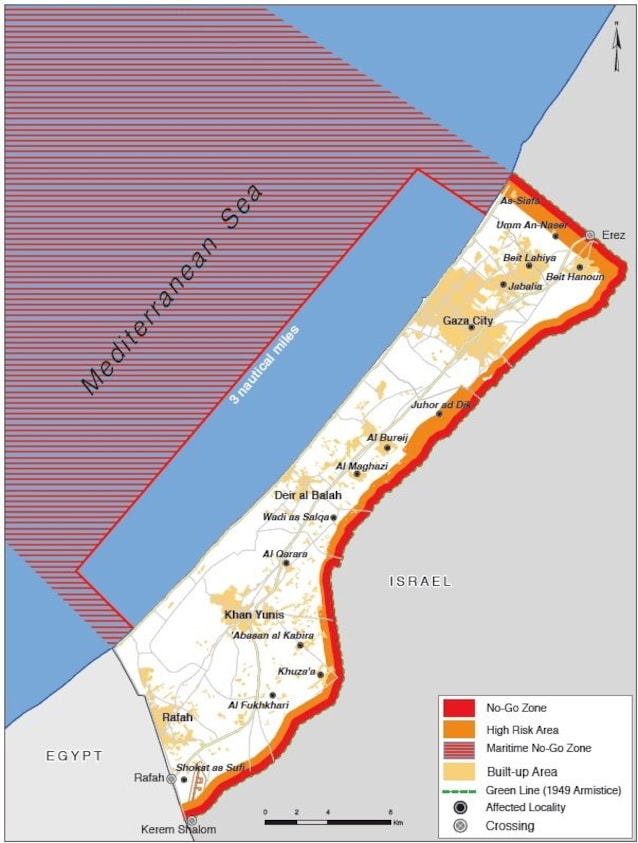
Currently, The Israeli army holds control of more than 85% of the territory: after the air raids and the raids by land in Gaza City – where the Israeli forces also took control of the suburbs – the bombings were also intensified in the neighborhoods of Zeitoun, Shuja’iyya and Sabrawhich is why the latest civilians remained an exodus to an uncertain direction. Other divisions are already a Khan Youunis And Rafahand the control is expanding with wildfire in the district of the occupied areas. Although the armed clashes are not finished, it is now increasingly complex to guess where Hamas is, and it is difficult to say that the strip is still govern.
What does it mean, in concrete terms, “occupy Gaza” and what changes today with the entry of the troops
According to the latest statements by Israeli Prime Minister, the army will not stop in these areas, but will soon take care of the entire area. Translated in practical terms, the number of soldiers and armored vehicles that will control cities and all the communication routes will increase, and for the remaining inhabitants it will be almost impossible – or at least hindered – move or rejoin with other family members. In addition, Israel could even establish real separation areascompletely limiting the mobility of the Palestinian population.
The Israeli settlements within the strip will expand, pushing civilians to live in increasingly restricted areas. Once the network of essential services (water, electricity, health care) has been restored, Tel Aviv will take on total control of their administration, as has already been done for years in the West Bank.
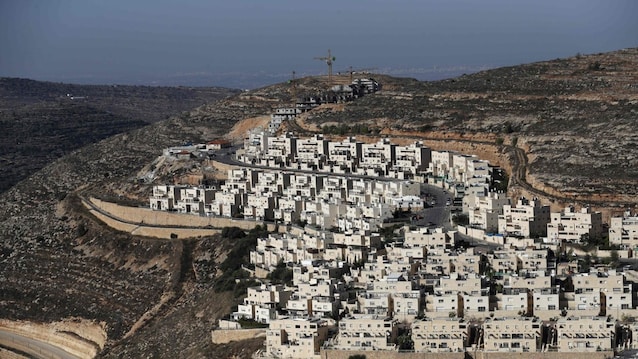
Furthermore, as confirmed by the Italian Army General and Military History Professor Paolo Capitinithe Israeli government is evaluating the construction (within the strip) of “humanitarian city“, Settlements manned by the army intended for Palestinians:
Access to this type of structures should be “voluntary”, but the exit from them would be prohibited. Which would make humanitarian cities of the real concentration camps.
But it is not said that the Palestinians manage to stay in the strip. In fact, every action made by the IDF seems to lead to the idea that there will be no real space for them. Even if they stayed, it would take a long time to restore the whole network of services, and the violence would be on the agenda. As Capitini added, the Israeli authorities would already be trying to understand where to direct the few remaining civilians:
The destruction of the housing heritage, together with the bombings, to the restrictions on the provision of water, food and medical treatment are aimed at spontaneously convinced the Palestinians surviving to leave other destinations that are no longer the Gaza strip. In fact, contacts between the Israeli authorities and those of South Sudan, Somalia, Libya, Syria or even Indonesia are active because they welcome the Palestinians who – placed in the impossibility of continuing to live in Gaza – decide to abandon it for other destinations.
Why does Israel want to occupy the strip, if it is an almost completely destroyed territory?
Israeli authorities have declared that employment “It is used to defeat Hamas “but it is now clear to geopolitical analysts from all over the world that the Tel Aviv government wants to appropriate the area to expel Palestinians, who have always been seen as a threat to the integrity of the Jewish state.
Recent statements by Donald Trump – according to which the territory must be sold to the United States, which would transform it into a sort of Great bathing resort – and of the far -right Israeli Minister Bezalel Smotrich They seem to support this hypothesis, but the project, at least for now, seems in fact. According to other analysts, Israel wanted to take possession of the soils rich in olive trees, but for days they have been circulating on the net video of the bulldozers who completely eradicate these centuries -old trees, as if they want to further erase what the Palestinians linked with their land for centuries.
But there is also another theory, as General Capitini recalls:
The possibility of directly controlling a strip of soil that humanity has already inhabited from the time of the ancient Egyptians has objective economic advantages. I only mention two: the first is that Gaza is faced with One of the largest natural gas deposits in the Mediterranean And the second that one of the entrances that would connect the Red Sea to the Mediterranean by land should be at those parts, in fact becoming a duplicate but also a competitor of the current Suez channel.
What is certain is that the Israeli ruling class has no intention of allowing the birth of one Palestinian stateneither in Gaza nor in the West Bank, as declared several times by his ministers, because they consider these territories as belonging to the “historical homeland of the Jewish people”.
In this regard, Smotrich expressed his intention of a few days ago annex The Gaza strip in Israel, backed by other politicians. But, Attention: occupy does not mean annex.
Occupy does not mean annex: what international law says
At the moment, as mentioned, the army has occupied most of the strip militarily in a few days, but without having claimed the sovereignty of the same. The employment, to be such, must be temporaryand Israel has already shown Continuous and permanent occupation In the West Bank, occupied by after the 1967 war (the international community has never recognized the annexation of these territories). Furthermore, employment should respect international laws (in particular those relating to the protection of human rights and the management of employed territories, as established by Geneva Convention), but this is unlikely that this happens, observing the media documents from the strip.
THE’annexationon the other hand, is theformal incorporation of a territory (in this case the strip) to the state that has occupied it: this means that it integrates it in its legal and political structure, taking on full sovereignty on it. Based on international law (as established by United Nations Charter), the annexation of a territory by force is always illegaland raises an international disdain. Among the recent cases, just think of the harsh reactions aroused byemployment of the Kuwait by Iraq in 1990, from which the First Gulf War arose, or Russian Crimean occupation of 2014, for which heavy penalties were imposed on Russia.
At the moment it is not known (despite the previous public statements of the Tel Aviv government) if Israel will formally attacked all the Palestinian territories. It must be considered, however, that in the early eighties the Jewish state has The eastern part of Jerusalem is annexed without particular obstaclesoccupied in 1967 and claimed by the Palestinians as their capital. Also, after the Six days war The UN emanate Resolution 242which imposed on Jewish state to leave the territories busy. Israel, however, have never done it, except for a part of the territories in question (Sinai, returned to Egypt), and no measures have been taken.
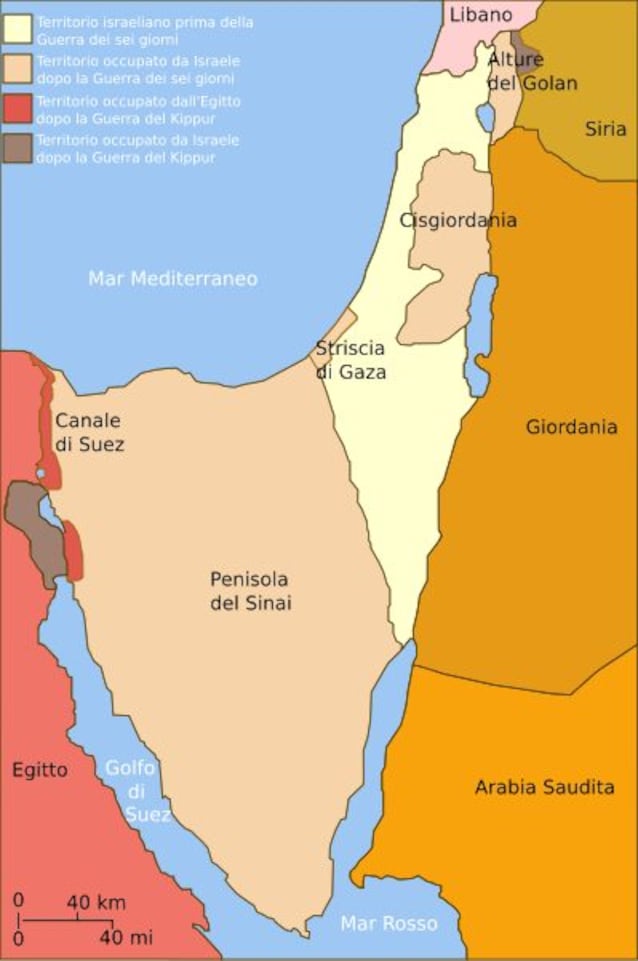
In the 90s, however, Israel decided to yield the administrative control – Not the sovereignty – of some sectors of the territories to the Palestinian National Authority, but things have not become more rosy. Over the years, in fact, violent acts have multiplied against the inhabitants by the colonists and the army, attacks that with the picture present risk becoming more and more violent.
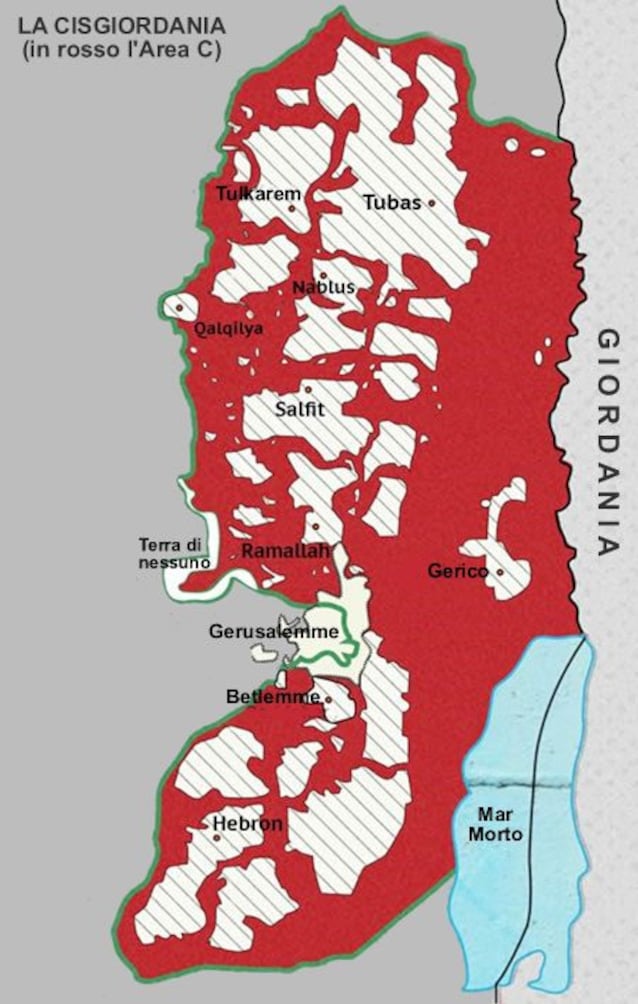
West Bank. In white the territories administered by the Palestinian Authority (Terrasanta.net)
Whatever theoutcome Of this occupation, it is easy to predict that over time the situation of the strip would be very similar to that of the West Bank – at least from the administrative point of view – and, De facto, international measures would not be taken.
