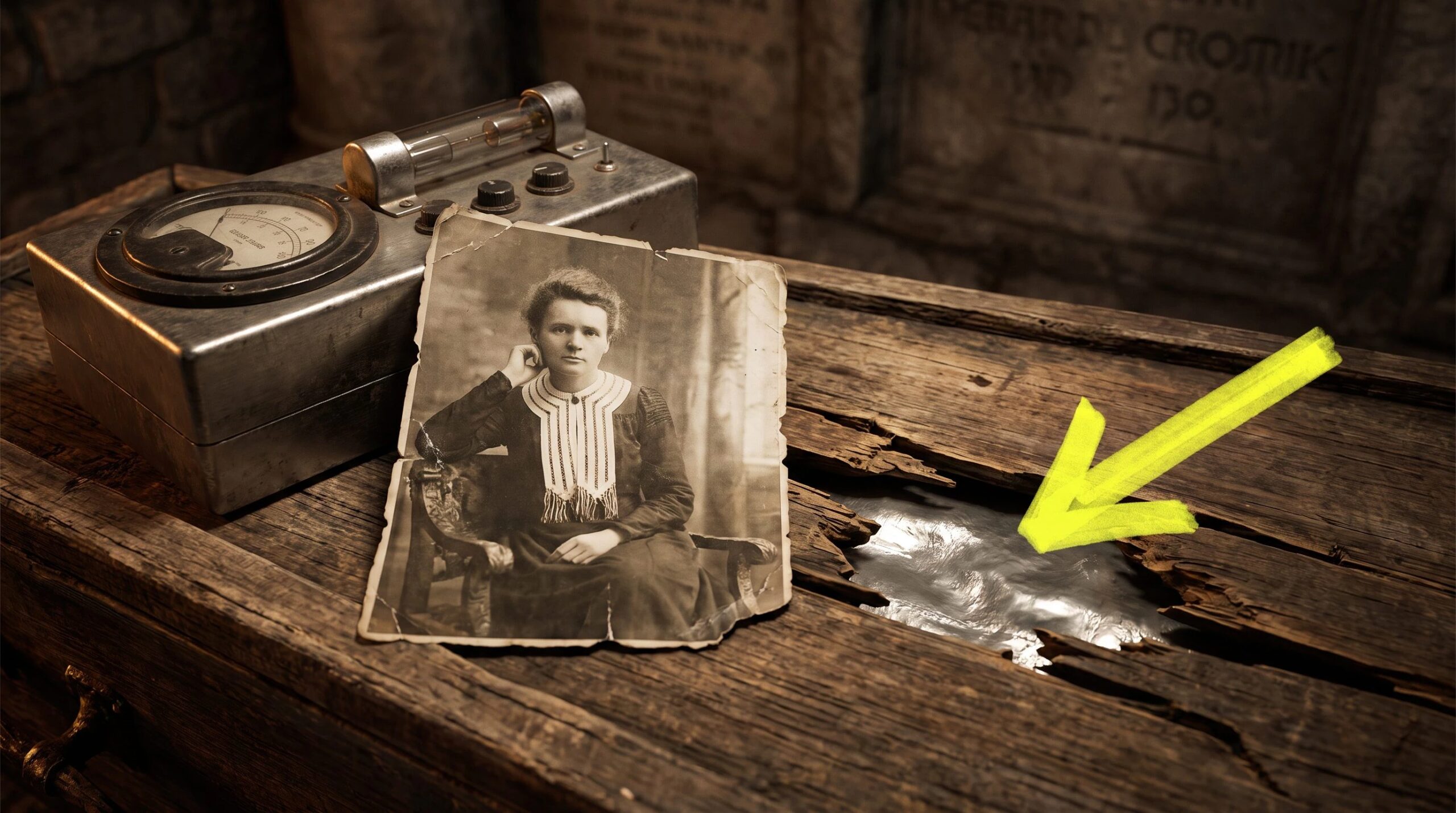
Talking about Marie Curie – the famous Polish naturalized French scientist who pioneered studies on radioactivity – you’ve probably heard the story of the radioactivity from his graveretained dangerous for those around you.
OPRI, the organization that oversaw the exhumation of the coffin of Marie Curie – and then transfer it to Pantheon of Paris together with the body of her husband and research partner Pierre Curie – made it known to the public that Pierre’s body presented a certain level of radioactivitywhile Marie’s had a much lower level, and therefore Not there were risks for the health of those around you.
Studies on radium and the radioactive effects on his body
Marie Skłodowska-Curie was born in Warsaw in 1867, but in 1891 he moved to Paris to study at Sorbonnewhere you would be then graduated in mathematics and physics. The scientist dedicated her entire life to the study of radioactive phenomena together with her husband Pierre Curie, with whom in 1898 she discovered two new elements: radium and polonium (the latter renamed in honor of her land of origin). It was she who coined the term “radioactivity“.
The couple spent years in their research laboratory, handling the two discovered elements without adequate protection. Indeed, they often carried samples in the pockets of their lab coats, without the slightest concern for their own health: after all, in those days nothing was known about the effects of radiation on the human body. As the years passed, however, they also realized that something was wrong: in fact, they both suffered from radiation burns on their hands and vision problems.
But not only that: in the last years of her life, Marie, suffering from increasingly marked weakness, decided to undergo blood tests. These clearly revealed a severe shortage of red and white blood cells in the blood, given by a net deterioration of the bone marrow (aplasia medullary) probably due to ionizing radiation.
The illness that had struck her was the only thing capable of stopping the scientist, who died in 1934 at the age of 66.
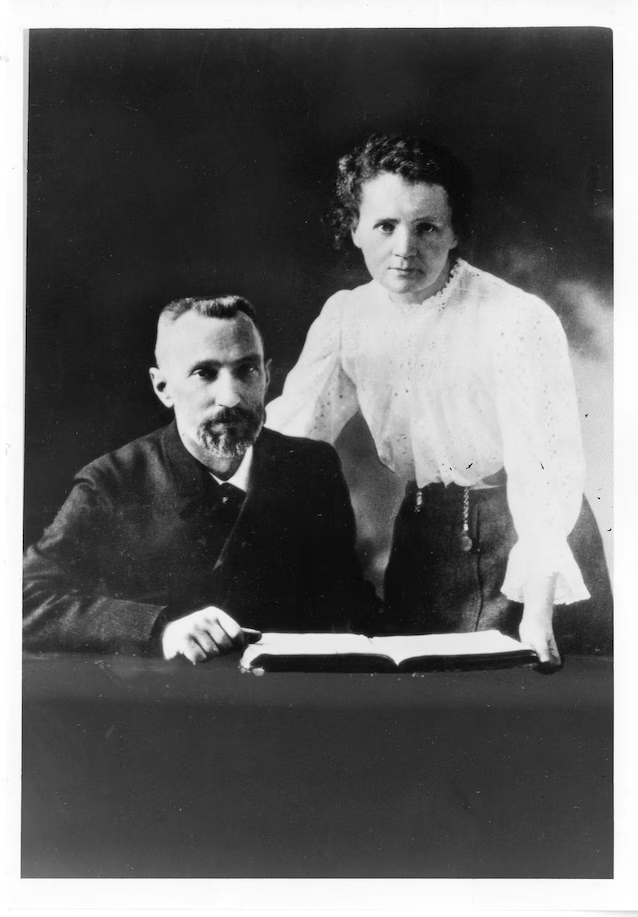
Thanks to her extraordinary work, Curie became the first woman in history to receive a Nobel Prize for Physics in 1903 for her joint research on radiation phenomena discovered by Professor Henri Becquerel, with whom she shared the prize together with her husband.
Marie Curie still remains the only person in the world to have won two Nobel Prizes in two different scientific disciplinesgiven that in 1911 he also received the Nobel Prize for Chemistry for his decisive contribution to the isolation of radium and the meticulous study of this element.
What Marie and her husband never knew was that their studies were necessary for the development of radiotherapybecause they allowed other scholars to understand the therapeutic use of radioactive substances against cancer.
The triple coffin in which Marie Curie was buried
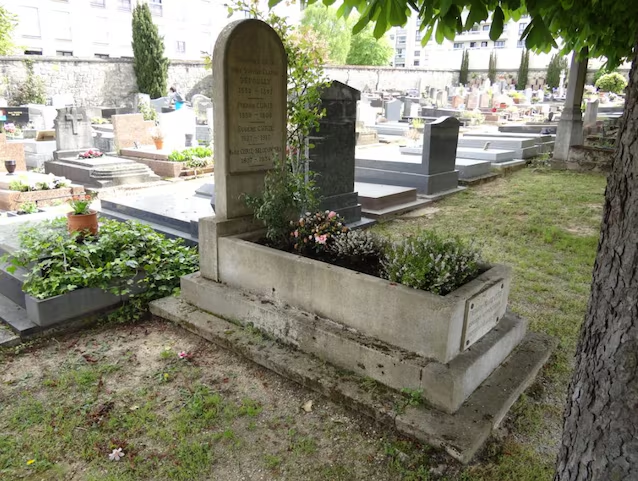
Marie Curie was buried with her husband, who died in 1906, in their underground crypt at Sceaux cemeteryabout 10 kilometers south of Paris. The man had died 28 years before his wife, and in tragic circumstances: while he was walking across the busy Rue Dauphine in pouring rain, he slipped and fell under the wheels of a horse-drawn carriage carrying military equipment. The wheel of the vehicle passed right over his head, causing a fatal skull fracture that led to his death instantly.
After years of rest together in that small cemetery on the outskirts of the capital, in 1995the French president François Mitterrand decided to move the coffin of the scientist and her husband to Pantheon of Paris, the secular mausoleum where the “greats of France” rest by virtue of their merits.
The Paris Ionizing Radiation Protection Agency (OPRI), expressed a number of concerns about the radioactive waste from the two bodieswhich could have been dangerous for those who would have to carry out the exhumation. The original coffins, in fact, had to be opened because neither of them respected the dimensions of the niches of the Pantheon, and the remains had to be moved into new coffins. Following OPRI’s concerns, recommendations were made precautions: the experts who went down into the crypt followed a radiation protection protocol specific to avoid the dispersion of contaminated dust and took measurements of the air in the crypt and in the area of the two coffins.
Marie had been buried in one triple coffin: an external wooden one, a internal lead (2 and a half millimeters thick) and a last coffin of wood, the one that actually does contained the remains. This is because in the 1930s the potential risk of contamination was already understood and the desire was to contain radioactivity.
Among other things, this type of burial allowed the body to be further isolated from humidity and external decomposer organisms typical of a crypt, slowing down the decomposition process. Precisely for these reasons, when the workers opened the coffin they found the scientist’s body well preserved 61 years after his death, with his face still recognisable.
Because Pierre Curie’s tomb was more radioactive
The same could not be said of her husband, however. Pierre, who died at just 46 years old, had been buried in a coffin without a lead lining, so moisture easily entered the wooden coffin. But despite this, the few remains found inside by OPRI technicians had a decidedly higher level of radioactivity compared to that of wife.
Indeed, the level of radioactivity measured a short distance from Marie Curie’s body was lower than what you breathe normally walking among the granite headstones of the same cemetery (due to the natural uranium contained in the stone). This intrigued the experts, who initially thought that the more radioactive body of the two would be Marie’s. But the measurements carried out – both on the air contained in the scientist’s coffin and that in contact with her remains – they revealed a higher than normal radioactivity, although rather low and therefore safe for those who had to proceed with the exhumation.
The reasons for this difference in radioactivity levels there are essentially three:
- Pierre died at the age of 46, at the height of his laboratory activity, when still no precautions were used of any kind when handling radioactive materials. The man’s body, therefore, did not have time to “eliminate” part of the radium accumulated in the body through biological processes which, in Marie’s case, occurred during the next 28 years of her life.
- After Pierre’s death, both Marie and other members of the scientific community began to understand that material necessarily had to be handled using gods principals to defend against radiation (a detail that allowed her to shield herself for at least the last twenty years of her life).
- The two bodies were not measured in the same way, which makes the comparison only partially homogeneous. In particular, the radioactivity in the scientist’s body was distributed over a greater bone mass: consequently, the concentration of radium it was smaller than that of Pierre’s few remaining remains (remember that the coffin did not have a lead lining).
In any case, despite the confirmation of the presence of radioactivity in the guise of Marie and Pierre, the OPRI technicians publicly specified that the radioactivity levels of Marie’s remains were lowand both hers and her husband’s did not represent such a danger as to prevent the transfer to the Pantheon, which took place on 20 April 1995.
When you see the two tombs of the spouses in the mausoleum, therefore, you can rest assured: there is no danger of radiation contamination being in their presence.
