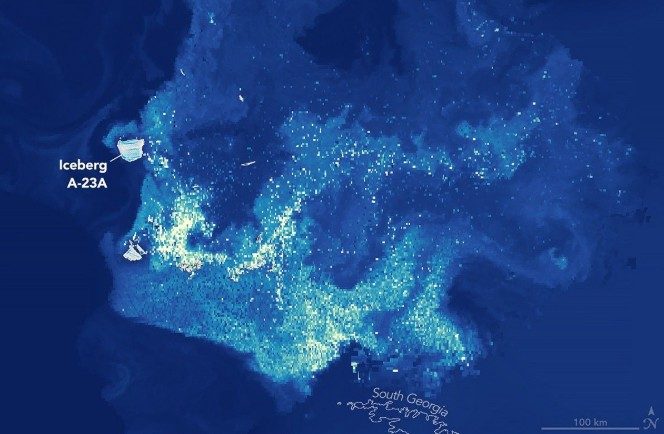
THE’iceberg A23awhich has long been one of the largest and longest-lived ever observed in the world, after 40 years since its detachment from Antarctica broke up in the South Atlantic into smaller icebergswhich upon melting feed a vast bloom of phytoplankton. It was the people who immortalized it NASA satelliteswhose images clearly show the trails of microalgae spreading from the melting icebergs, highlighting the close link between the two phenomena. As they melt, icebergs release large amounts of nutrients that feed phytoplankton. This, in turn, is very important in atmospheric carbon sequestration in the ocean.
Images of the phenomenon captured by NASA satellites
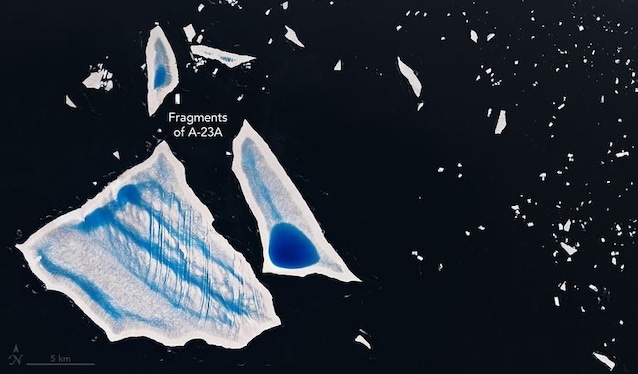
In January, satellites had already captured images of the A23a iceberg drifting in the South Atlantic, between the island of South Georgia and the eastern tip of South America. The iceberg arrived here after a very long journey began in 1986when it was detached from Antarcticaand then ran aground for a long time and several times in its drift towards the north. The images from January showed a notable accumulation of melt water on the surface of the main iceberg, now reduced to 1182 km2less than a third of the original one. Now in the new images the iceberg, which is moving towards increasingly warmer waters, appears even more fragmented and the small blocks are associated with a microalgae bloom.
This bloom is too large and spreading too clearly from the icebergs not to be strongly related to them.
These are the words of Grant Bigg, oceanographer at the University of Sheffield, England.
Because the iceberg melt caused phytoplankton to proliferate
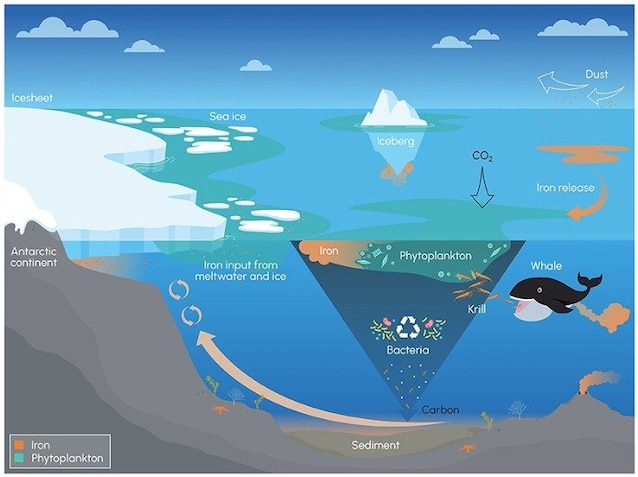
Melting icebergs they release fresh water and consequently light, which remains on the surface forming a more stable surface layer of water. Additionally, they release a large amount of nutrientssuch as iron, manganese, nitrates and phosphates. These nutrients accumulate on the ice cap of which the icebergs were part, transported by the wind in the form of dust or removed by the erosive action that the ice performs by sliding on the rock. The release of fresh water and nutrients results in the development of phytoplanktonwhich is usually limited in this area of the ocean by the scarcity of nutrients and light; this also happens in summer, with strong winds and turbulence that push it into depth. It can be said, therefore, that these icebergs fertilize the oceans.
The importance of phytoplankton in carbon sequestration
Phytoplankton plays a fundamental role in the oceans, as it forms the basis of the marine food web. These microalgaealso through photosynthesis they release an enormous amount of oxygen into the atmosphere and they transfer carbon dioxide from the atmosphere to the deep ocean. Much of the carbon sequestered by the oceans comes from its capture by phytoplankton and ends up being deposited on the seabed when the organisms die. Some research suggests that in this region in recent years the melting of icebergs, especially large ones, feeding the phytoplankton may have determined up to a fifth of the Southern Ocean’s total carbon sequestration. Even if their fusion contributes to the reduction of CO2 in the atmosphere, but we must not forget the serious environmental consequences: it contributes to sea level rise and alters ocean circulation and ecosystems.
We currently do not know how long the A23a iceberg will continue to proliferate phytoplankton, but it is possible that months will pass, during which the trails of microalgae could extend further, even for hundreds of kilometers.
