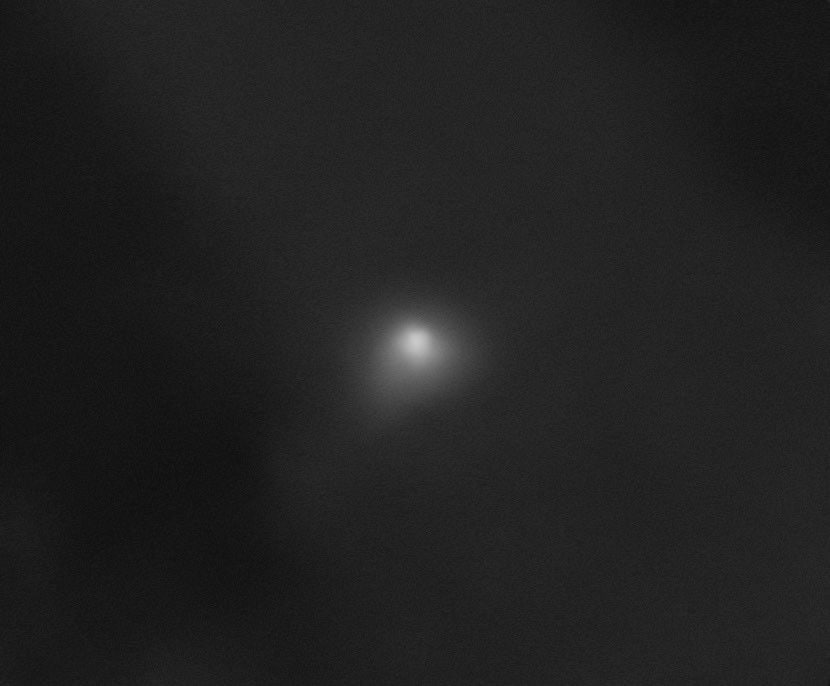
NASA presented new images of the comet 3I/ATLASthe third interstellar object discovered in our Solar System, in a press conference broadcast live on YouTube. The images are the result of an unprecedented observational campaign that exploited the enormous fleet of probes launched by NASA over the years. Observation through the various probes made it possible to obtain Images of the comet from different angleswith different solar illuminations of its coma and core, thus helping astronomers to better understand the geometry of the comet and confirming it size estimated core at approx 2-5 km in diameter. The images shown were obtained between September and October, but were only released on November 19 due to the US government shutdown.
NASA made it clear from the start of the live broadcast that 3I/ATLAS is a comet that shows the typical behaviors of these objectsalthough with many peculiarities that are not surprising given that we are talking about an object that comes from another star system and is potentially older than Earth and our Sun itself.

Images of the interstellar comet 3I/ATLAS
The images of the Psyche mission
The first images released by NASA are those obtained from the on-board cameras of the NASA Psyche missionintended for close study of the asteroid 16 Psycheone of the largest in the main asteroid belt between Mars and Jupiter. The images were obtained on8 and 9 September from a distance of 53 million km in 4 different exhibitions and show 3I/ATLAS in low resolution like a little “blob” moving against the background of fixed stars. The figure above in fact shows the position of 3I/ATLAS theSeptember 8 at 21:00 and 23:40 UT and September 9 at 02:20 and 05:00 UT. Although not detailed, the images will help astronomers to refine the trajectory precisely of 3I/ATLAS.
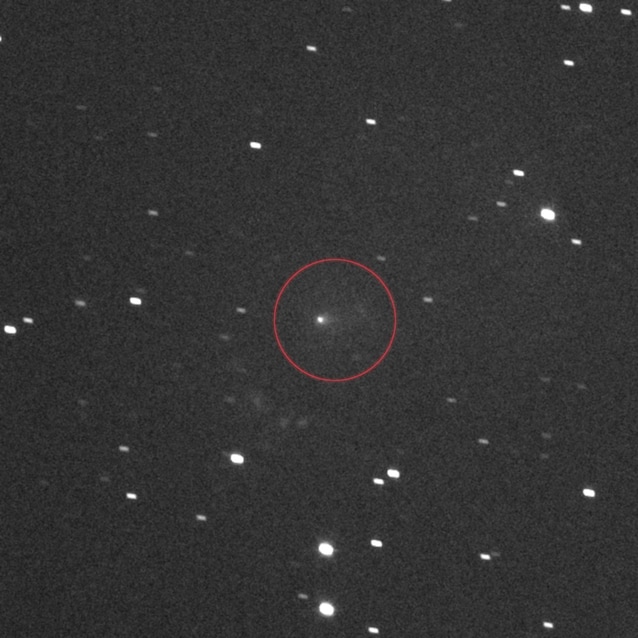
The comet observed by the Lucy probe
The following week of September instead saw the protagonist NASA Lucy probe intended for the study of asteroids Trojans of the Solar System. Lucy produced much more detailed images of 3I/ATLAS (above) although it was at a greater distance than Psyche, 386 million kmthanks to the help of its high resolution L’LORI camera. The image, obtained on September 16thclearly shows thecometary aspect of 3I/ATLAS with his hair and a weak one tail which points away from the Sun. From the point of view of the observer looking at this image the Sun is behind his left shoulder. These images will help instead study the hair and tail in more detail of the comet thanks also to observations conducted at the exact same moment by astronomers at the Las Cumbres Observatory in Chile.
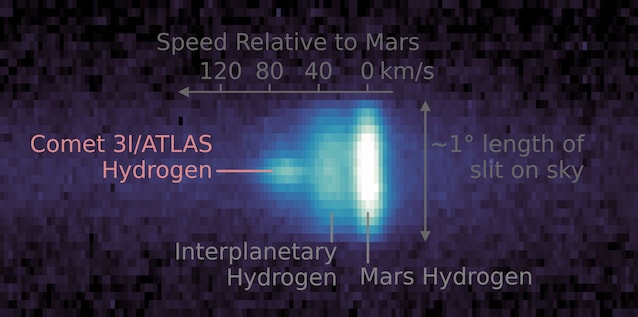
3I/ATLAS imaged from Mars
October was instead the month of resumed of comet 3I/ATLAS from the perspective of Mars. The interstellar visitor was in fact imaged by the probe Mars Reconnaissance Orbiter (cover image), from MAVEN probe (above) and from the surface of the planet from Rover Perseverance (image below). The Mars Reconnaissance Orbiter images were obtained on 2 October 2025 from approximately 30 million km away from the comet and represent the most detailed among those released by NASA thanks to the use of the high-resolution HiRISE instrument which will allow scientists to study the coma of 3I/ATLAS in detail. A completely new perspective was instead obtained by MAVEN probe. Unlike all the other images released, here we do not see a photo of 3I/ATLAS but rather its own electromagnetic emission spectrumto. MAVEN has in fact broken down the light of the interstellar comet into its constituent wavelengths thanks to a ultraviolet spectrograph to better understand the chemistry of this object, finding a copious emission of hydrogen gas coming from the comet which will help estimate the rate of water vapor emission. The images taken by Perseverance probe they are those less spectacular of all since 3I/ATLAS appears as a faint puff against the background of the fixed stars. The peculiarity, however, is due to the fact that these images were obtained from Perseverance directly from the surface of Marson the edge of the Jezero crater. Credits: NASA/JPL-Caltech/ASU/MSSS.
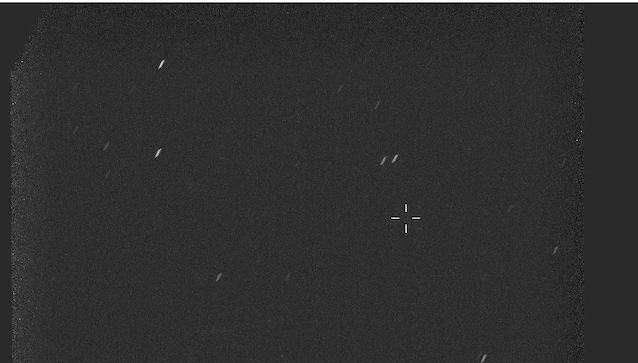
Images from solar probes
The latest images released (below) were instead obtained by NASA probes intended for studying the Sun. These were not aimed directly at 3I/ATLAS, but rather it was the comet to end up in their field of view near the perihelion at the end of October, when the comet was angularly very close to the Sun and was therefore impossible to observe with instruments other than solar probes. In all three cases, the comet appears as one bright and blurry sphere in the center of the image.
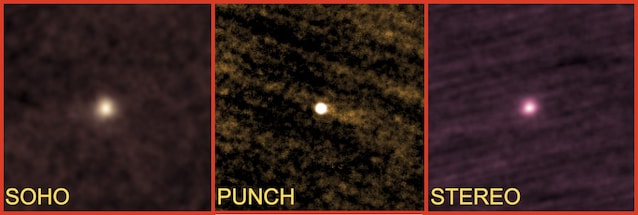
The images from SOHO probea joint ESA and NASA mission, were obtained between 15 and 26 October at a distance of approximately 358 million km. Comet 3I/ATLAS was expected to be too faint to be seen from SOHO, but detailed processing and combinations of different images finally generated the image shown above, where the comet appears in the center as a bright, fuzzy “blob”.
The image of PUNCH was obtained by combining multiple observations conducted between September 20th and October 3rd so as to make the comet stand out against the background of fixed stars that appear as bright streaks in the image. PUNCH observations reveal the tail of the comet, visible as a slight elongation at the bottom right. These images pushed PUNCH’s instruments beyond their limits, since the probe is designed to study the atmosphere and solar wind.
The probe STEREO observed 3I/ATLAS betweenSeptember 11th and October 2nd. Again, astronomers expected the comet to be too faint to be seen in STEREO’s single exposures, but with careful processing and combinations of the different images obtained by the Heliospheric Imager-1 instrument, the comet emerged from the data.
The combination of all the data obtained from NASA probes will allow us to obtain more information on dimensions, physical properties and chemical composition of the interstellar visitor 3I/ATLAS. More data is on the way since NASA has not yet finished downloading all the data from the various probes scattered across the Solar System through the Deep Space NetworkNASA’s international network of giant radio antennas that supports interplanetary space missions.
