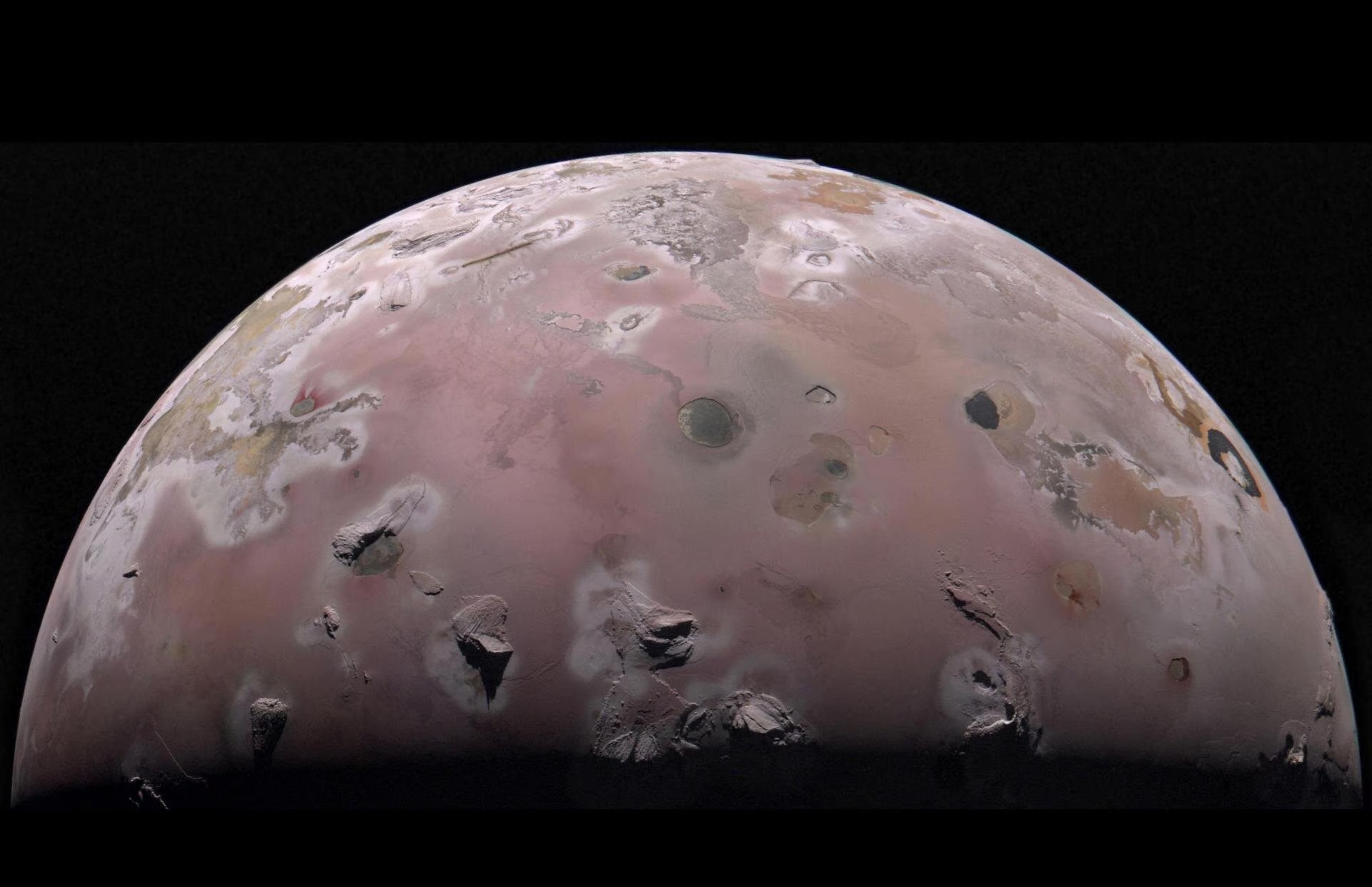
For the first time scientists have managed to measure the temperature under the crust of IJupiter’s moon volcanically more active of the Solar System. The NASA probe succeeded Junowhich has been orbiting the gas giant since 2016. Thanks to the tool Microwave Radiometer (MWR) was possible map the temperature of the rocky crust deep. The study was produced by a research team from JPL (Jet Propulsion Laboratoryone of NASA’s most important research centers) and published in the journal Journal of Geophysical Research: Planets.
Unlike the other Galilean moons, such as Europa, Ganymede and Callisto, which hide oceans of water under thick crusts of ice, Io is a world entirely rocky which hosts hundreds of active volcanoes. The reason for this intense geological activity is tidal friction. The gravity of Jupiter stretches and compresses Io along its slightly elliptical orbit, making raise and lower its surface up to 100 meters during each orbit and generating heat in the internal rocky shells.
It is the same mechanism that is thought to be the case on other icy moons allow you to maintain of the liquid oceans hidden under the ice crust. Understanding how this process works on Io, where the phenomenon is easier to observe, also helps to understand those worlds where life could potentially have formed.
Juno measured the heat beneath Io’s crust with close flybys
The observations analyzed by the study come from two close flybys of Io carried out by the Juno probe on 30 December 2023 and 3 February 2024. During these flybys the probe pointed the MWR instrument, composed of six antennas capable of picking up microwaves with wavelengths between approximately 1.3 and 50 centimetres. During these overflights the probe passed alone 1,500 km altitude from the surface of Io.
Unlike infrared light which is used to map the surface temperature of a planet or moon, the low frequency microwaves they manage to penetrate solid materials for several meters before being re-emitted into space. By observing how the intensity of the reflected signal changes depending on the wavelength used, researchers can reconstruct a real one temperature profile in depth. The shorter wavelengths return information on the first centimeters of the crust, the longer ones on layers that reach up to a few tens of metres.
Juno’s MWR instrument, however, was not designed to probe rock surfaces. The MWR had already been used successfully on Ganymede and Europa, where it had enabled probe up to tens of km into their ice shells. But I is a world of volcanic rock, a material never tested before with this technique from orbit.
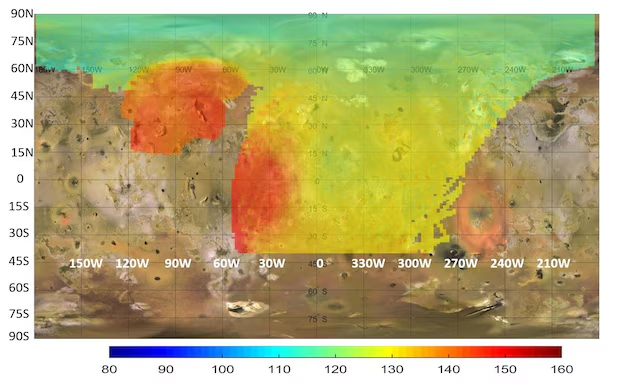
The MWR data thus provided a depth mapping of Io’s surface and its heat profile. The researchers found that the temperature it rises by over 22°C in the first few meters of depth. In some localized areas, the subsoil is even between 10 and 20°C warmer than the surrounding ground, evidence that indicates a internal heat flow That it rises constantly towards the surface.
What tidal heating is and how it works
Io orbits Jupiter at one distance from the center of approximately 420,000 km in about 42 hours, but its trajectory is not perfectly circular. It is indeed surrendered slightly elliptical from the orbital resonance with the nearby moons Europa and Ganymede, which periodically disturb it with their gravity.
This eccentricity and the extreme proximity to Jupiter (practically 40,000 km more of the distance of the Moon from the Earth) are the reason why the rock under the surface of the moon has a heat gradient. As Io approaches and recedes from Jupiter, the planet’s gravity relentlessly stretches and compresses it, a phenomenon called tidal heating. It is same mechanism which, on a smaller scalewarms the underground oceans of Europa and Ganymede.
There surface of Io it rises and falls up to 100 meters per orbit. As a point of comparison, the solid earth tides generated by the Moon (i.e. caused on the earth’s crust and not on the oceans) produce just one thirty centimeters of raising the soil.
The friction of the rock which is continually compressed and stretched generates heat which rises towards the crust and it feeds hundreds of volcanoes that dot the surface, making I am the most volcanically active body of the Solar System.
However, exactly where this heat comes from remains partly unknown. The authors of the study hypothesize that it may rise steadily through a conductive crust, or come from cooling lava flows, buried under a layer of solidified rock just about ten meters thick.
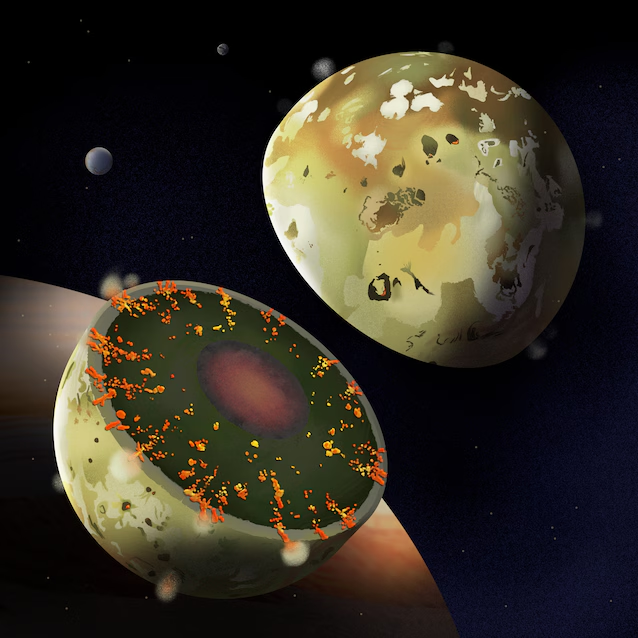
Juno’s observations also revealed that much of its surface it is extremely smooth and flatwith expanses extending for over 100 km, a phenomenon that had not yet been precisely measured. The material that composes them also has a very low density, much more similar to pumice or volcanic ash than to solid rock, an effect of how the surface is continually fractured and reshaped by eruptive activity.
The next exploration missions of Jupiter’s moons
The tidal heating It’s not just about Io but also about the icy moons Europe And Ganymede are affected, albeit to a lesser extent. Europa orbits at approximately 670,000 km from Jupiter, while Ganymede, the largest moon in the Solar System, orbits further away at approx 1,070,000 km. In these two moons tidal heating is thought helps keep their underground oceans liquid buried under several kilometers of ice.
Two missions are already underway to explore these oceans. The probe Juice (Jupiter Icy Moons Explorer) of the European Space Agency (ESA), which launched in April 2023 and will arrive in the Jupiter system in 2031, will make two flybys of Europa before moving on to Ganymede, becoming the first probe to enter a stable orbit around a moon of Jupiter. The probe Europa Clipper of NASA, the largest interplanetary probe ever built in terms of total mass, launched in October 2024 and arriving in April 2030, its sole objective will be the moon Europa. Through numerous close flyovers it will have to be able to measure the thickness of its ice crust and evaluate whether its ocean may be suitable for host life forms.
THE data collected by Juno they become like this complementary to those who will take up these missions. Having measured how tidal heat rises from the interior of a rocky moon provides a reference model calibrated on a case, that of Io, which is more extreme and therefore easier to observe. By comparing what Juice and Europa Clipper will discover under the ice shells of Ganymede and Europa it will therefore be possible to understand how much of the heat that feeds their oceans comes from the same tidal mechanism observed on Io.
