THE’Institute of Geosciences and Georesources of the CNR (CNR-IGG) developed the first systematic mapping of the Italian white hydrogen potentialcrossing and processing structural, geochemical and thermal data of the national territory. A research that is part of the growing international interest in this possible resource in the context of the energy transition.
THE’white hydrogen or geologicalis an energy resource of great interest: a gaseous molecule (H₂) that can form naturally in the earth’s crust through geochemical processes. For years it was considered little more than a scientific curiosity, because it was believed to tend to disperse rapidly in the atmosphere. The discovery of important underground accumulations However, in several countries it has changed this perspective, demonstrating that the subsoil can not only generate it, but also conserve significant quantities of it.
Compared to traditional procurement methods, the paradigm shift is relevant. Today the majority of industrial hydrogen is in fact obtained from hydrocarbons: it is the so-called gray hydrogen, associated with significant CO₂ emissions. THE’green hydrogenobtained through electrolysis of water powered by renewable sources, reduces emissions but requires large quantities of electricity and expensive systems. THE’white hydrogenon the contrary, it forms spontaneously – and free of charge – underground: being able to extract it directly could therefore reduce production costs and environmental impact compared to conventional processes.
How is white or geological hydrogen formed underground?
Unlike traditional hydrocarbons, which derive from the transformation of organic matter, geological hydrogen can be formed through specific chemical-physical reactions that happen underground. The Italian study identifies three main mechanisms:
- The rock-water reaction (serpentinization): when deep waters come into contact with iron-rich rocks, such as peridotites, the iron oxidizes, removing oxygen from the water molecules and releasing hydrogen gas (H₂).
- The hydrothermal interaction: in volcanic or geothermal systems, high-temperature fluids react with the rocks of the crust, favoring the formation and release of hydrogen.
- Thermal decomposition: at great depths, where temperatures can vary between 200°C and 600°C and in the absence of oxygen, heat can break chemical bonds in ancient organic deposits, releasing hydrogen.
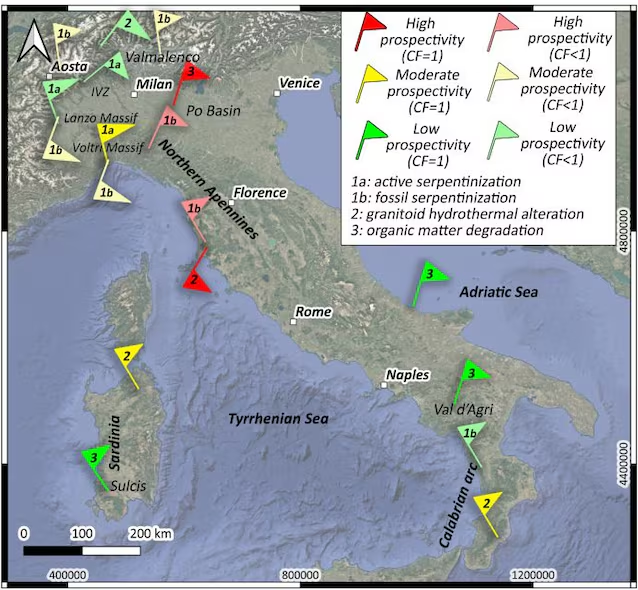
Where the potential deposits are concentrated in Italy: the map
Taking advantage of an indicator developed ad hoc, theH₂ Prospectivity Indexthe research team developed a map that estimates a overall theoretical potential in the order of tens of millions of tons. The areas considered most favorable from a geological point of view include the Tuscanythanks to the high geothermal gradient and the intense circulation of hot fluids at depth, and theNorthern Apennines together with Voltri massifBetween Liguria And Piedmontwhere the presence of serpentinite rocks is abundant, fundamental for the serpentinization processes. Significant potential also emerges in Po Valleywhere the thick sedimentary layers and particular structural arrangements could have favored the accumulation of hydrogen rising from the mantle or generated at depth.
Identify areas of high potential it doesn’t mean have already found a deposit ready for industrial exploitation. Hydrogen is in fact an extremely small and mobile molecule, which tends to migrate towards the surface and disperse into the atmosphere, unless it is retained by covering rocks or impermeable formations. The work of the CNR therefore represents a starting point to guide the subsequent ones research activitiesfrom sampling to core drilling to analyzes of the gases present in the subsoil. If they field checks confirm the model predictions, Italy could have a new energy resource produced naturally in its subsoil and potentially strategic for the future.
