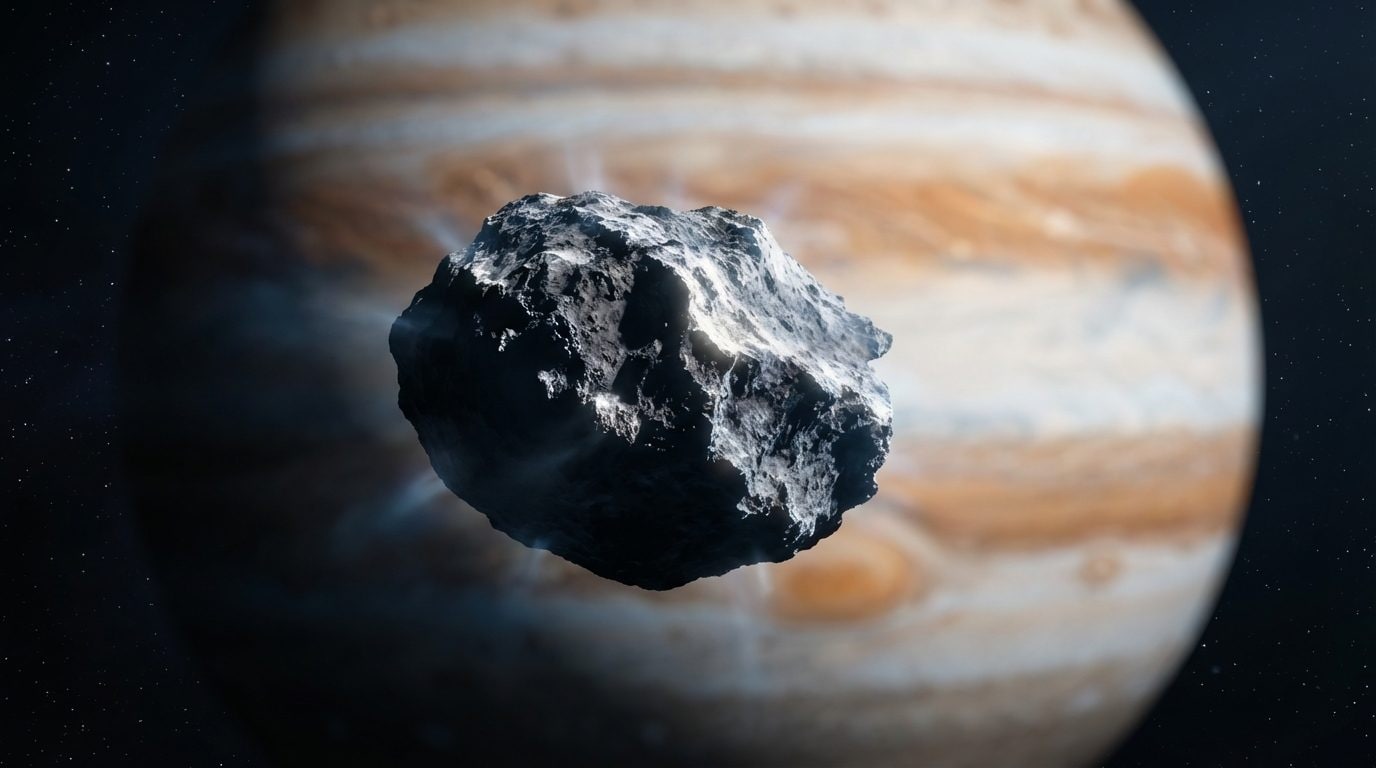
The astrophysicist Avi Loeb highlighted new coincidence of comet 3I/ATLASthe third interstellar object discovered in our Solar System. And again, unfortunately, he uses it to reiterate his hypothesis that it could be a extraterrestrial artifact.
The coincidence is this: the March 16, 2026 the comet will reach its closest proximity to Jupiter at a distance of approximately 53.5 million km from the gas giant. What is special about this distance? It is substantially identical to what the value of the so-called will be on that date Hill radius of Jupiter, that is, the radius within which thegravitational influence of the planet exceeds that of the Sun. In practice, according to Loeb, this coincidence would lead one to think that this minimum distance is somehow desired by someone who, with a precise maneuver, would have “sent” 3I/ATLAS into the Solar System, in order to release probes to study the planet.
Loeb argues that this coincidence is made possible by the fact that the comet showed, near its point of maximum proximity to the Sun, a non-gravitational acceleration which – according to the Harvard astrophysicist – would have had the exact value to allow the Hill radius of Jupiter to be precisely reached.
Why does this reasoning fail? Simply because if we want to talk about fine-tuning (i.e. precise regulation) of the non-gravitational acceleration, we should at least know precisely the value of this acceleration. But we do not know this value precisely.
In his speech on MediumLoeb uses the value of for acceleration 5 · 10–7 astronomical units per square day, reporting the Small Body Database of NASA’s Jet Propulsion Laboratory as the source. This value, however, is not clear, because it does not match the data provided by JPL itself. Doing the calculations, the total non-gravitational acceleration is in fact about an order of magnitude lower (8.22 · 10–8 astronomical units per square day). The value 5 · 10–7 appears (but in meters per second squared) in a study recently published on arXiv. Study which, incidentally, claimed that the non-gravitational acceleration of 3I/ATLAS was completely explainable by its loss of volatile materialsthus refuting the hypothesis that the comet was accelerating thanks to the action of presumed thrusters. Among other things, near the Sun the comet showed several jets simultaneously directed in various directions, and it is absolutely not clear how this behavior could be an effective way for a supposed spacecraft to ultraprecisely change its trajectory.
We also remember – as reported by JPL – that the estimates of non-gravitational acceleration still exist considerable margins of uncertaintyabove 30%: in short, we don’t have numbers anywhere near precise enough to be able to talk about fine-tuning.
Then it can be said that, whatever this value is, in any case it makes possible the coincidence between the minimum distance from Jupiter and the Hill radius of Jupiter on that date. But that’s what it’s all about: one coincidence. Which comes not only from the non-gravitational acceleration, which is extremely small, but above all from that gravitational – and alien technologies have nothing to do with that – and from the entry trajectory of 3I/ATLAS into the Solar System. In short, a very interesting coincidence but there is no margin, at the moment, to interpret it as Loeb would like.
