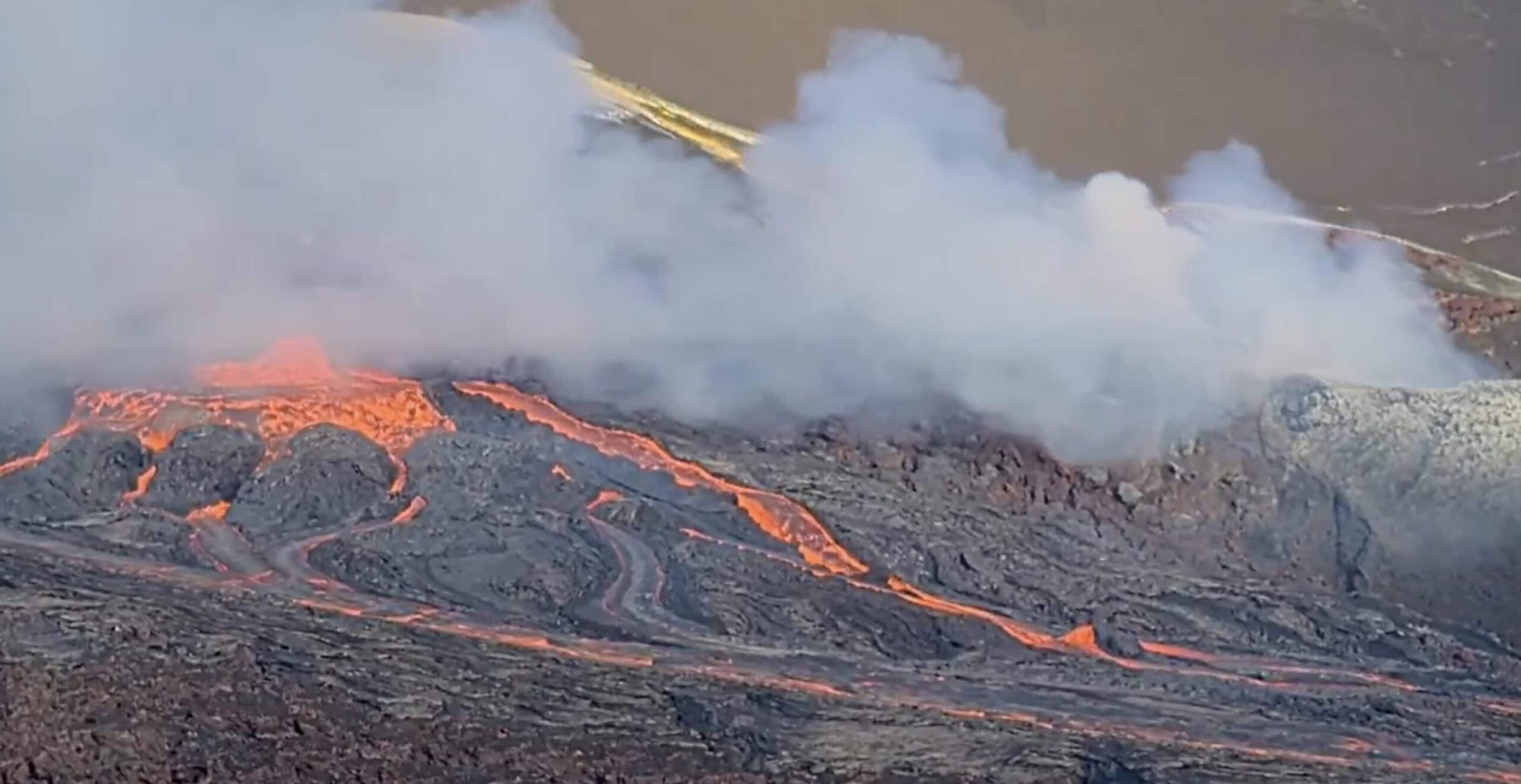
There was a new eruption of the volcano Kilauea in Hawaiia few days after the last episode. As reported by the USGS (US Geological Survey), the eruptive activity began around 8.33pm (Italian time, 09:33 local time) yesterday Sunday 23 November, and was characterized by overflows lava periodicals – lasting 5/15 minutes – from the southern mouth of the volcano e fountains domed approximately 5/10 meters high.
Overall, they were recorded 58 overflows from the summit vents, with gas plumes visible from both the southern and northern vents and an increase in seismic intensity. Volcanic gas emissions, composed mainly of water vapor (H2O), carbon dioxide (CO2) And sulfur dioxide (SO2), however, are confirmed at the eruption pause levels, generally between 1,200 and 1,500 tons per day.
In its forecast, the USGS highlighted that the next eruptive episode – the number 37 – could occur by November 26th: also for this reason, the institute has confirmed the orange alert level also for l‘aviation, while the volcano remains under close observation.
Yet another eruptive episode therefore does not come as a surprise: Kilauea, located in a closed area of the Hawaii Volcanoes National Park, is one of most active volcanoes in the world, characterized by very frequent effusive eruptions, which are also reflected in its “shield volcano” shape. This, in fact, is the 36th eruption which has been recorded since 23 December 2024: fortunately, in most cases these events have extremely limited, if any, destructive power. Just a few weeks ago, among other things, an eruption of Kilauea produced the rare phenomenon of the “Volnado”, a tornado of volcanic origin.
