They have been found traces of the eruption of Vesuvius which in 79 AD destroyed Pompeii and Herculaneum on the seabed of the Tyrrhenian Seaoff the coast of Calabria a hundreds of kilometers from the volcano and beyond 600 m below sea level. This was revealed by the studies carried out by the University of Palermo in collaboration with the University of Naples and the CNR, which emerged during the conference “POMPEII 79 AD questions of method and historical narration“. The discovery, which was made by taking marine sediment coresreveals the great distance reached by the ashes emitted by Vesuvius and thedrop in temperature who followed the event. Further analysis of pollen and fossil trunks could help to define the date of the eruption more precisely, which according to the testimony of Pliny the Younger was August 24, but about which there are still uncertainties.
The discovery of traces of the eruption of Vesuvius in 79 AD
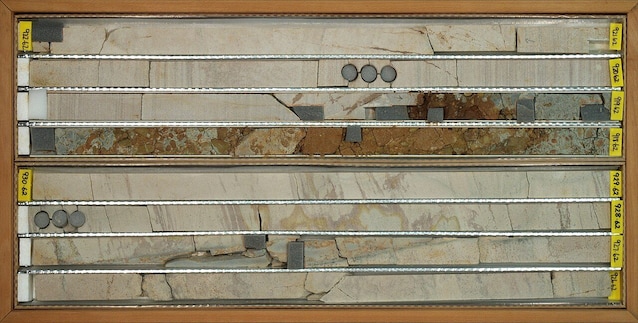
The researchers carried out oceanographic campaigns on the seabed of the Tyrrhenian Sea, the Ionian Sea and the Sicilian Channel, taking marine sediment cores which were then analyzed and compared with each other. In the southern Tyrrhenian Sea core, which provides information on the last 15,000 years of the Earth’s geological history, one layer of volcanic ash that carbon-14 dating dates back to the eruption of Vesuvius in 79 AD. The geographical location of the discovery, according to the paleoclimatologist Antonio Caruso, demonstrates that “the ashes of the volcanic cloud were carried by the wind towards south-south-eastreaching distances of hundreds of kilometers and settling at the bottom of the sea”. The geochemical analyzes of the sediments and the fossil shells of marine organisms contained therein also showed that immediately after the eruption of Vesuvius there occurred a slight decrease in temperaturewhich however could not be quantified. This is what can happen after particularly intense eruptions that emit large quantities of ash, capable of reflecting and therefore partially blocking solar radiation, thus lowering temperatures for a certain period of time.
The reconstruction of the volcano eruption: dates and temperatures
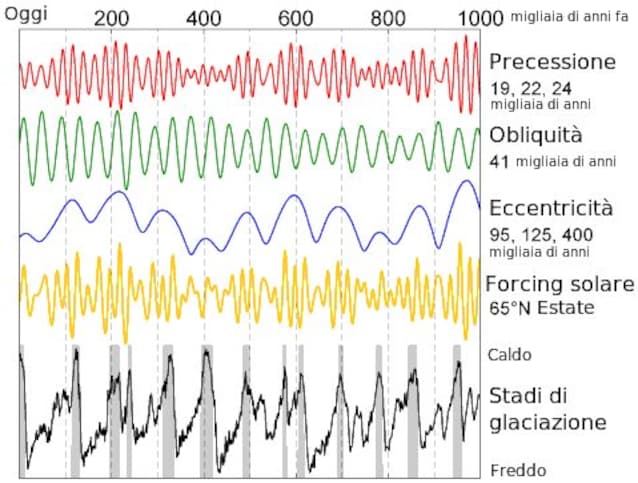
The researchers’ goal is also to reconstruct the average temperatures present in the central Mediterranean during the century in which the eruption occurred, between the year 0 and 100 AD To do this, you will need to analyze fossil pollen contained in the continental sediments coming from the lakes of central-southern Italy and the growth rings of fossil tree trunks found in Herculaneum. In this reconstruction it will be necessary to keep in mind the astronomical factors that may have influenced the climate of the time: these are the millennial movementsperiodic variations in the orientation and inclination of the Earth’s axis and the shape of the Earth’s orbit. These motions influence the distribution of solar radiation arriving on the Earth’s surface during the course of the year and therefore on the temperatures and duration of the seasons. Another factor to consider is the sunspotsthe number of which varies cyclically over time, with an effect on the climate.
All these elements could contribute, in addition to reconstructing the temperatures of the time, also to defining the actual date of the eruption. Based on what emerged during the conference, it currently appears that the date of the eruption indicated in the famous letter of Pliny the Younger the historian Tacitus could be trusted. According to the testimony of Pliny the Younger it was the August 24tha date that at that time fell in the autumn season. The hypothesis, formulated in 2022 based on some findings, according to which the event took place on 24 October, would therefore be in question.