When we talk about nuclear fusion, we often think of large international laboratories, first and foremost ITER in France. In reality, Italy is one of the countries that is contributing the most to the development of this technology. Not just with the scientific researchbut also with a industrial fabric capable of producing components that few in the world know how to make. In Italy, a “local” tokamak is also under construction, the Divertor Tokamak Test (DDT) to test the handling of plasma at very high temperatures. Understanding how our country participates in the fusion race helps to see a broader picture: that of a sector in which skills, innovation and international collaboration they are fundamental.
Italy’s role in major international projects on nuclear fusion: the project ITER
Italy is a founding member of ITERthe largest fusion experiment in the world. The country contributes to the development of crucial parts of the reactor, such as superconducting magnets and plasma heating systems.

Participating in the project, for example, isAENEAS, i.e. the National Agency for new technologies, energy and sustainable economic development. It is one of the main Italian public research centers, together with CNR and INFN. Also participates in RFX Consortium of Paduaa public consortium that brings together some of the main Italian institutions involved in plasma physics and fusion technologies.
Then there are Italian companies and excellences such as Thales Alenia Space Italia, Ansaldo Nucleare, ASG Superconductors and many others that supply extremely high precision components.
These collaborations allow the country to be competitive in a sector where advanced materials, cryogenics, power electronics and the ability to work on a millimeter and at the same time gigantic scale are needed.
The Italian experiments, from the RFX-mod2 to the Divertor Tokamak Test
Let us now briefly see what the main Italian experiments in this sector are.
RFX-mod2
Always within the RFX Consortium of Padua we study the magnetic confinement of the plasmawith an alternative approach to Tokamak. The RFX experiment and its evolution – RFX-mod2 – It is one of the world’s largest type devices Reversed Field Pinch. This project allows testing of plasma stability, advanced magnetic control and different materials and diagnostics.
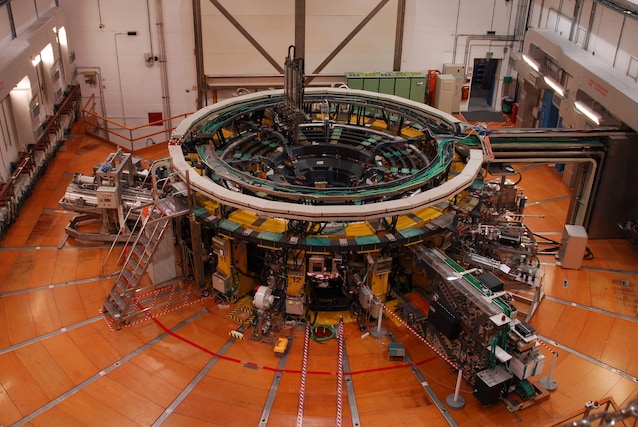
BEFORE / NBTF (Neutral Beam Test Facility)
Always within the same site as Paduathere is a second infrastructure that is used to test i very high energy neutral injection systems intended for ITER and the Japanese JT‑60SA system. It includes two large experiments: SPIDER, the largest ion source ever built, and MYTHICAL, Full-scale prototype of ITER’s 1 MeV injector.
DTT (Divertor Tokamak Test)
TO Frascatithere is the new Italian tokamak currently under construction, designed to study the entertainerthe part of the nuclear reactor that must withstand the most intense heat flows. It is used to test advanced materials, develop solutions for DEMO – the future European powerhouse – and create an international research hub. The DTT it is considered a key step towards industrial fusion.
ENEA laboratories – Frascati, Brasimone, Portici
AENEAS is one of the European protagonists of fusion. Its centers study high-temperature materials, superconductors, plasma heating systems, diagnostics and components for ITER. Frascati it has been the historical headquarters of Italian fusion since the 1960s, but there are other headquarters such as, for example, that of Brasimone (Bologna) e Porticoes (Naples).
Euroatom and EUROfusion
Italy is an active part of European projects that finance research and development of technologies in the field of plasma physics and fusion.
Euratom is the European Atomic Energy Community, founded in 1957. Euroatom finances and coordinates European nuclear research, establishes safety standards for nuclear power, supports fission and fusion programs, manages international agreements, such as European participation in ITER. In practice, Euratom is the legal and financial framework which allows Europe to work on nuclear power in a coordinated way.
EUROfusion is a European scientific consortium created in 2014. It is an alliance of more 30 research institutes and European universities which coordinates European research on nuclear fusion, manages Euratom funds intended for fusion, develops the European strategy towards the demonstration center DEMO, coordinates experiments such as JET, W7‑X, JT‑60SA and DTT, and supports ITER with research, simulations and technological development.
