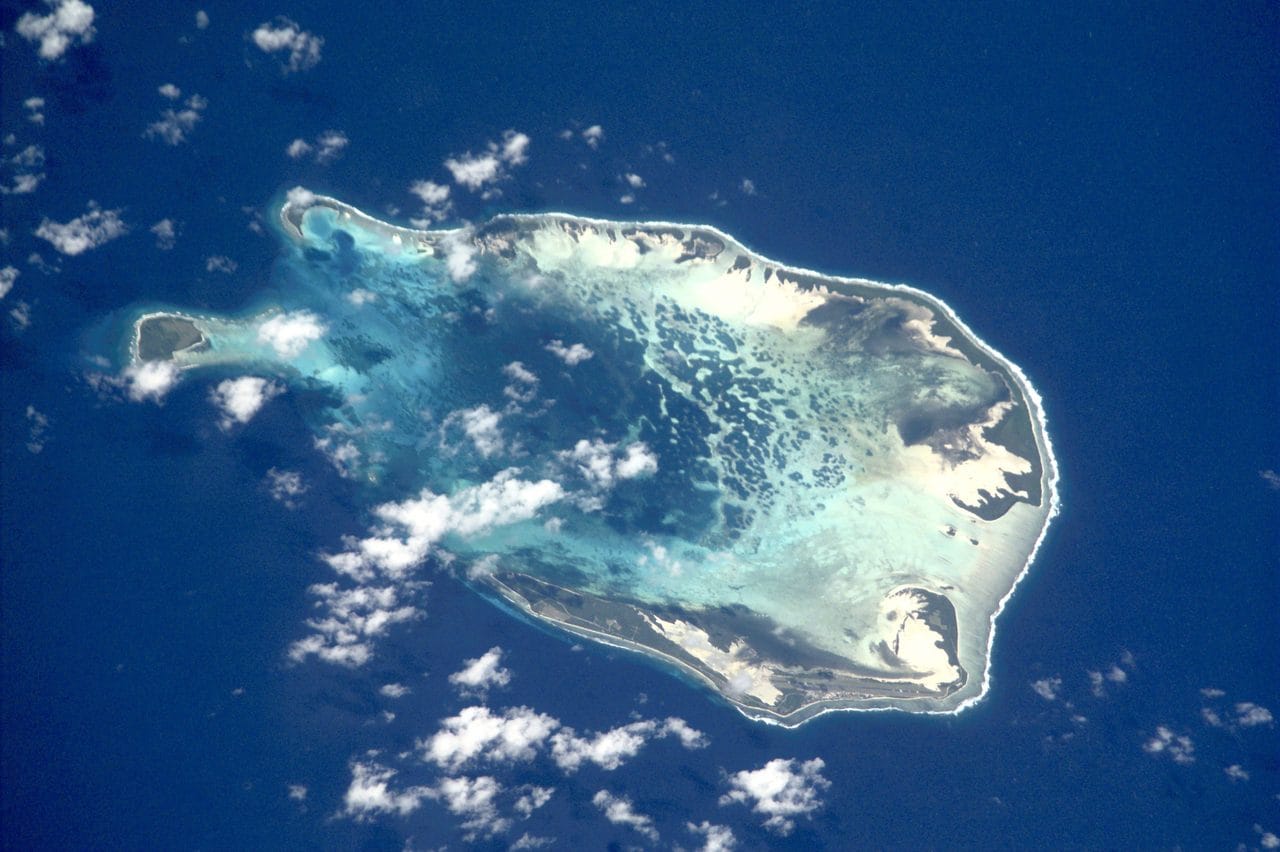
Many islands located in the middle of the ocean they contain rocky materials that appear to come from the continents from which they are very far away. The reason for this characteristic has long remained a mystery: now a team of researchers from the University of Southampton, in England, has solved it and published the study in the journal Nature Geoscience. When continents break apart, as they have many times during Earth’s geologic history, movements are generated in the underlying mantle which lead to the detachment of rock fragments at their base which are dragged over distances of up to 1000 km. These materials then rise from the mantle in the form of magma, feeding volcanic eruptions on the seabed oceans that over time lead to formation of emerged islands.
The study on the birth of islands from fragments of continents: the chemical composition
Islands are formed by magma leakage onto the seabed oceanic, which solidifies and accumulates over time until it emerges from the surface of the sea. The magma from which they originate comes from the fusion of the rocks that make up the earth’s mantle. Its composition is basaltic and when it solidifies it forms the rocks called basaltswhich make up the ocean floor. However, it has long been discovered that the rocks of many islands also contain chemical elements characteristic of the continents. The researchers, in particular, analyzed the composition of one submarine volcanic chain of the Indian Ocean which was formed after fragmentation of the supercontinent Gondwana over 100 million years ago. They thus discovered that after fragmentation, a large quantity of magma enriched with chemical elements characteristic of continents rose to the surface. “We’ve known for decades that parts of the mantle beneath the oceans appear strangely contaminated, as if pieces of ancient continents had somehow ended up there“said Thomas Gernon, professor of Earth Sciences at the University of Southampton and lead author of the study, “but we haven’t been able to adequately explain how all that continental material got there“. In the past it had been hypothesized, for example, that it came from sediments “scraped away” from the continent and pushed deeper when an oceanic plate sinks beneath it during the subduction process.

How islands are born: the mechanism behind their composition
The new study proposes an alternative explanation, based on previous research and on movement simulations of the continents and the mantle. At the origin of the composition of many islands there would be the fragmentation of continentswhich generates ainstability in the underlying mantlewith the formation of “waves” in its viscous materials. These they propagate under the continents at depths between 150 and 200 km e they tear fragments of rock at their base very slowly, at a speed that corresponds to one millionth of that of a snail, even taking millions of years. The fragments come then transported laterally even for 1000 km in the cloak. From here, continental material can subsequently escape to the surface in the form of magma through volcanic eruptions. Professor Sascha Brune, co-author of the study, says: “We found that the mantle is still feeling the effects of continental breakup long after the continents themselves have separated. The system does not shut down when a new ocean basin forms: the mantle continues to move, reorganize and transport enriched material away from where it originated“. The movements of the mantle can even modify the morphology of the Earth’s surface and are involved in the ascent of diamond-rich magma from the mantle.

