Why does Italy have such a peculiar shape? Why are there fossils of marine animals in the Alps? Italy has not always existed: it is the result of the very long action of tectonic forces that date back to about 250 million years ago, when the supercontinent Pangea began to fragment. It all started with a microplate that geologists call Adriaand which over time would become our peninsula. Italy was gradually formed from the movements of pieces of present-day Africa and present-day France, which gave rise to the Alps and to Apennineswhose dynamics contributed to the formation of Po Valley and the Adriatic. Only in the last million years do the great volcanoes of the Bel Paese appear: Stromboli, Etna, Vesuvius And Phlegraean Fields.
Geological evolution of Italy: when and how it was formed
250-180 million years ago: the end of Pangea
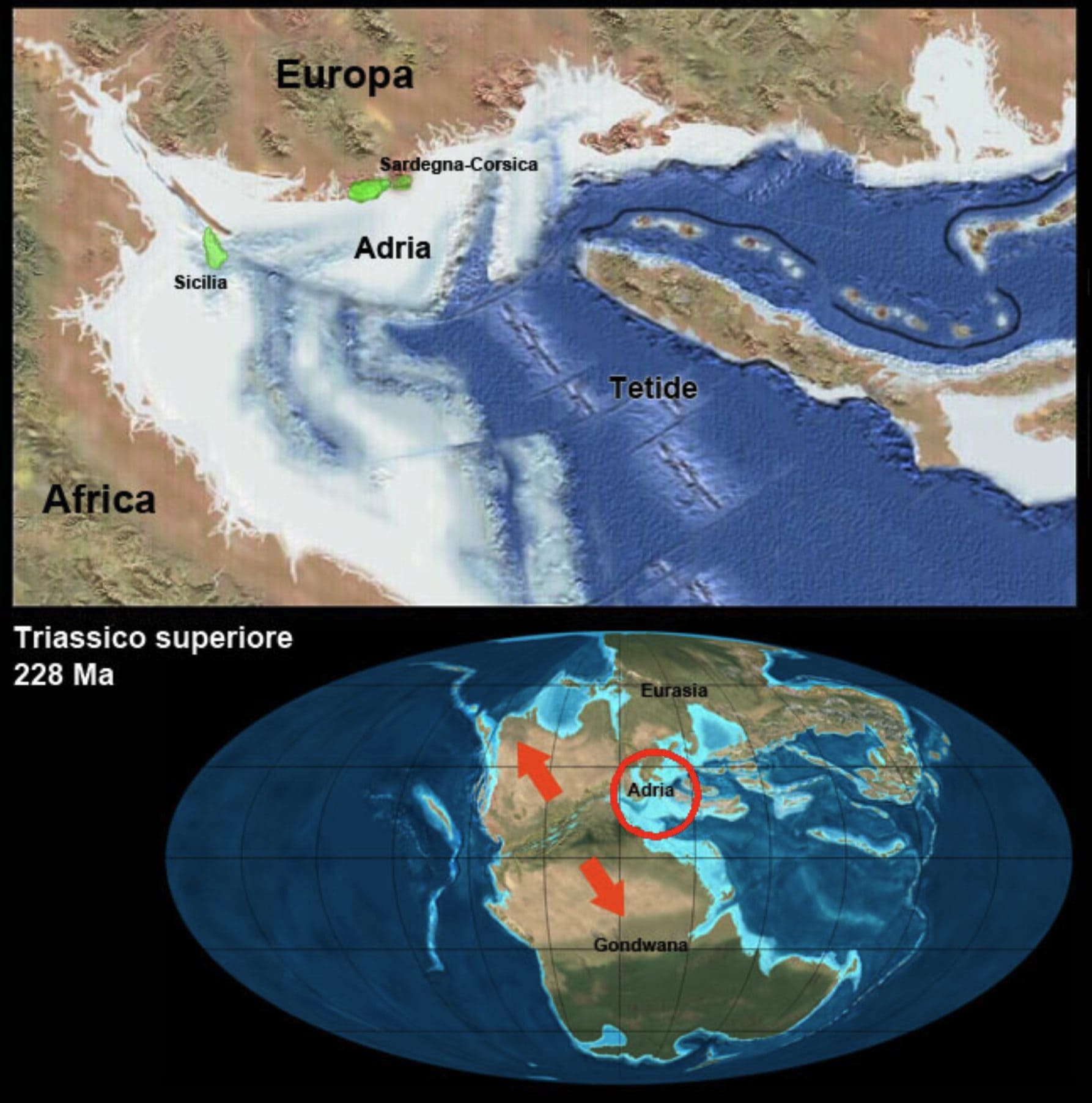
As the fragmentation of Pangea begins, a breakup in the eastern part of the supercontinent causes a branch of the ancient Panthalassa ocean to flow into a branch we call Tethys oceanwhose coasts correspond to present-day Europe and present-day Africa. It is here that we identify the first “seeds” of what will be Italy: the current one Sicily (a fragment of what we call Gondwana, i.e. the southern block of Pangea), the Sardinia and Corsica (at the time united in the coast of the northern block of Pangea, present-day Europe) but above all Adriaa microplate in which we find most of the emerged lands that will constitute the Italian peninsula.
Initially Adria was submerged in the Tethys ocean. In this period (around 220 million years ago) the sedimentary rocks (in this case carbonate rocks) were formed which we find at high altitudes in the eastern Alps or on certain Apennine ridges.
180-130 million years ago: the Ligurian-Piedmont ocean
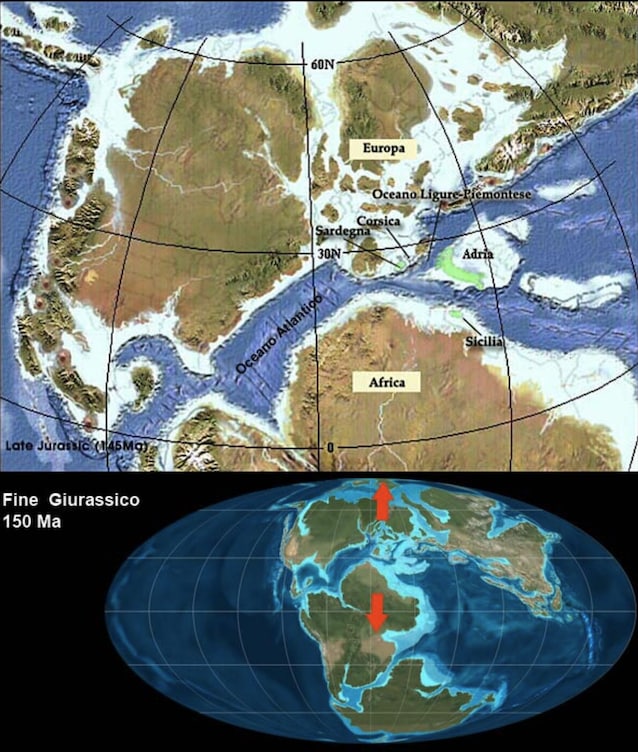
While the breakup of Pangea leads to the birth of the central Atlantic Ocean, which separates Africa from Europe and North America, Adria detaches itself from the European continent and moves away from present-day Europe, forming a deep basin that today we call Ligurian-Piedmontese ocean. Here new oceanic crust is formed, with rocks such as basalts, gabbros and serpentinites, which today are part of the Alps and Apennines. Our two mountain ranges are mainly composed of rocks typical of the deep oceans!
130-90 million years ago: the closure of the ocean and the birth of the Alps
With the separation of Africa from South America and the formation of the South Atlantic, the African plate begins to rotate counterclockwise, thus pushing the Adria block towards present-day Europe. The Ligurian-Piedmont ocean is crushed, the oceanic crust slides by subduction under the European continent and the ocean closes.
The “clash” between Adria and Europe took place between 65 and 30 million years ago and generated the Alps. The ocean floors, in fact, were raised by the crumpling of the crust and the progressive disappearance of the ocean. The Alps first, and present-day Northern Italy with them, thus began to emerge from the water. Adria begins to become dry land.
25-7 million years ago: the birth of the Apennines, Adriatic and Tyrrhenian Sea
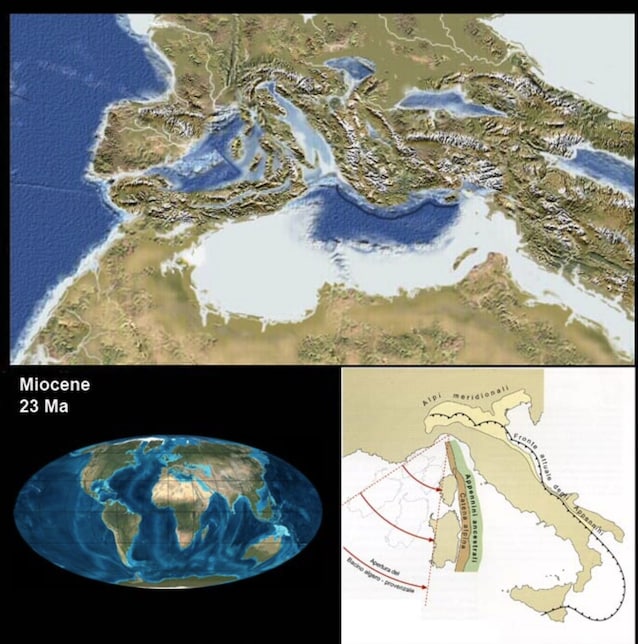
Between the upper Oligocene and the lower Miocene, a fragment of the European block, where present-day France is located, broke away and began to rotate counterclockwise in the direction of what is now Italy. The center of the rotation is in the current Gulf of Genoa, and those that are coming towards us are Sardinia and Corsica.
The rotation of the Sardinian-Corsican block and its approach to Adria leads to another crumpling, which will generate our second mountain range: the Apennines.
The formation of the Apennine chain causes a bending of the crust east of Adria, creating a basin next to the new mountain chain: thus the Adriatic Sea. This sea is shallow because it is the product of crustal flexure, and 5 million years ago it reached as far as Genoa: the Po Valley finished forming only about 1 million years ago.
To the east, however, the Tyrrhenian Seabut this time the Apennines are not involved: its formation is due to a tearing of the continental crust which causes new oceanic crust to emerge. Technically, the Tyrrhenian Sea is not a sea but an ocean!
7-0 million years ago: the disappearance and reappearance of the Mediterranean
The rapprochement of Africa and Europe led to the closure of the Strait of Gibraltar about 6-7 million years ago. The Mediterranean became a closed sea and slowly evaporated, leaving large deposits of salts on the new emerged lands. At this point Italy is de facto connected with Africa. These deposits form i chalks which we still find today in many areas of Italy, from Sicily to Monferrato.
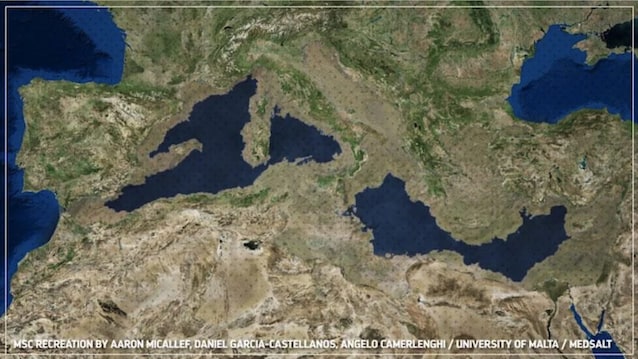
5.3 million years ago the Strait of Gibiterra reopened, leading to an organization of seas and emerged lands now similar to the current one.
Our active volcanoes they were born only at the end of this very long story: Stromboli was born about 1 million years ago, theEtna 500,000 years ago, the Vesuvius 400,000 years ago and last i Phlegraean Fields80-100,000 years ago.
