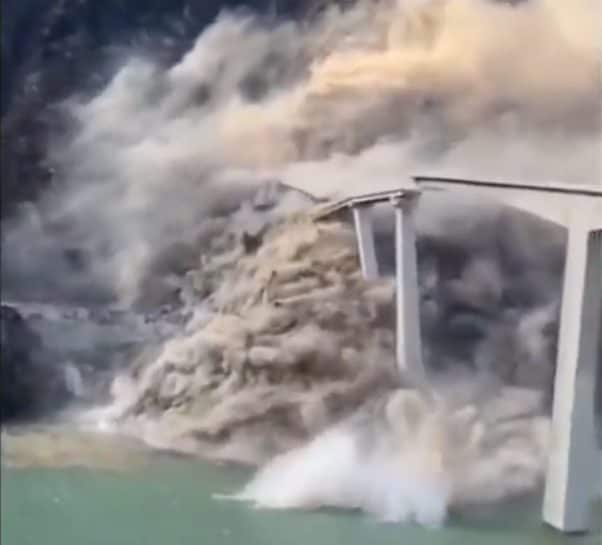
In the last few days, the images of partial collapse of the Hongqi Bridgelocated in the province of Sichuan (south-eastern China) and 758 meters long, are making the rounds on the web. The videos show with impressive clarity the triggering of a landslide movement on the side adjacent to the highway bridge that connects China to Tibet and the consequent cascading collapse of a part of the deck, due to the collapse of the piers and the consequent loss of support. The structure, inaugurated recently, had been closed for safety reasons by the authorities, avoiding deaths or injuries. In this article we propose one technical interpretation key of the incident, analyzing the dynamics of the phenomenon and the possible causes.
The dynamics of the collapse of the Hongqi Bridge
From the observation of the available images, the phenomenon can be interpreted through some key points:
- Trigger of landslide movement: one develops slope sliding near the end part of the bridge. In essence, what happens is that a “piece” of land of significant dimensions detaches itself from the remaining part to which it was previously bound, moving away from it through a progressive sliding. It is not yet clear whether the sliding surface also involves them foundations of the terminal piles or if these are outside the unstable zone. This detail is important because it directs the analysis towards two scenarios:
- Scenario A: natural instability of the slope, independent of the work. The thrust generated by the landslide elements causes the bridge to collapse.
- Scenario B: instability induced by construction, which modified the equilibrium conditions of the slope. Foundations slide with moving soil.
- Effect on foundation structures: if the foundations are affected by the movement, a chain reaction. The piles undergo horizontal displacements and vertical settlements caused by the landslide movement and the thrust generated by the landslide elements, which – at speed – can impact the vertical structures, compromising their stability. This causes the loss of support of the deck, which can also occur with relatively modest movements, in the order of tens of centimetres.
- Collapse of the decks: the horizontal structures, connected from pile to pile, are now without support at one or two ends and collapse like a rigid body in free fall.
- Collapse propagation: the kinematic mechanism extends to the adjacent spans, until it stops at the “bracket” parts of the deck on the main stacks of the new viaduct. These parts, thanks to their static cantilever schemeare able to support their weight even without support on the opposite end, similarly to what happens every day on any balcony. The residual structure therefore remains intact, not only because it is not directly affected by the landslide movement, but also because it is characterized by a more redundant static scheme.
Was the Hongqi Bridge in Sichuan poorly designed?
This is the question many ask themselves when looking at the images. The answer, however, is complex.
The collapse cannot be attributed solely to design errors. A bridge that loses a support, except for highly redundant static schemes, can hardly avoid serious damage or partial collapse, such as the collapse of the decks.
Secondly, the real crux is the geological and geotechnical context in which the work is inserted: the landslide that occurred gives clear evidence of the presence of a unstable slopesusceptible to variations in surrounding conditions, such as heavy rain, excavations, vibrations or even new constructions. The construction of the foundation and terminal elevation structures, for example, may have altered the balance of the slopeworsening an already critical situation. Think of the tragic event relating there Vajont damwhere the interaction between infrastructure and geology has had dramatic consequences.
To clarify the causes of what happened, careful investigation will therefore be necessary project analysis and its insertion into the geological context. Furthermore, it will probably be necessary to carry out geotechnical investigations for the characterization of the soil substrates present and their mechanical properties. Finally, it will be necessary to evaluate the stability of the slope in its original condition and any disturbances induced by construction.
