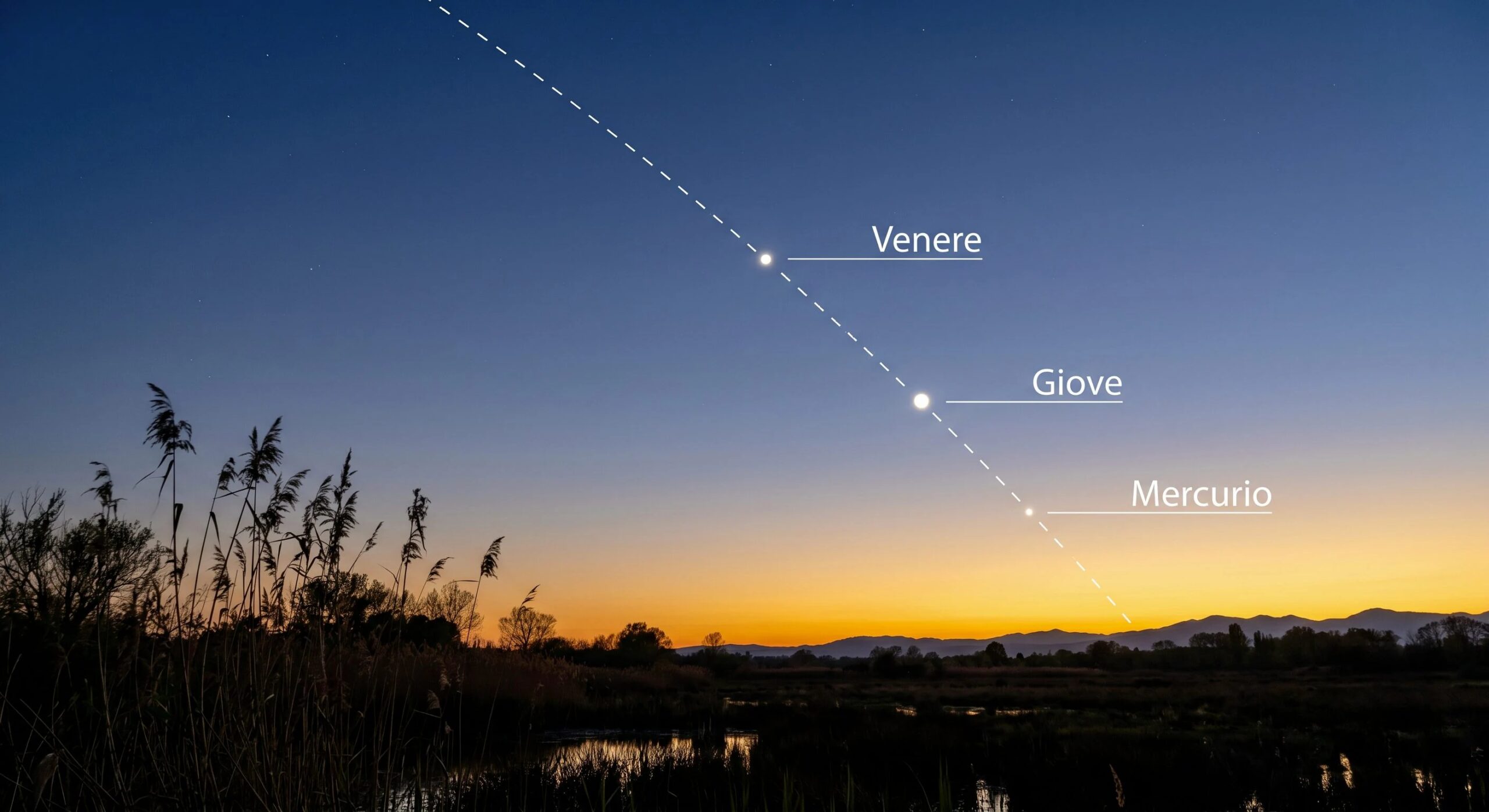
Eyes on the sky tonight, June 12, 2026to observe theplanetary alignment which will involve the planets Mercury, Venus and Jupiter (these two already protagonists of the “heavenly kiss”) and which will be visible to the naked eye shortly after sunset. At the coordinates of Rome, the Sun will set at 8.46pm, offering a window of simultaneous visibility of the three stars on thewest/northwest horizon for about two hours. Mercury will set at around 10.30pm, followed by Jupiter at 11pm and Venus at 11.20pm. A fourth inconvenience, a thin crescent moon, will keep the trio company at sunset on June 16th and 17th.
The three planets, in reality, will not form a perfect straight line in space: it is rather a prospective effect linked to the observation point on Earth, with the planets appearing close to us along the ecliptic, the imaginary line on which the Sun appears to move during the year from the perspective of our planet.
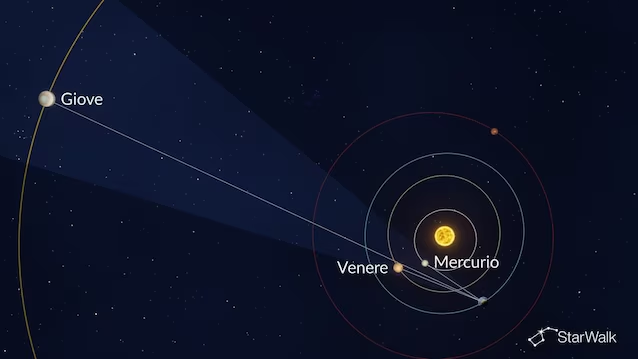
Where and when to observe the “mini parade” of planets in the sky
There main date of the alignment is today, June 12ththe best time to see all 3 planets together: Jupiter, Venus and Mercury. The astronomical show, however, will continue for several evenings: the June 15, in fact, Mercury will reach its maximum elongation (with an angular distance from the Sun of 24° and 31′) and will therefore be at the maximum apparent distance from our star. Monday 15th, therefore, will be the best time of the entire period to be able to easily identify this planet, generally immersed in the glow of sunset or sunrise due to its proximity to the Sun.
The June 16th and 17thinstead, a subtle one crescent moon it will join the trio of planets shortly after sunset, making the show even more suggestive. Bright stars will also be visible nearby Pollux And Castorin the constellation Gemini.
In terms of time, the best time to observe the planetary alignment is between approximately 30 minutes and one hour after sunsetlooking in west/northwest directionin the area where the Sun has just dropped below the horizon. The observation window, therefore, will be relatively short (about 2 hours): taking into account the coordinates of Rome, Mercury will set at approximately 10.30pm, followed by Jupiter at 11pm and Venus at 11.20pm.
Since the planets will be quite low on the horizon, it will be essential to go to an area withobstacle-free western horizon: buildings, tall trees or hills could block our view. The ideal will therefore be an open and flat area, a coast, a field or even a balcony with an unobstructed view towards the west.
How to spot planets in the sky
The easiest way to locate the three planets after sunset is to rely on the planet Venus, looking in the direction west. With one magnitude of -4.0Venus will be absolutely the brightest object in that portion of the sky, similar to an intensely bright star, and will stand out easily even when the sky is not yet completely dark.
Once you locate Venus, the rest becomes much simpler: Jupiter (with a magnitude -1.8) will be in the vicinity of Venus and, although less dazzling, it will still be much brighter than most stars. The more challenging protagonist will be Mercury (magnitude 0.3), which will be found lower than the other twocloser to the horizon and therefore more difficult to see because it is often immersed in the residual light of twilight. If mist, buildings or vegetation hide it, you will still be able to enjoy the conjunction between Venus and Jupiter.
In general, this alignment will be visible quite easily with the naked eye (provided that weather conditions allow it), but those who have binoculars can try pointing them at Jupiter, after the Sun is well below the horizon: in good conditions it will even be possible to glimpse some of its four larger moons, visible as tiny points of light aligned on the sides of the planet.
