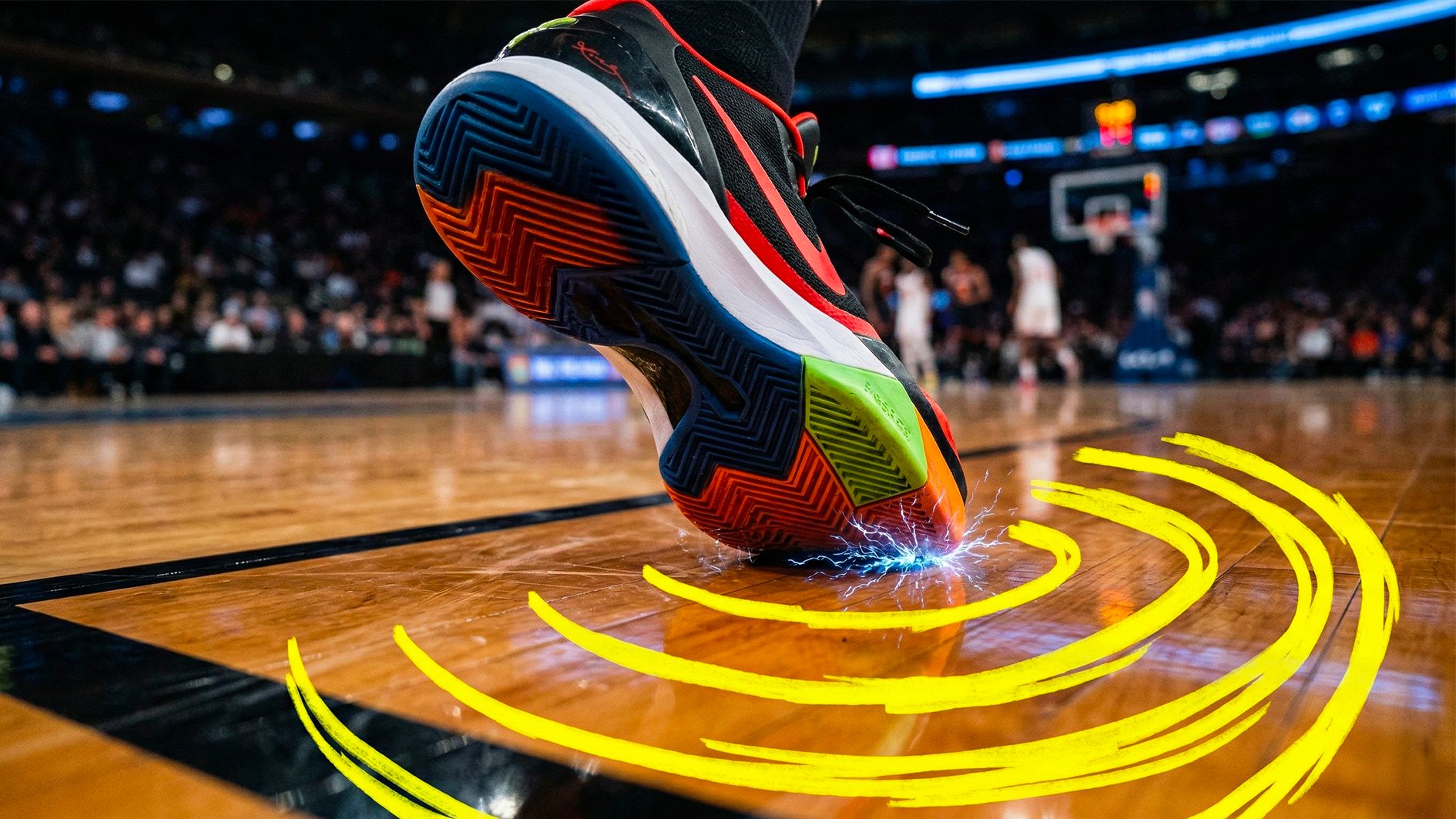
The squeaking of shoes basketball on the parquet is the result of a physical mechanism never studied in depth before, which surprisingly has a lot to do with the way in which the seismic waves of an earthquake are formed. This is the discovery of a team of researchers from the Harvard John A. Paulson School of Engineering and Applied Sciences (SEAS), in collaboration with the University of Nottingham and the French National Center for Scientific Research. The study, published on Naturechanges the knowledge underlying the squeak of NBA players on the basketball courts. On the one hand, it provides a new theoretical model to understand the physics of earthquakes and on the other, thanks to the thickness of the rubber and the frequency of the sound, it allowed researchers to play the Star Wars Imperial March by sliding blocks of different heights.
Before this study, the model for the origin of the squeaking of the soles on the parquet was the so-called stick-slip (literally “attacks and slides”), that is, when between two surfaces that slide over each other there is a very rapid alternation between a phase in which the two surfaces remain attached and one in which they slide. In this case, each small portion of rubber on the sole “glues” to the floor for a fraction of a second, then slides for another fraction of a second and so on, generating a series of irregular clicks that generate the characteristic noise. This model, however, describes thefriction between two rigid surfaceswhile here one of its surfaces – the rubber of the sole – is not.
So here is a team of researchers led by Adel Djellouli studied the phenomenon by observing it with ultra-fast cameras capable of capturing up to one million frames per second and listening to it with a microphone. For the experiment, basketball shoes or rubber blocks were used which were slid on a transparent glass surface illuminated with LED lights to visualize the dynamics of the contact zones between the two surfaces.
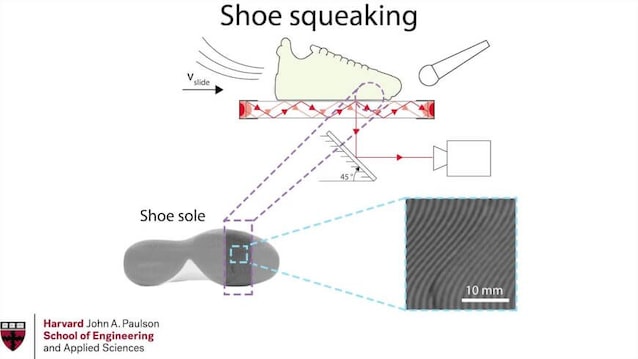
The result? The mechanism is similar to that of stick-slipbut with particularities due not only to the fact that rubber is not a rigid material, but also to the fact that the soles of the shoes are not smooth surfaces but have grooves and reliefs.
The experiment showed that, when the sole rubs rapidly on a smooth and rigid surface – such as the parquet of basketball courts – the reliefs on the soles do not slide on the floor uniformly: the relative motion between the two surfaces is organized into detachment “fronts” which propagate at speeds much higher than the sliding speed, thus causing shock waves which then generate the “whistle”.
Unlike the “traditional” stick-slip, in which these detachment-sliding events occur somewhat randomly on the surface, in the case of the sole the non-rigidity of the sole and the geometry of the reliefs ensure that these impulses are ordered in space and above all regular over time. So a sound wave is created made up of many impulses that propagate with one well-defined frequency: but this is exactly the definition of musical note!
The authors of the study have in fact noticed that, as the height of the rubber block or groove varies, the frequency of the squeakand therefore the pitch of the note produced. To demonstrate this, they cut rubber blocks of different heights and, by sliding them on a glass plate, they managed to play the Imperial march Of Star Wars. You can listen to the iconic melody “played” only with pieces of rubber below!
But there’s more: very high-speed cameras have shown some tiny electrical discharges generated by the rubbing of the rubber, like gods microscopic “lightning”. These discharges are the result oftriboelectric effecta physical phenomenon whereby two different materials (such as the rubber of the sole and the wood of the parquet, of which at least one is insulating) exchange electrical charges by rubbing together, or even touching and then separating. Friction generates electrical voltage, as can be seen in the video below.
The surprises in this research do not end here and are not limited to materials engineering. The slip dynamics is reminiscent of what happens in earthquakes with faults moving relative to each other. The research team opens up the possibility that rubber patterns with grooves and ripples could become an easy way to study the physics of earthquakes in the laboratory.
