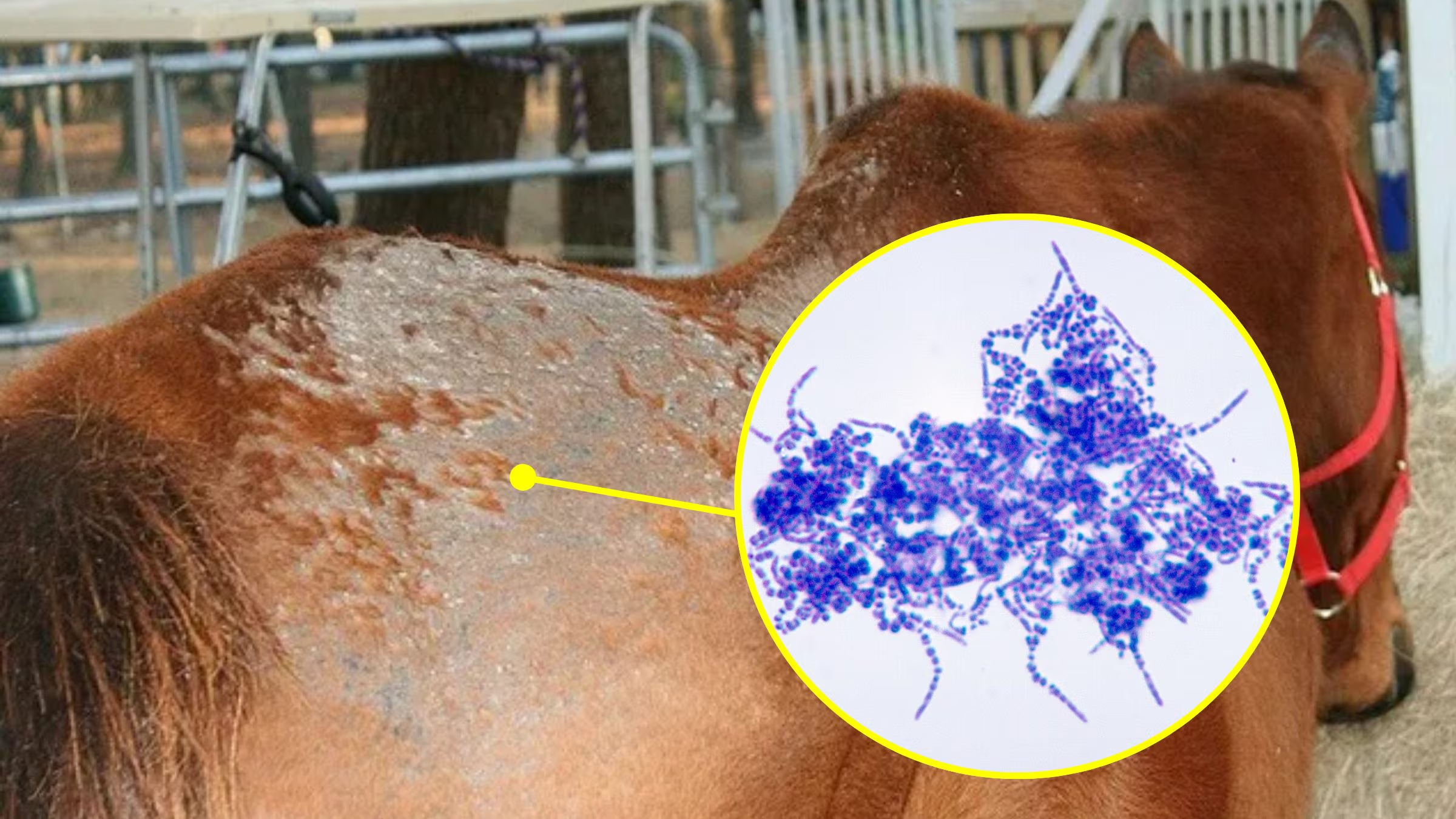
In recent weeks, European health radars have intercepted an epidemiological anomaly linked to a bacterial infection (Dermatophilus congolensis) historically known in the veterinary field: the dermatophilosisknown in popular parlance as “rain disease”. According to a recent report by the ECDC (European Center for Disease Prevention and Control), starting from the end of 2025 approximately 123 human cases distributed in 10 European countries (Austria, Denmark, France, Germany, the Netherlands, Norway, Spain, Sweden, Switzerland, the United Kingdom). In Italy, at the moment, no cases have been recorded and the risk for the general population remains very low. However, the attention of the scientific community is high because, if in the past the infection affected almost exclusively animals, possible dynamics of human-to-human contagion are now being evaluated.
To understand exactly what it is, how it is transmitted and what the real contours of this story are, we interviewed the professor Antonella Castagnahead of Infectious Diseases at the IRCCS San Raffaele Hospital in Milan and full professor of Infectious Diseases at the Vita-Salute San Raffaele University.
What pathology is it and what exactly is dermatophilosis, known as “rain disease”?
It is a bacterial skin infection caused by Dermatophilus congolensisa microorganism responsible for a exudative dermatitis: a condition characterized by the appearance of pustular lesions which tend, at a later time, to form skin lesions. Historically it is a pathology that mainly affects cattle And sheepdeveloping mainly in areas characterized by tropical climates.
What are the biological and environmental dynamics that lead to the development of this infection?
The development of the infection basically depends on two combined factors. The first is the presence of micro-abrasions on the skinthrough which the bacterium manages to penetrate. Inside these small lesions, if the environment is humidthe so-called are activated motile zoospores of the bacterium, which penetrate the epidermis. Finding an already compromised skin barrier and a condition of prolonged humidity, the spores germinate and invade the superficial layers of the skin, triggering inflammation and the consequent formation of crusts.
How did the popular name “rain sickness” associated with this pathology originate?
It is important to clarify this point: it is a term in popular use, especially widespread in the field veterinarianwhich can be misleading. You don’t get sick simply by “catching the rain”. In animals, the bacterium finds ideal conditions to proliferate when the skin, in the presence of small pre-existing lesions, remains moist for a long time. Consequently, the infection is much more frequent in animals that spend i rainy periods outdoorsfrom which the name derives.
Public attention is currently high due to a possible evolution of the bacterium and recent reports of human cases in Europe. What is the real situation you are observing?
It is an evolution that the relevant bodies, such as the ECDC at European level, are evaluating with great attention. Since December last year, approximately 120 cases in humansdistributed in 10 countries. Italy, at the moment, is not among thesewhich represents a strong element of tranquility. Scientific attention was triggered because, in addition to the well known zoonotic transmission (from animal to man), recent sequencing studies of the bacterium suggest the hypothesis of one human-to-human transmission within these foci.
In what specific locations or contexts is this human-to-human transmission suspected to be occurring?
The infections occurred in people who frequented hot, humid and mixed-use environments such as saunas or sports changing rooms: in these conditions, in fact, if skin microtraumas are present, the bacterium finds the ideal habitat to proliferate. We are therefore investigating to understand whether these clusters have always resulted from a single animal-human passage, or whether in these specific contexts a real human-to-human transmission has been triggered. Fortunately, today we have very advanced epidemiological tools that allow us to immediately intercept when the incidence of a disease deviates from the norm.
What are the main symptoms?
From a clinical point of view, the first alarm bell is the appearance of skin lesions. In recent European cases, we have observed pustular lesions, sometimes associated with episodes of conjunctivitis; in other cases, the lesions appeared in the anal or perianal area. This raised the hypothesis that i unprotected sexual intercoursecombined with skin contact in humid environments such as saunas, may have favored the spread in the clusters. These dynamics are still being verified, so it is essential not to create alarmism and maintain a rigorous scientific approach.
From a clinical and visual point of view, can the skin lesions caused by this bacterium be confused with other more common pathologies?
Yes, certainly. Depending on the stage of development of the disease, the lesions can closely resemble a common one fungal mycosis. In other circumstances, especially when they manifest themselves at the genital level, they can easily be mistaken for one herpetic lesion (herpes). These are the two most frequent differential diagnoses that doctors need to pay attention to.
How is this infection diagnosed and treated?
The clinical diagnosis is simple: it is carried out via a swab or a biopsy of the lesion. On the therapeutic front, we have it available very effective drugs. The bacterium is sensitive to different classes of antibiotics (tetracyclines, penicillins, macrolides) and, sometimes, the infection even regresses spontaneously. In some patients healing may be slower because the skin is a poorly vascularized organ: the superficial layers of the skin (the epidermis) are not vascularized, this reduces the ability of oral antibiotics to reach these layers, while topical therapies (creams) struggle to reach the deep layers of the skin (the dermis). In some cases it may therefore be necessary to prolong the therapy, but it is an absolutely curable infection.
What prevention measures should be adopted at this time to limit the risk of contagion?
In this phase the priority is preventionwhich is based on simple common sense rules. Where a risk of human-to-human transmission is suspected, this is necessary avoid direct contact with the skin of people with suspicious skin lesions. It is essential to maintain aexcellent personal hygieneespecially when frequenting hot-humid environments such as sports facilities or saunas, even more so if you are in geographical areas (such as the Nordic countries) where outbreaks have been reported.
For those who work in close contact with animals, such as veterinarians or breeders, the golden rules remain valid: always use i personal protective equipment And take care of hand hygieneespecially in the presence of abrasions. Also, if suspicious lesions appear on the body, it is essential do not share towels or clothingespecially those intended for the face or genital area. The situation is evolving and must be monitored, but the risk for the general population remains very low.
In recent years, viral spillovers have been widely discussed, as in the case of Covid or hantavirus. When it comes to bacterial agents, do the dynamics of species jump and diffusion manifest themselves differently?
Yes, bacteria, due to their complex biological structure, require extremely specific environmental and physiological conditions to proliferate.
We are not faced with the expansive potential typical of a viral infection especially respiratory transmitted agents. In cases of explosive viruses transmitted by aerosol, we witness outbreaks in which the pathogen manages to spread at very high speed. In the case of bacteria, albeit with some exceptions, diffusion dynamics in the environment they are much slower and more limitedsince the microorganism requires an exact coincidence of factors: the perfect environment, ideal replication conditions (such as damaged skin and humidity) and a precise mode of transmission.
