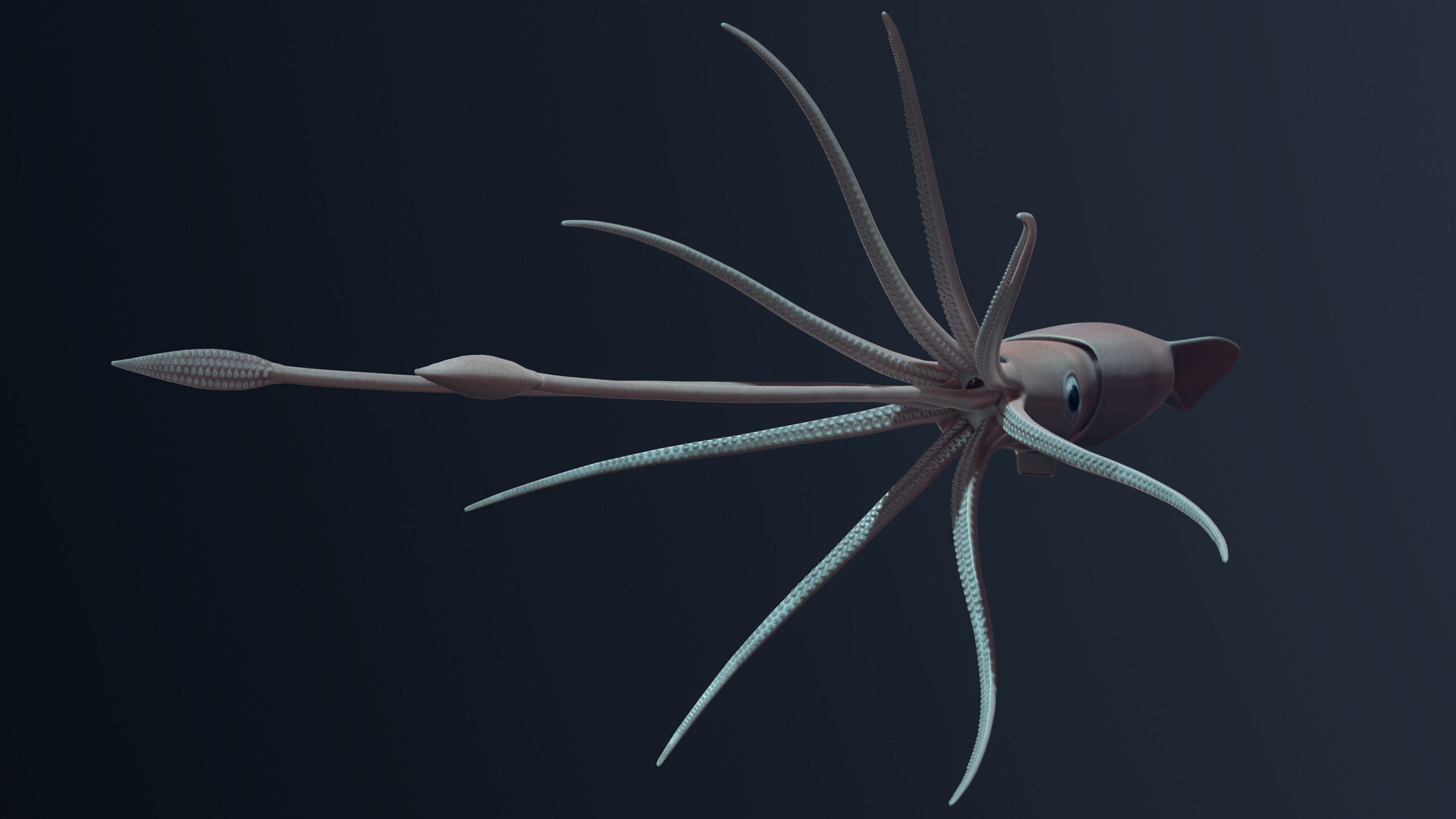
We are used to imagining invertebrates as small and insignificant creatures – those we usually encounter in everyday life rarely exceed a few centimeters. But some species are actually capable of achieving it impressive dimensions, capable of competing — despite the lack of an internal skeleton — with many vertebrates. The colossal squid (Mesonychoteuthis hamiltoni) – with a weight that can reach i 500kg – in fact inhabits the ocean depths and was filmed for the first time in its natural habitat only in March 2025. These dimensions can only be reached in the depths of the sea: on land, there are in fact physical limitationssuch as gravity and oxygen density, which put a damper on the size of invertebrates on land. This has not stopped some of them from reaching record sizes.
The colossal squid and the giant squid: the differences
The largest invertebrate creatures are found in the sea, and the existence of the largest of them all has been shrouded in mystery and legend for centuries. Both the colossal squid (Mesonychoteuthis hamiltoni) which the giant squid (Architeuthis dux) can reach impressive overall lengths, between 10 and 13 meters (consisting largely of very long tentacles). They have a typical cephalopod anatomy with a mantle for movement, gills, chitinous beak, 8 arms and 2 tentacles. However, they have differences in terms of size.
The colossal squid can weigh up to 500kg while the giant squid is slightly smaller and reaches up to 300kg. The very rare sightings of the latter have fueled rumors and speculation for decades krakenleviathans and other marine monstrosities.
Such dimensions can only be reached in water. This in fact provides hydrostatic supporteffectively canceling gravity: an invertebrate without a skeleton can grow in this way without risk of structural collapse. The squid’s body, supported by external pressure and an efficient muscular architecture, can thus reach sizes that are unachievable on land.
The coconut crab, the land giant
Out of the water the situation changes radically. On the mainland the largest extant invertebrate is the coconut hermit crab (Birgus latro), a decapod famous for its very powerful claws capable of breaking coconuts and climbing palm trees. Reaches i 40 cm long and 1 meter leg opening, and a weight that can exceed the 4kg in the most massive specimens. Remarkable dimensions but far from those reached by marine invertebrates. In the absence of an internal skeleton, the carapace must support the entire weight of the animal, but if it grows excessively it becomes so heavy that impede locomotionmaking the trade off between size and movement no longer advantageous.
Other record-breaking land invertebrates include the centipedes Scolopendra gigantea (30 cm long), among insects the stick insect (the genus Phryganistria exceeds 60 cm in length) and the giant weta (genus Deinacridaup to 70 g in weight) and among molluscs the record goes to the giant African snail (Achatina achatinamore than 30 cm and 900 g in weight).
Another limiting factor to growth in size on land has to do with the breathing. Terrestrial arthropods do not have lungs but instead rely on a tracheal system that functions by passive diffusion of gas through openings on the body’s surface. The surface/volume ratio and the thick exoskeleton would make it increasingly difficult diffusion of oxygen towards internal tissues as the body grows in size. The result is an evolutionary compromise that keeps the size of terrestrial arthropods relatively small.
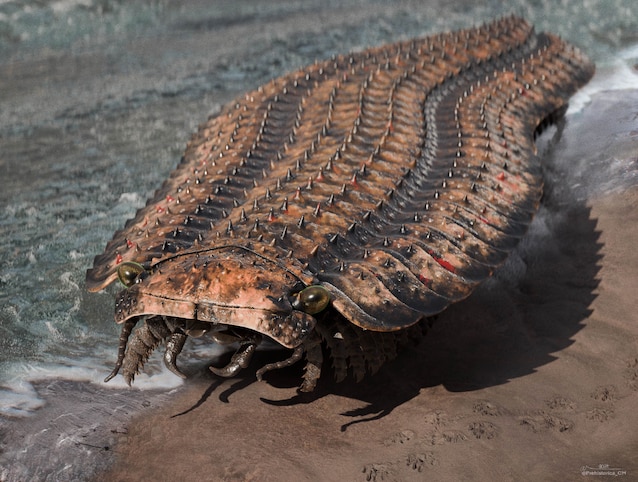
Credit: Prehistorica CM, CC BY 4.0, via Wikimedia Commons
Arthropleura, the colossus of the past
Under conditions of higher oxygen density, however, the situation changes. During the Carboniferous, when the percentage of atmospheric oxygen was significantly higher than today, tracheal diffusion respiration was more efficient and the gigantism among terrestrial invertebrates it was not at all rare. In the forests of 300 million years ago there was in fact theArthropleuraa giant millipede up to 2.5 meters long and with an estimated weight of over 50 kg. Big as a small carthis animal fed on debris and small prey and is thelargest terrestrial invertebrate that ever existed – today these dimensions would not be possible given the current density of atmospheric oxygen.
