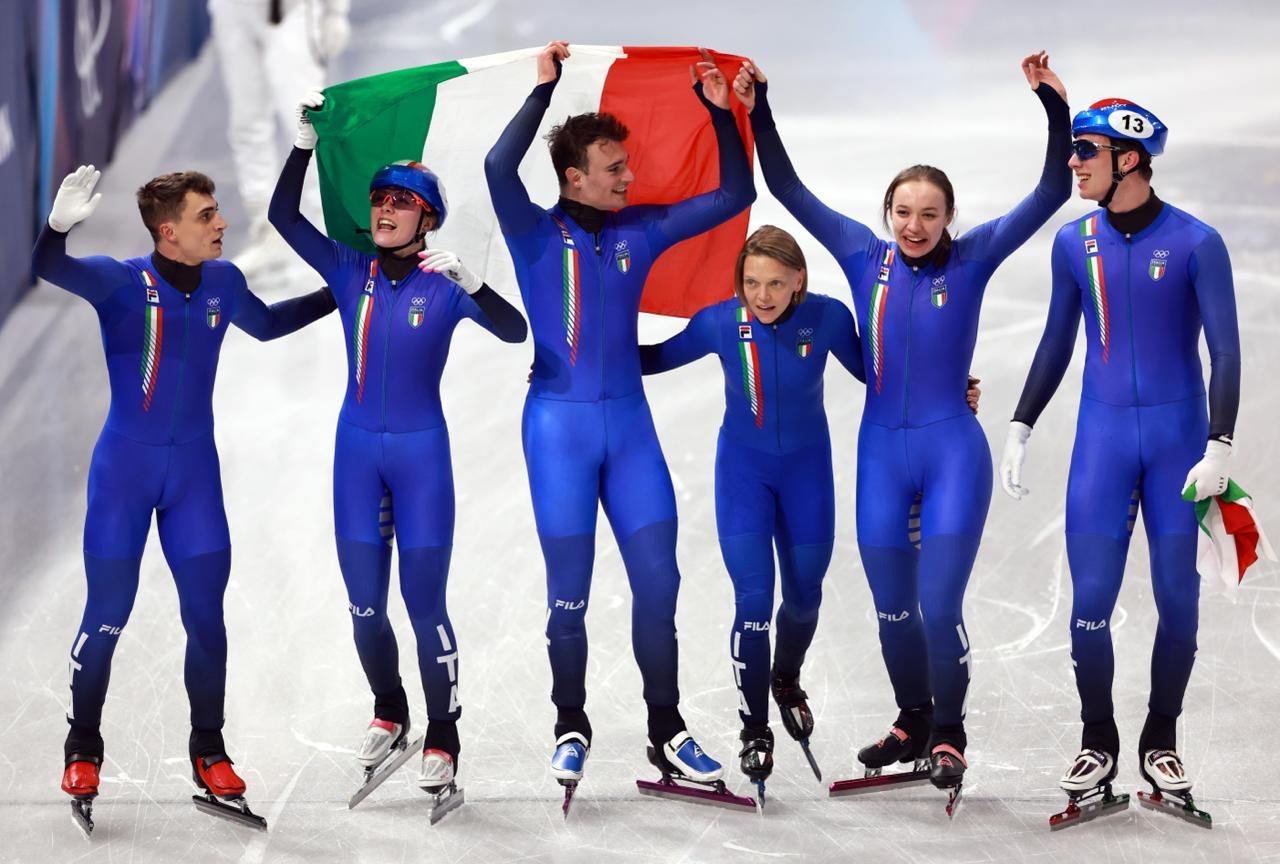
Italy had never won so much at the Winter Olympic Games. It was in Milan-Cortina surpassed the historical record of the 20 medals won at Lillehammer 1994, a result that for years had seemed almost unattainable. And instead it arrived, with good 30 total medals (10 gold, 6 silver and 14 bronze) a haul that has grown day after day and which has redesigned Italy’s place in world winter sport. The final medal table sees the Azzurri in fourth place behind only Norway (41), the United States (33) and the Netherlands (20 with 10 gold and only 3 bronze). But to really understand how it was possible it is not enough to stop at the final number: we need to look at where these medals come from, how the movement has evolved over the last twenty years and why this result says something bigger than a single Olympics.
All the medals won by Italy at the Olympics: the new record
The first comparison that can be made is with the last home Games, those of Turin 2006. On that occasion Italy did not fare particularly well, finishing with 11 medals: 5 gold and 6 bronze. A result that arrived after difficult years and which improved on the four golds from Salt Lake City 2002 and the two from Nagano 1998, but which did not represent a real leap in quality. Indeed, after Turin came an even more complicated phase: in Vancouver 2010 there were just five medals, with only one gold won by Giuliano Razzoli in the special slalom, which still remains the last Olympic title for men’s alpine skiing. In Sochi 2014 the medals rose to eight, but without even a single gold.
Then, slowly, the ascent. In 2018 there were 10 medals, in 2022 in Beijing they became 17, and now the definitive leap with the absolute record of 30 medalsof which 10 gold. Continuous growth, built over time, with a trend that does not only concern winter sports. Even in the Summer Olympics Italy is experiencing a historical period: 40 medals in Tokyo 2020, an absolute record, then surpassed in Paris 2024, again with 40 medals but with more golds, 12 against 10.
It’s a clear signal: it’s not just a question of snow, ice or mountains, but it is the entire Italian sports system which is experiencing a phase of transversal growth. While our “national sport”, football, struggles to bring high-level results on the international field, the so-called “minor” sports are showing us that the Italian athletes are among the best in the world in many disciplines.
The push of the Games at home and the unexpected exploits
Regarding the great result obtained by our standard bearers in recent days, have Home Games it has certainly given a boost and the field factor counts: less travel, more familiarity with the structures, the public in favor, teams qualified by right in team sports that can concentrate on Olympic preparation without the anguish of having to snatch a pass. But this alone is not enough to explain such a record. Before the Games, analysts believed it was possible to exceed 20 medals, but it was considered very difficult to improve the 7 gold medals in 1994. The predictions were not only respected: in many cases they were exceeded. In many races in which Italy started with the possibility of a medal, that medal actually arrived.
There were also unexpected exploits. The four medals that came from the sled, including two golds, surprised even the experts and tell a good story of how the work behind the scenes works. He is leading that movement Armin Zöggelerone of the greatest sledders in history, capable of winning six consecutive Olympic medals and today technical director of the national team. His role has been decisive in transmitting experience and skills to a new generation of athletes.
Then there are individual stories that explain this result well. Like that of Federica Brignone, capable of winning two gold medals despite a serious injury that had kept her away from the slopes for almost a year and which had seriously put her career at risk. Or the same number of heavy metals won by Francesca Lollobrigida in speed skating, a discipline in which Italy once again became a protagonist at the highest levels, winning 3 golds and 2 bronzes in total.
The balance between veterans and new recruits
However, one of the most interesting interpretations is the perfect fit between different generations. On the one hand there are the veteransathletes who have kept the level high for years and who have brought experience and solidity to these Olympics too. Arianna Fontana continues to be the symbolic face of Italian short track, and has become the most medaled Italian ever at the Olympic Games with 14 medals in 6 editions of the Games. Dominik Paris has confirmed itself as the point of reference in the fast disciplines of alpine skiing. Dorothea Wierer it has represented the heart of Italian biathlon for years. They are athletes accustomed to the Olympic pressure and capable of acting as a driving force for those who arrive later.
Alongside them is the generation at the height of their careers: Federica Brignone, Sofia Goggia, Michela Moioli, Dominik Fischnaller and Lisa Vittozzi, athletes now in their third Olympics or more, in the perfect moment of their sporting maturity. And then the young people, those who are starting to reap the first important results and who are giving depth to the movement. Giovanni Franzoni – silver in the downhill – is one of the faces of the change in alpine skiing, but the growth also concerns the many relays and freestyle disciplines, which in recent years have begun to bring results with greater continuity.
The “Turin 2006 generation” and the results in many different disciplines
Behind these results there is also a symbolic aspect: many of the protagonist athletes today belong to what can be called the “Turin 2006 generation”. Boys who were children at the time, who saw the Olympics in Italy for the first time, became passionate about the disciplines seen on TV and today find themselves in the midst of their sporting careers. It is a mechanism that has already been seen in other sports, with entire generations approaching a discipline after having experienced great events or seen the exploits of prominent athletes, as has been happening in recent years. with Jannik Sinner and the boom in registrations for tennis clubs.
Behind all this there is also a more structured preparation than in the past, with four-year programs, targeted investments and a big push at the level of individual federations to try to make a good impression at the Olympics on home soil.
But there is also another element, often underestimated, which helps to explain the record: Italy has won in many different disciplines. And this is a huge difference compared to other large nations.
There Norwaywho finished in 1st place in the medal table, traditionally builds much of its success on cross-country skiing and biathlon. THE Netherlands they dominate in speed skating and short track, with 20 medals including 10 golds won in just two disciplines. There France he won 13 medals in biathlon, including 6 of his 8 total golds.
Italy instead distributed the medals among 10 disciplines: alpine skiing, biathlon, short track, figure skating, speed skating, cross-country skiing, snowboarding, curling, freestyle skiing and sledding. We are not a nation that dominates a single sport, but we are competitive in many different disciplines, a sign of a varied and widespread movement made up of many small federations which, despite a great lack of structures, manage to shape athletes capable of competing for an Olympic medal. Furthermore, 11 medals came from relay or team races, another sign of how the movement as a whole is in excellent health, without the need to cling to a few champions.
The more medals up for grabs, the more nations capable of winning them
In the comparison with Lillehammer 1994 there are also other values to consider, such as the quantity of medals up for grabs and participating nations.
At the ’94 Games, when Italy won 20 medals, there were 67 golds up for grabs. In Milan Cortina they were as many as 116so it is logical to think that it is normal, and simpler, to win a greater quantity of medals. The position in the 2026 medal table is also the same as in 1994, with an excellent fourth place.
Despite this, it should be considered that 30 years ago the medals ended up around the necks of a few nations, while now, with more than 90 countries at the start of the Winter Games, the competition is more fierce and varied. Just think of countries like China, Japan or the Netherlands, far from the radar of winter disciplines in the 80s and 90s, but capable of winning dozens of medals in the latest editions of the Games.
Milan-Cortina 2026, for our colours, is therefore not the Olympics of a single protagonist. Of course, there are feats that will remain in the memory, such as those of Federica Brignone and Francesca Lollobrigida with two gold medals each, Arianna Fontana’s record of personal medals or the sledding exploits, but this record did not arrive by chance, it is the result of a twenty-year long journey, made of investments, growth and generations that overlapped at the right time. And we hope that it will also be a new starting point, with many young people who have been excited in these two weeks and will be able to make us dream in 15 or 20 years.
The next winter event is in 4 years not far from home, in the French Alps (with some races also in Turin), but who knows, maybe the next record will arrive in a couple of summers, at the Summer Games in Los Angeles 2028.
