
What do the periodic table and song have in common Yesterday and the novel Frankenstein? All these works, according to what their respective authors told, were born thanks to creative intuitions that appeared in a dream. But can dreams really generate original ideas useful for a specific purpose or is it just a fascinating suggestion? A new study conducted by Northwestern University and published in the journal Neuroscience of Consciousness he might have found a way to address this question. Using a technique called TMR (Targeted Memory Reactivation), which allows you to reactivate during sleep memory traces learned while awakeresearchers observed that when a puzzle that remained unsolved while awake was “recalled” during REM sleep (when dreams occur), the likelihood that participants would be able to solve it upon awakening increased. In short, despite different limits that the authors themselves point out, this study is a first step that could demonstrate that when a problem torments us, perhaps there is no better strategy than… sleep on it!
How to “enter a dream” in the laboratory: the experiment
Let’s be honest: one of the things that makes dreams so fascinating is theirs inaccessible dimensionon which (except in exceptional cases) we cannot have no control. Yet, American researchers seem to have found a trick to “open a breach” in the dream world, using a technique called TMR (Targeted Memory Reactivation), which allows you to specifically reactivate a memory trace formed while awake, partially orienting the content of dreams.
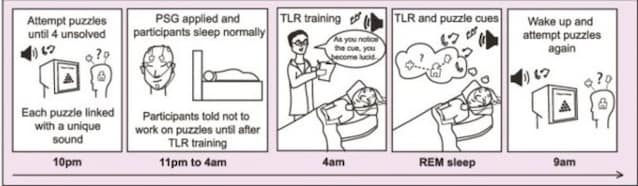
To this end, twenty participants invited to the laboratories of Northwestern University were put to the test with a series of difficult puzzles (similar to those we propose on Geopop), associating each puzzle with listening to a specific melody. Once the association was consolidated, the participants came invited to fall asleep, while a polysomnography (an instrument that records brain activity and other physiological parameters) constantly monitored the state of sleep.
CC BY–NC 4.0
Once you enter REM phase (in which brain activity is more similar to waking and dreams become more vivid and narrative) the researchers applied TMR reproducing one of the melodies associated with an unsolved enigma, with the aim of encouraging its appearance in the dream. The result? Upon awakening, participants undergoing TMR were more likely to report having dreamed of working on that puzzle and, the next morning, they showed a higher probability of be able to solve itoften through new and creative solutions.
Why (despite its limitations) this study could be important
While interesting, this study presents several limitsas the authors themselves rightly point out. First of all, it small number of participants: only twenty! Furthermore, TMR was only applied to the REM phase: the contribution of the other sleep phases to this ability to solve puzzles once awakened is therefore unknown.
Which is true role of dreams It’s a question that science has always asked itself, but only found answers based on speculative hypothesesoften lacking solid and repeatable experimental evidence. Despite the methodological difficulties in studying the dream world, today many dream researchers maintain that dreams, especially those that occur during REM sleep, could facilitate the appearance of creative intuitions. On the other hand, several studies have shown that during the REM phase the brain reorganizes circuits related to memory“taking apart and putting together” our memories, paving the way for new ideas and associations unexplorable while awake, under conscious control.
This study, although with obvious limits, however, he remains the first to provide a possible experimental indication that dreams in REM sleep actually might stimulate creative thinkingpushing us to explore reasoning and connections that escape us in the conscious state.
