
A new study of the CNR Published in the magazine Solid Earth demonstrates a hypothesis already developed in the past, according to which the Direct cause of Bradisism at Campi Flegrei It would not be magma, but thewater of meteoric origin accumulated in the subsoil of the Caldera, between about 2.7 and 4 km deep. These fluids, heated by the gases issued by the magma, of expander and exercise one considerable pressure. The consequences are the increase in deformation and seismicity. Such a high pressure of fluids in the future could result in potentially dangerous phenomena, which involve sudden emission on the surface of steam, water and rocky fragments with “mud flows boiling and debris “that take the name of Freatic explosions.
The study on the Aquifer at the origin of Bradisism
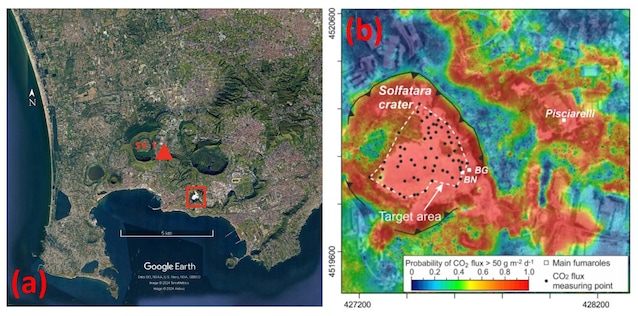
The study, conducted by the CNR in collaboration with the Steam company, specialized in the development of geothermal energy technologies, focused on Fluids emitted by flues of the Solfatara. In fact, their chemical and physical characteristics provide clues to the underground environment from which they originate. The data acquired on the surface were integrated with those obtained thanks to the geothermal wells made in the 70s and 80s, up to 3 km deep.
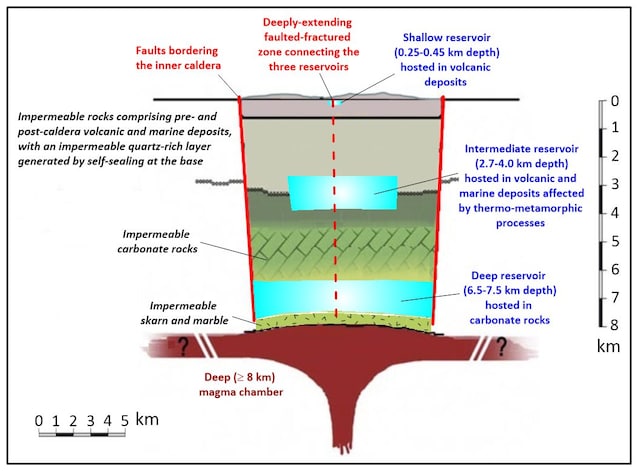
In this way it was possible to reconstruct a Caldera model Which shows its structure in depth, highlighting in particular the distribution of aquifers. Under the Solfatara they are present three buyers at different depths. That responsible for bradisism would be theintermediate aquiferplaced at a depth included Between about 2.7 and 4 km. In the pores of his sediments there is one mixture of water, steam and carbon dioxide which is heated by the gases emitted by the magma located deeper. These fluids, once heated, they expand and thus exert a pressure on the surrounding rocks. The presence above the intermediate aquifer of one layer consisting of waterproof rocks which acts as a seal causes fluids to find it difficult to find an escape route. The result is that the pressure increases enormously, causing the deformation of the waterproof layer up to the breakdown of the rocks, accompanied by earthquakes.
The potential risk of frieze explosions
The pressure condition in which the aquifer is currently could cause Freatic explosionsa phenomenon contemplated by yellow alert level (Middle sinking subelvelaccording to the new planning strategy for the volcanic risk of the Campi Flegrei) in which the Caldera area is now located. Freatic explosions occur when the overheated underground water turns into steam suddenly: this happens when fractures are formed through which the water can go up, therefore when you have a decrease in pressure. In this case water and steam, together with rocky fragments, are released on the surface with an explosion. It is a localized phenomenon that does not involve magma, but potentially dangerouswhich cannot be foreseen due to its sudden nature. This was favored by the weakening of the waterproof layer, which subjected to prolonged stress fractures. Claudia Principe of the CNR – Institute of Geosciences and Georisorse and co -author of the study, he says:
If an event of this type occurs, it would determine the formation of mud flows hot and debris that would rapidly pour outside the source area, would travel the morphological bass and would head towards the coast line, as already happened in the past at the Solfatara
To manage the risk of Freatico explosions, the authors of the study argue that, in addition to monitoring the temperature and pressure of the intermediate aquifer, the geothermal wells to reduce pressure inside the Aquifer. It is a topic controversial Since, as other Ingv researchers claim, this solution would result in interfere with the delicate system of the Campi Flegreiwith the possible trigger of earthquakes and the same Freatic explosions, in addition to the spread of harmful gases in the atmosphere.
