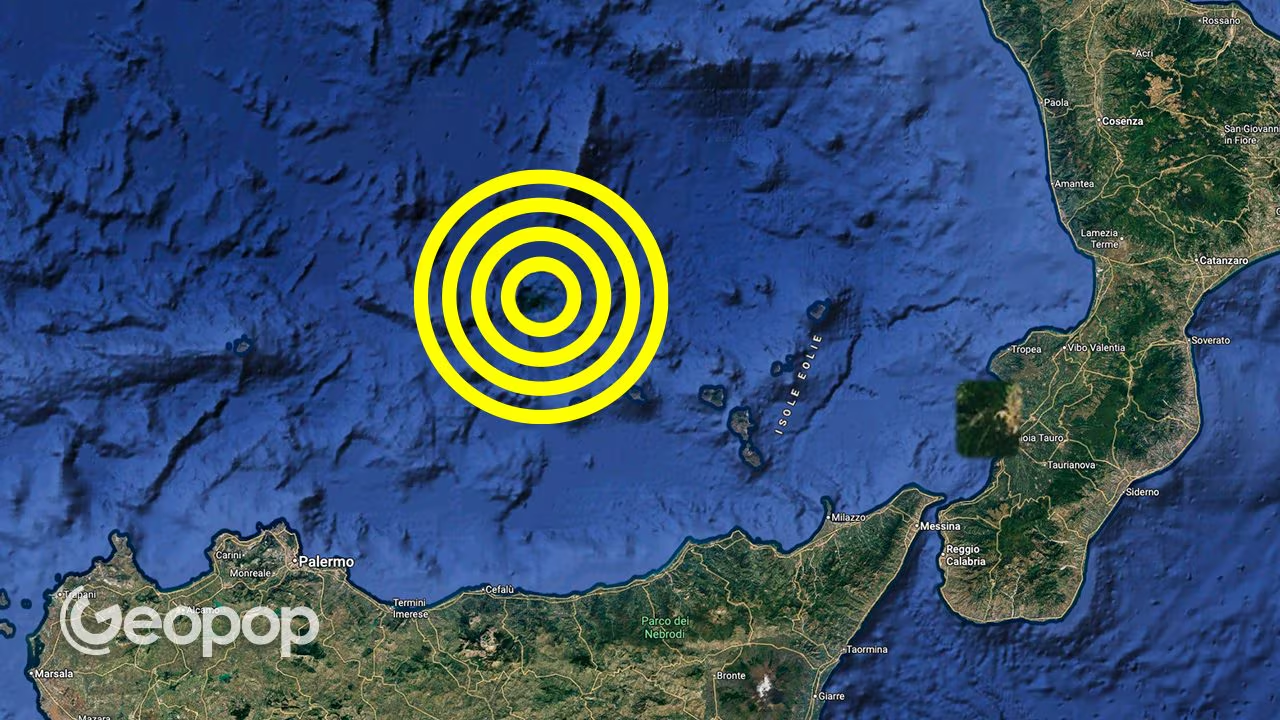
The ongoing seismic sequence in the Southern Tyrrhenian Sea is not related to the activity of the Marsili volcano, according to INGV experts. Today’s earthquakes – the strongest of which was Mw 5.5 in magnitude – therefore seem to be linked to the fault system, in an area of high seismic danger: in March 2026, a seismic sequence with just over 50 earthquakes occurred in the area.
Following the numerous earthquake shocks recorded in the Southern Tyrrhenian Seaof which the strongest in magnitude MW 5.5 (according to the latest revised estimates from INGV) several questions have started to circulate regarding a potential bond with the underwater volcano Marsilithe largest in Europe.
To shed light on the topic, we interviewed Lucia MargheritiDirector of the National Earthquake Observatory (INGV), e Guido Venturaresearcher at the Institute, who provided us with an analysis of the current situation, the monitoring status of the volcano and what we can likely expect.
Is there a correlation between today’s seismic sequence and the Marsili Volcano?
Let’s start by saying that the Marsili volcano is not monitored in real time. At the bottom of the Tyrrhenian Sea there are some deep seismographs (OBS) that record seismic activity, but an underwater monitoring system is actually missing, as it is also a less active volcano than Etna or Stromboli, which are constantly monitored.
«What we know is that it is there continuous hydrothermal activitycharacterized by gaseous emissions and very low energy but very intense microseismicity, which is typical of hydrothermal systems. This activity, however, accompanies the history of Marsili since measurements have existed: This is not an anomaly and there has been no recent change in this respect,” explained Ventura.
As for earthquakes, the current sequence is occurring in one seismic band already known and active (with earthquakes equal to or greater than magnitude 5.0), which is indicative from Ustica to the Aeolian Islands: looking at the distance between the epicentral area of today’s sequence and the Marsili volcano, there does not appear to be any direct relationship.
«Another element that makes me think that the earthquake is not correlated with the Marsili is the fact that this earthquake (editor’s note: today’s 5.0 magnitude shock, then reevaluated to magnitude Mw 5.5) is related to a phenomenon of compression. Marsili is affected by volcanism linked instead to a phenomenon of relaxation, a separation of two parts of the earth’s crust, as if it were the beginning of an oceanic ridge”, specified Dr. Margheriti.
Today’s earthquakes, therefore, seem more related to fault system. Among other things, the director of the National Earthquake Observatory reminds us that a similar seismic sequence occurred in the area as early as March 2026, located around 15 km west of Alicudi, with little more than 50 earthquakes. The strongest earthquake magnitude ML 4.6 (MW 4.7) occurred on the night of March 21, 2026.
Can these tremors in any way influence the volcanic activity of Marsili or the Aeolian Islands?
According to researcher Ventura, this is «an aspect that will go verified in the next few months. Sometimes hydrothermal volcanic activity can undergo variations following seismic events, perhaps manifesting increases in gas emission flux or microseismicitybut this depends on several variables, including the type of rock, the magnitude of the seismic event, its depth and the value of the rising gas flow in the volcanic system.”
How many more earthquakes should we expect?
Both experts agree that seismicity will continue in the next few hours: clearly, it is not possible to make exact predictions about earthquakes or their magnitude, but the area affected by the ongoing sequence is close to the area of the Aeolian Islands, a region characterized by high seismic hazard. Earthquakes of even greater magnitude cannot therefore be ruled out.
Among other things, Dr. clarified Margheriti, «the area of today’s seismic sequence has already been hit by several seismic events, some of which have a magnitude equal to or greater than magnitude 5, including the earthquakes of 28 May 1980 (Mw 5.7), 20 May 1957 (Mw 5.2) and 21 May 1957 (Mw 5.3)”.
