You’re watching Yellow Mirror Don’t miss out on more content from Geopop

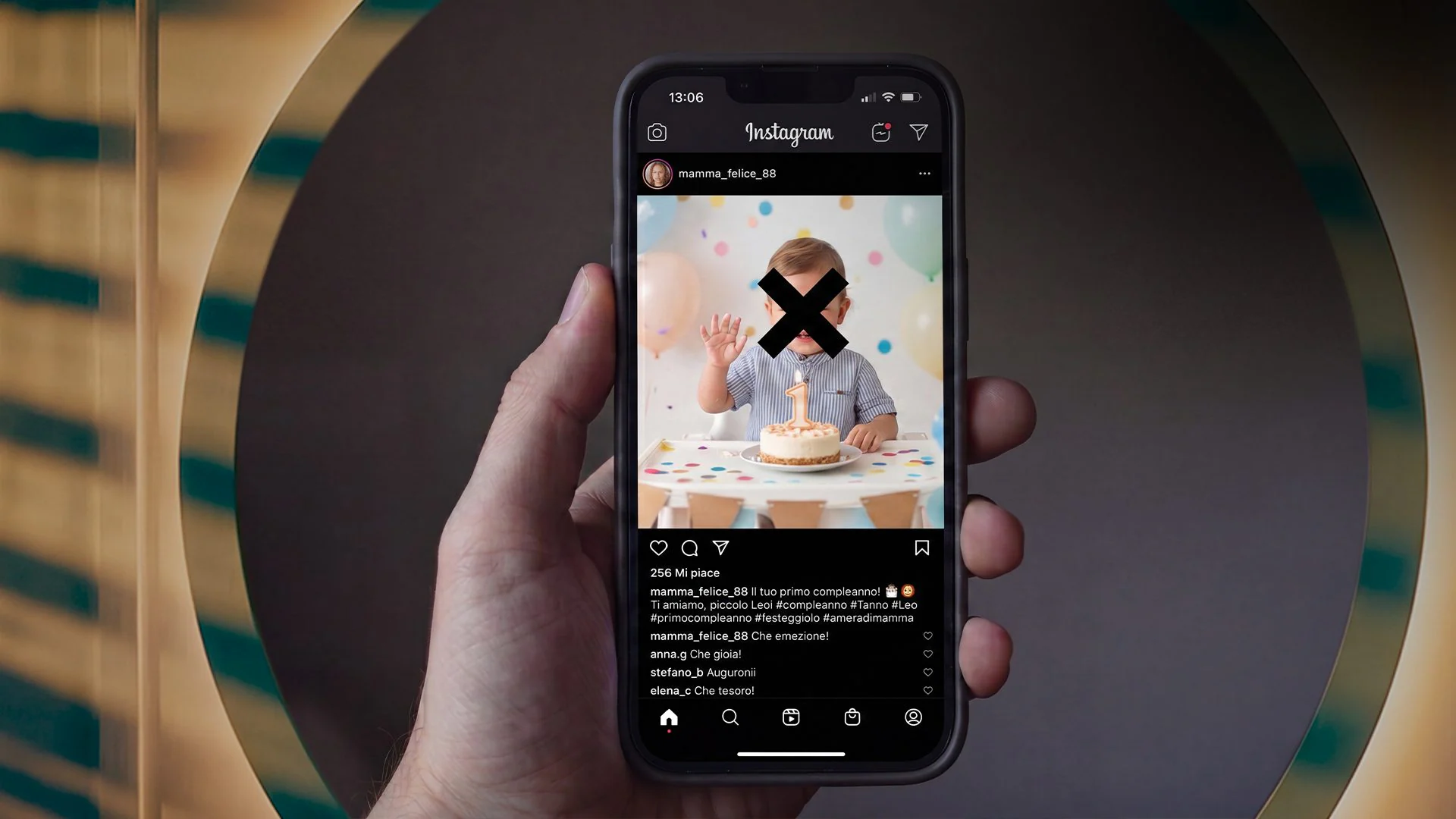
The debate around the risks of posting children’s photos online has become so relevant that a specific term was born: sharenting (from the portmanteau of the English words share and parenting). The numbers speak for themselves: 75% of parents who have a social profile regularly share content with their child protagonists. On average, before a child’s fifth birthday has already appeared online in around 1,500 postsand a third of these children appear there for the first time on the day of their birth.
Let’s be clear right from the start: we are not here to judge. Almost all parents make this gesture out of love, out of a desire to share a happy moment or to keep distant relatives updated. The posts simply replaced the old family albums. However, most people who do it don’t know the real and technical risks that this practice entails. We often talk about it with exaggeratedly alarmist tones, but there are concrete dangers that are worth knowing about to protect people who are assigned a social presence even before they can choose for themselves.
Before going into the merits, a distinction is necessary. We are not talking about the so-called family influencers or vloggers, i.e. those who build an entire career and business around the documented lives of their children. That is a separate issue, with enormous ethical and legal implications (in Italy, for example, no law yet protects those children economically, unlike in France or the USA). Here we talk about normal parents, in total good faith: those who have a few hundred followers, those who update their Instagram stories or those who send the photo to their relatives’ WhatsApp group, without imagining the possible technical consequences.
The illusion of the private account and WhatsApp
The idea that a social profile set as “private“really protects a child’s identity is an illusion, because the moment you upload a photo to platforms like Instagram or Facebookthat image stops being just ours. The ones who betray us first and foremost are invisible metadata: every shot taken with a smartphone brings with it hidden information such as datetheNowThe phone model and, if active, the exact GPS coordinates, so much so that a simple souvenir photo in front of the school can reveal to anyone the precise location of the building.
Added to this is the rapid loss of control. An account with a few hundred followers may seem reassuring, but anyone in our circles can make one screenshot or download the image; in fact, it only takes one “friend” to have a compromised phone for the photo to escape from that apparently safe enclosure. And let’s not fool ourselves about it staying onlinebecause a deleted photo never disappears completely, it may have been saved a fraction of a second before or definitively indexed by search engines. Neither WhatsApp represents a completely safe haven. We often consider it an armored alternative, but it is only partially so. If it is true that the end-to-end encryption effectively protects the message as it travels from one phone to another, keeping it safe from hackers, the real problem lies not in transit, but in the destination. In fact, once it arrives on the recipient’s device, the photo becomes clear again: at that point it can be saved in the gallery, forwarded to other groups or automatically end up saved in the cloud of third parties, causing us to totally and irremediably lose control.
What sharenting means and what are the risks
But what are, in practice, the dangers linked to the overexposure of minors online? Setting aside unfounded fears, technical and psychological analysis has identified four real and documented risk scenarios, ranging from the illicit use of personal data to the impact on long-term identity and privacy. Here they are:
- Identity theft: it is the most underestimated risk, because its effects manifest themselves years later. Each photo is a piece of the puzzle: the name in the caption, the date of birth in the greetings, the name of the school on the backpack, the recognizable neighborhood. Over the years, these fragments form a complete personal profile that cybercriminals use to open bank accounts or apply for loans in the name of a minor. In the US, nearly one million children were victims of identity theft in 2020. The biggest pitfall? It is discovered only when you reach the age of majority, when you find yourself with debts you have never incurred.
- “Digital Kidnapping”: consists of stealing photos of a minor from their parents’ profiles for create a fake identity online. These images are used for illicit purposes: fictitious role-playing games, false fundraising for non-existent illnesses or to lure other minors by pretending to be their peers. There are also cases (documented by the FBI) of scammers who fake fake kidnappings using social media photos to extort money from families.
- Deepfakes and AI manipulation: it is the most current risk. With today’s artificial intelligence software (the so-called nudifier), it’s possible to take a banal photo of a clothed child and generate a sexually explicit version of it in seconds. An investigation by the Cosenza Prosecutor’s Office in 2025 brought to light the case of around 1,200 photos of girls (taken from their social networks) manipulated and spread on Telegram by their peers. Even an innocent photo can unfortunately become starting material for these alterations.
- An unchosen digital identity: a child born in 2018 will find himself an adult with 18 years of life documented online, without ever having chosen it: crying fits, embarrassing moments, baths. 12% of European children have already asked their parents to remove content that concerns them. To deal with this problem, a bill is also being discussed in Italy to introduce the right to digital oblivion from the age of 14allowing minors to demand the erasure of their “footprint” left by their parents.
What is not proven and what Italian law says
Correct information also requires dismantling the unjustified alarmism that often circulates on the topic. For example, it is misleading to believe that i pedophiles typically use photos posted by parents for solicitation, since the so-called grooming it almost always develops through direct contact with the minor. Likewise, there is no elusive mass tracking taking place through children’s irises: although this biometric technology exists, it is absolutely not applied systematically to normal photos posted on social media. Finally, it should be made very clear that posting an image is not the same as triggering immediate physical danger. The vast majority of content shared online does not generate any negative consequencesprecisely because the risk linked to these practices is probabilistic and diluted over time, certainly not a mathematical automatism.
In Italy There is no specific law yeta on sharenting, but jurisprudence has already set very clear boundaries, establishing first of all that posting a photo of a child always requires the consent of both parents. Several courts have already intervened harshly in cases of disagreement between mothers and fathers. In 2017, for example, the Court of Mantua has established that publishing photos of children is “potentially harmful” behavior, so much so that today those who separate in that city sign a standard ban on the publication of images of minors. In the same year, the Court of Brescia has taken a further step, extending this ban even to images used as profile photos on WhatsApp. Even more striking was the decision of Court of Rome of 2018, which sentenced a mother to compensate her son with well 10,000 euros for the social damage caused by the obsessive and continuous publication of details about his private life.
There is no absolute answer and technology must not paralyze us. There’s only one question worth asking yourself before hitting the publish button: Who am I really sharing this photo with? And in fifteen years, will my child agree with this choice?
Sources
MU Extension, University of Missouri (2025)
Conti, G., Di Questo, P., Ferrigno, L., Salerno, G., & Vitali, M. (2024). Sharing and privacy risks: an Italian perspective. BMC Pediatrics Javelin Strategy & Research (2021). Child Identity Fraud Study. BBC Trending FBI Global Threat Assessment 2025 La Scuola Oggi (2025) MediaLaws (2023) UNICEF Italia (2026)
