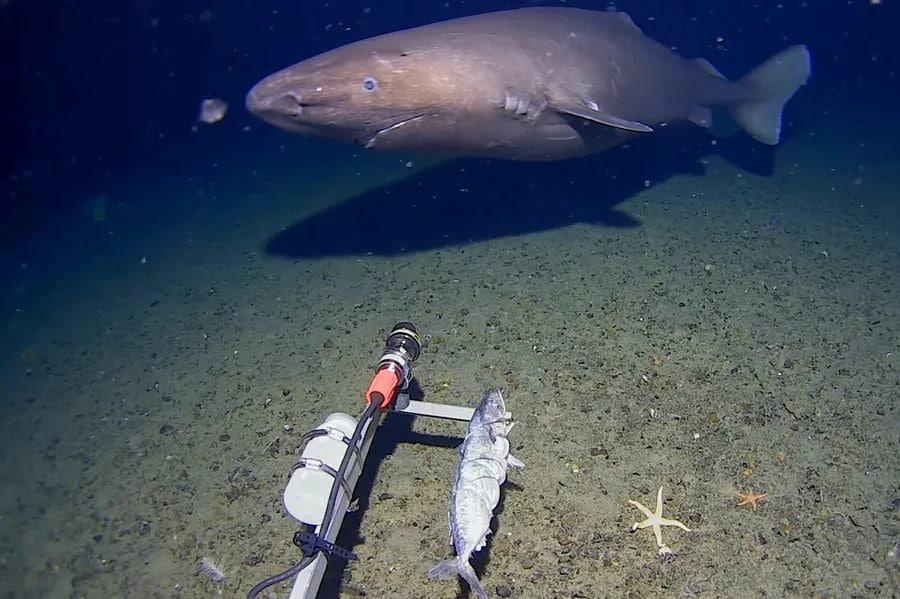
A southern sleeper shark (Somniosus antarcticus) was spotted for the first time in the deep, cold waters ofAntarctica. The sighting, possible thanks to a decoy camera from Dal Minderoo–University of Western Australia (UWA) Deep-Sea Research Centreis the southernmost one ever of this elusive species. Although the news is circulating these days, the footage of the 3 to 4 meter long specimen was carried out by researchers in January 2025 in a trench in the Southern Ocean about 490 meters deep off the South Shetland Islands at a temperature of 1.27°C. Somniosus antarcticus it is part of a large family of large sharks characterized by spotted skin and small fins that live in the ocean from the surface to thousands of meters deep. He is related to Greenland shark (Somniosus microcephalus), one of the longest-lived animals in the world capable of living around a 400/500 years.
The importance of this encounter is explained by the fact that sharks, present in almost all marine ecosystems in the world, were thought to be absent in these remote, freezing waters with sub-zero temperatures. Climate change may have altered this extreme habitat, opening new routes for these large predators.
The video of the shark in the icy depths surprises the scientific community
In January 2025, a baited underwater camera deployed by the Minderoo-UWA Deep-Sea Research Center recorded video at 490 meters deep off the South Shetland Islands: the surprise appearance of a southern sleeper shark (Somniosus antarcticus). The rare images show a specimen between 3 and 4 meters long, presumably female, swimming slowly in a current about 2°Carousing the direct amazement of the researchers. DNA tests to confirm any shark-specific information have yet to be done.
This footage represents the most southerly sighting ever documented for the species, overturning the belief that the frigid Antarctic waters are free of sharks. The species was known from the subantarctic area between Macquarie, Heard and McDonald Islands.
As highlighted by the researchers: «This changes what we know about the distribution of sharks and their ability to tolerate extreme environments. The Southern Ocean may not be as shark-free as we once thought».
Southern sleeper shark, relative of the Greenland shark: characteristics
The southern sleeper shark (Somniosus antarcticus) belongs to the class Elasmobranchii (sharks and rays) and to the family Somniosidae. The name is explanatory, it derives from Latin Somniosus – sleepywhich reflects their slow movement due to their relatively small dorsal fins and their slow metabolism which gives them a “lazy” appearance unlike better known sharks such as the white shark or the mako shark. Information on these marine animals remains limited due to very rare sightings. Most of the data, in fact, comes from accidental catches during fishing, since studying this shark in its abyssal habitats represents a logistical challenge for researchers.
It is a species that usually moves in waters whose temperatures vary from 0.6 at 12°Cat estimated depths between 400 and 1,150 meters. As for size, they are giants of the deep, they can exceed 4 meters long and have a massive body with a short, rounded snout. Sleeper sharks are deep-sea predators and their diet includes fish, cephalopods (including the colossal squid) and carcasses of marine mammals that settle on the seabed. They have a very slow metabolism and can go a long time without eating.
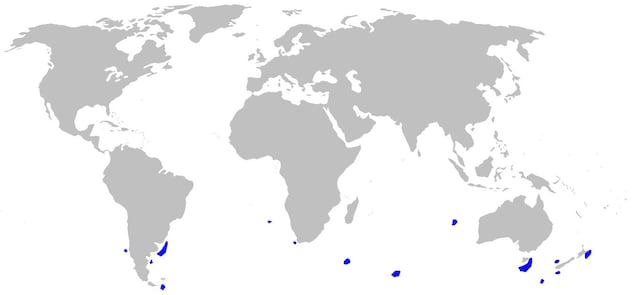
In the same way as Greenland’s long-lived “cousins”, too Somniosus antarcticus lives a very long time, it is estimated up to 250-300 years. How easy to understand, it is considered harmless for man given that, in addition to living at inaccessible depths, he is a passive animal that offers very little resistance even when captured.
Because there aren’t many sharks in Antarctica
For decades it was believed that sharks could not live in Antarctica for several reasons. Extreme cold slows down metabolism, making survival difficult for sharks who must swim constantly. Unlike Antarctic bony fish, which over time have developed special antifreeze glycoproteins to survive icy waters, sharks (which are cartilaginous fish) lack this adaptation and may have severe physiological limitations. Added to this are the food shortagethe isolation of ocean trenches and extreme currents.
The recent video of a sleeping shark opens up new scenarios and hypotheses. The specimen may have exploited a “thermal corridor”a slightly less cold intermediate current (around 1.2/2 °C). As we have seen, both Somniosus antarcticus and its relatives Somniosus pacifucus and Somniosus microcephalus have a very slow metabolismand behaviors suited to darkness and pressure.
Its presence in this habitat could be favored by climate change and the consequent warming of the waters, or these sharks have always been there and simply had never been filmed. If the first hypothesis were correct (and it was therefore a “new entry”), the arrival of the predator would risk disturbing the balance of the Antarctic ecosystem, triggering a chain reaction that would alter the availability of food for other species.
