
A team of Australian researchers may have confirmed that i stone blocks of Stonehenge were transported by human beingswho would move them from their places of origin in Wales and Scotland toSouthern England. The large distances – even hundreds of kilometers – that separate the Neolithic boulders from the places where the rocks from which they come were formed had in fact led some scientists to hypothesize that the glaciers had played a role in their transport. In this case, along the way the boulders would have left behind traces of the minerals they are made of. The new study, published in the journal Communications Earth and Environment of Nature, shows instead how in-depth analyzes near Stonehenge have not detected any trace of it.
The new study on the glacial transport of stone blocks from Stonehenge
The rocks that make up the blocks of Stonehenge come from distant sites, in Wales and Scotland, as evidenced by their composition. According to theglacial transport hypothesisthe vast glaciers that once covered Great Britain could have torn large boulders from the bedrock upstream with their erosive force, then incorporated them and transported them to southern England. Subsequently, as temperatures increased, the glaciers retreated, depositing the boulders on the Salisbury Plain. Here, prehistoric men would have found them and arranged them to form the famous stone circle. If this were the case, there should be many mineral grains from the regions of origin in the area. So, to test the hypothesis, the researchers analyzed the river sands around Stonehenge.
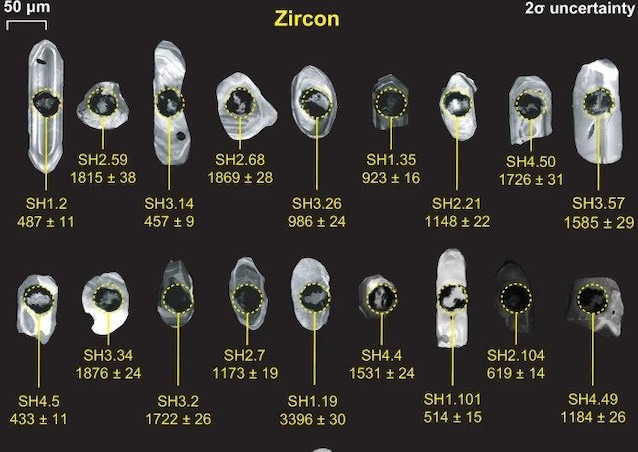
In particular, they took into account more than 700 microscopic mineral granules of apatite and zircon. These contain small amounts of radioactive uraniumwhich progressively transforms into lead taking a period of time known to us. It is therefore possible to identify how much uranium has been transformed into lead to date date the formation of these minerals. Since British rocks have very different ages from place to place, the age of these minerals also provides information about their area of origin. In this case, however, it was not found no match between their age and that of the rocks of Wales and Scotland from which the Stonehenge blocks come.
The implications of the discovery
Once the involvement of glaciers has been excluded, we can conclude that were men, between 3000 and 1600 BCto transport these blocks over very long distances. The blocks that form the outer circle, called “sarsen“, I am on average 4 m high, weighing around 25 tons and consist of sandstones whose place of origin is in the West Woods area a 25 km from Stonehenge. The smaller internal blocks, the “bluestones”, are instead dolerites coming from the Preseli Hills in Walesfar away 300km. Then there is the altar stone, a block of sandstone 6 tons in the center of the circle, which would even come from the North-east Scotland, 750 km away from the megalithic site. The ways and means by which Neolithic man managed to transport boulders for such surprising distances are still being studied. It is assumed that it was possible by exploiting a sea route on board boats, as well as by land using means such as slides and rollers.

