A date, interview or meeting with the boss and a nice pimple appears on your face? It will be stress! Not exactly. Let’s get one thing straight: Stress doesn’t make pimples appear out of nowhere. Pimples are a manifestation ofacnea complex and multifactorial pathology, influenced by genetics, sebum, hormones and bacteria. If these elements are not there, stress alone is not enough to make a pimple appear as if by magic, but it can act as an “helper”, worsening the signs and symptoms of acne and above all slowing the disappearance of the pimple. However, it is one two-way relationship: acne can promote anxiety and social difficulties, becoming itself a source of stress and fueling a vicious circle in which stress and illness reinforce each other, as the Istituto Superiore di Sanità (ISS) also reminds us.
Stress makes acne worse
Scientific literature shows that the link between psychological stress and acne rests on complex biological basessome of which are still difficult to understand. The onset of acne is mainly linked to four key factors: excessive sebum production, obstruction of the hair follicle due to dead cellsproliferation of the bacterium Cutibacterium acneif inflammation. When these four come together, they “plug” the hair follicle leading to the formation of blackheads, whiteheads and finally, inflamed pimples.
Stress can act a hormonal, inflammatory level and the integrity of the skin barrier, thus worsening an already critical situation. In short: stress activates the brain, the brain sends hormonal signals, the skin responds by producing inflammatory mediators, the sebaceous glands increase their activity and inflammation grows. The result is a weaker skin barrier and a greater chance of or appearing worsen acne lesions.
From the brain to the skin and back: research published in the Lancet
For years the link between stress and pimples was mostly anecdotal (we told each other about it), but more and more studies since the 2000s have highlighted the connection between skin and brain. And also intestine to tell the truth, the so-called brain-skin-gut axisa sort of private telephone line between these three bodies.
Indeed, a study published in the famous magazine as early as 1995 Lancet had highlighted how psychological stress could slow down wound healingconfirming direct communication between brain and skin. But we must not imagine the skin as a passive receptor of messages from the brain: it in turn responds and produces hormones and regulatory molecules.
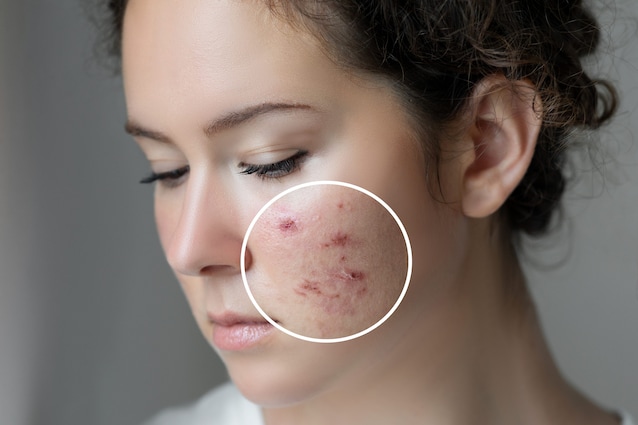
The molecules involved in the relationship between stress, brain and skin
Stress, even psychological stress, activates the axis hypothalamic-pituitary-adrenal and the sympathetic nervous system, inducing the synthesis and release of neurotransmitters, hormones and cytokines, inflammatory molecules. All these molecules have receptors also at the skin leveltherefore they directly influence skin health, for example by increasing sebum production. Among the most important molecules released in response to stressful stimuli we find the corticotropin-releasing hormone (corticotropin-releasing hormone, CRH) and the substance P.
The CRH
CRH is produced by the hypothalamus and begins the signaling cascade that will then lead to the production of cortisolthe infamous stress hormone. But its action does not stop here: when the organism is under stress, it is also produced at the skin level where it regulates the proliferation and maturation of keratinocytes (the cells that line the follicle), inhibits the apoptosis of various skin cells and promotes the release of inflammatory cytokines. As if that wasn’t enough, it increases the activity of the sebaceous glands, making them produce more sebum.
The dear friend also plays a part Cutibacterium acnesthe artist formerly known as Propionibacterium acnes. Usually a silent and calm tenant of our skin, when there is an excess of sebum it starts to gorge on it. However, it breaks it down into irritating substances that trigger theinflammation and induce skin cells to produce, coincidentally, more CRH, in a continuous loop that is difficult to interrupt.
The Substance P
In conditions of stress, the nerve endings present in the skin instead release a neuropeptide, substance P, precisely where there is already inflammation taking place. As expected, it only makes the situation worse by increasing the release of other chemical messengers of inflammation: IL-1, IL-6 and TNF-α. The study Sebaceous glands in acne patients express high levels of neutral endopeptidase published in Experimental Dermatology has in fact found that in the skin of acne patients there are more nerve fibers containing substance P, compared to more “relaxed” patients.
Acne, stress and anxiety: a two-way relationship according to the ISS
The link between stress and acne doesn’t follow just one direction. If stress can make lesions worse, acne can also have a significant psychological impact. As also reported by the Istituto Superiore di Sanità, acne can be a source of embarrassmentlowering of self-esteem to the point of degenerating into actual anxious and depressive episodes. All of this spills over into the brain, causing additional stress: Emotional distress increases physiological stress signals, which in turn worsens skin inflammation and acne. For this reason, when necessary, we look for a integrated therapeutic approach which also takes these factors into account and protects the psychological well-being of those suffering from acne.
Sources:
ISS – Acne Merck Manual – Acne Kiecolt-Glaser, J. K., Marucha, P. T., Malarkey, W. B., Mercado, A. M., & Glaser, R. (1995). Slowing of wound healing by psychological stress. Lancet Chiu, A., Chon, S.Y., Kimball, A.B. (2003). The response of skin disease to stress: Changes in the severity of acne vulgaris as affected by emotional stress. Journal of the American Medical Association Dermatology, Jović, A., Marinović, B., Kostović, K., Čeović, R., Basta-Juzbašić, A., & Bukvić Mokos, Z. (2017). The Impact of Psychological Stress on Acne. Acta dermato venereologica Croatica. Toyoda, M., Nakamura, M., Makino, T., Kagoura, M., & Morohashi, M. (2002). Sebaceous glands in acne patients express high levels of neutral endopeptidase. Experimental dermatology
