Taratatà, the report cards: Sangiorgi destroys Annalisa with yodeling (2), does D’Alessio go on strike? (5), Amoroso’s serenades to his Penelope (8)
The second episode of ‘Taratatà’, the musical show hosted by Paolo Bonolis on Canale 5 on Monday evenings, sees Italian artists of the caliber of Annalisa, Gigi D’Alessio, Negramaro, Alessandra Amoroso, Fiorella Mannoia and Luca Carboni alternate as guests. Around one in the morning, Edoardo Leo also appears. While waiting for the two unicorns who, evidently, had other things to do, let’s see together the pass and fail entries of this evening of live music. And some cues.
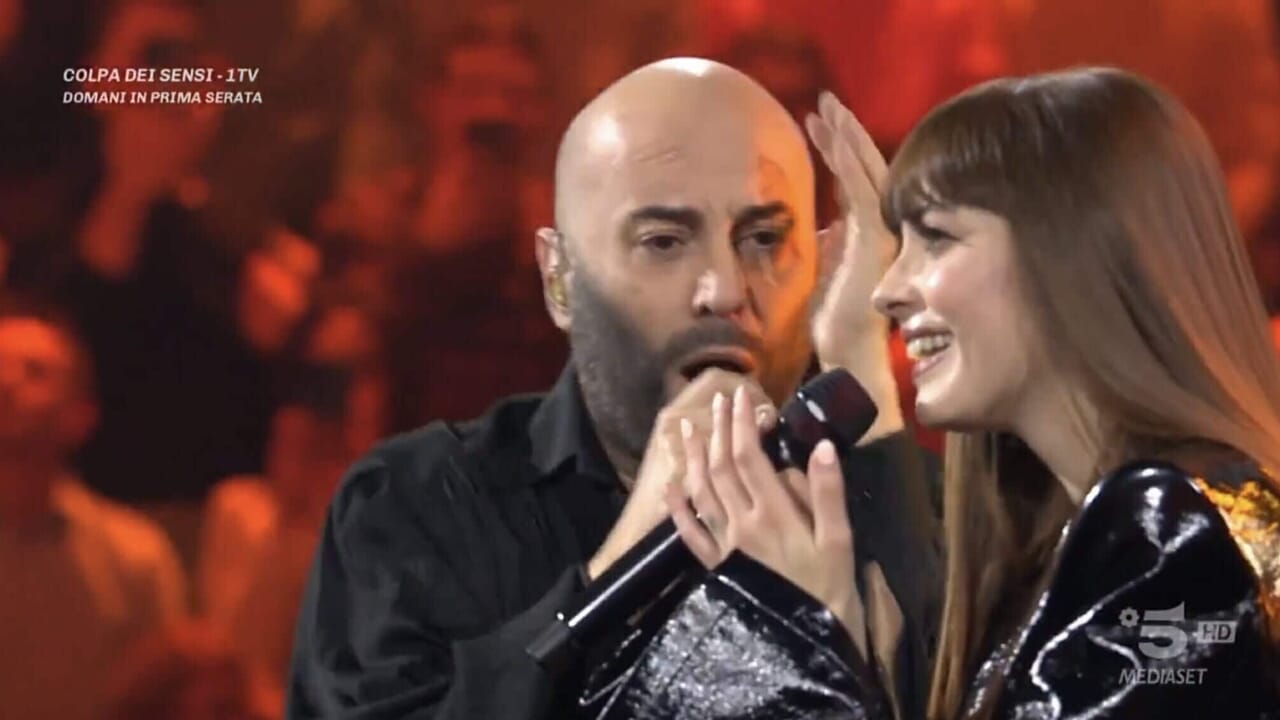
Giuliano Sangiorgi destroys Annalisa’s ‘Bellissima’ with yodeling (in her face): vote 2
There are plenty of horror movies with much less plot than this. A duet between Giuliano Sangiorgi and Annalisa on the notes of ‘Bellissima’ it comes unexpectedly, like a twist. Only, not the good ones. The Negramaro frontman screams the song, from the first verse, with the same grace as Leatherface when he takes up the electric saw to chop off the limbs of the unfortunate people who appear in front of him in ‘Don’t open that door’ – and sequel. Here, in the part of the aforementioned ‘unlucky people’, the notes of the song. Sangiorgi decides to warble every syllable, producing a sort of yodel that is as perennial as it is heartbreaking. Annalisa, in total black, continues to sing as if her hit wasn’t imploding in front of her face. She maintains a truly enviable savoir faire, a poker face that not even Lady Gaga. Inevitable, however, when we hear them perfectly intoning the ‘Dove vaaaai?’ and ‘What do you want?’ of the refrain, the thought that these questions are addressed, annoyed, precisely to the ill-fated Sangiorgi. What a disgrace.
Amoroso puts his little Penelope to sleep by singing ‘Serenade’ to her: rating 8
‘So far so good’, ‘Serenade’, ‘Stupid Things’‘Living in colour’. This is the medley with which Alessandra Amoroso presents herself at ‘Taratatà’. Is it possible that this is her first public appearance, on a television stage, after giving birth to her little Penelope? Could be. She has never lacked her voice and it accompanies her here too, at least as much as the ‘Big Family’ that has always supported her: the arena fills with billboards for her as soon as she enters the stage. A noisy, colorful affection, we feel embraced even on the sofa at home. Then the bomb: Amoroso chooses ‘Amor Mio’ by Mina as a cover and interprets it divinely. An enchanting, powerful performance. The subsequent chats with Bonolis are a cuddle: the host asks for them what do you sing to Penny to put her to sleep and ours, perhaps surprisingly, replies ‘Serenade’the summer hit he shared with Serena Brancale. Works? Yes, even before the baby was born: “It was calm in my belly only when I was doing this song, as soon as I finished it started kicking again”. We leave you with the image of an Amoroso little girl who stressed her mother because she spent her days singing along to ‘Brava’, also by Mina, without interruption. He already had clear ideas. And the holy benevolence of the neighbors, one might say. However, Amoroso manages to involve even Bonolis in a duet to the tune of ‘Stand by Me’, an evergreen from 1961 very dear to the presenter. Which would really be better if he continued to present, in fact. But we forgive him for the skid. For this time.
Is Gigi D’Alessio on strike? Lets the audience sing for him almost all the time: 5
What about Gigi D’Alessio? His participation in ‘Taratatà’ wasn’t exactly in playback, that wouldn’t be exact, it took on more of the contours of a karaoke evening for five thousand people (the audience at the Chorus Life Arena in Bergamo, ed.). The Neapolitan singer-songwriter wanted to experience the affection of the spectators who knew every one of his hits by heart from ‘Non Dirgli Mai’ to ‘Un Nuovo Bacio’. However, he went on strike with his voice. He had actually crossed not his arms but his vocal cords. The result of this abstentionism is a magma of chaos: it becomes impossible to distinguish the words of each song. But also one song from another. The rejection is limited to a five because, surprisingly, ‘O Sarracino ‘in the Santana version’, although it may have seemed like a heresy on paper, turns out to be one of the most particular (and successful) musical moments of the evening. Together with D’Alessio’s duet with Annalisa on the notes of ‘Annarè’ (this too has already been proposed in other places, probably those of a recent ‘Radio Italia Live’). Not a first, in short. But it works. It works when D’Alessio decides he wants to sing. If not, mass karaoke. But perhaps, following the Japanese metaphor, more harakiri.
The beautiful return of Luca Carboni (and that meeting with Lucio Dalla at the restaurant): rating 8
Luca Carboni, Fiorella Mannoia and the usual troublemaker Sangiorgi arrange themselves in a vocal triptych to sing ‘Farfallina’. Then Carboni takes back, thank goodness, his own spaces and, after seven long years of absence from the stage also for health reasons, he easily unleashes two eternal songs such as ‘Sea Sea’ and ‘It Takes a Beastly Body’. With fluorescent ocher sunglasses on his face and a cap on his head, Luca Carboni is back and is preparing to string together dates up and down Italy in what Bonolis envisions as “a tour of misery!”. The suspicion arises that better words could have been chosen, but it doesn’t matter, room for anecdotal: the host tells of a nineteen-year-old Carboni already intending to make music his life. Having failed the driving license exam and therefore without a car, he was accompanied by a cousin to the ‘Da Vito’ tavern in Bologna, often frequented by famous singers. Instead of bringing cassettes with his own songs to listen to, our young hopeful chooses ‘a file’ with all the lyrics he had written up to that point. He arrives outside the club, Lucio Dalla is even there, he sees him from the window. He asks the waiters to give him the aforementioned ‘file’ and stands by. From the law for a couple of minutes, he also passes the papers to the guests. He notices Carboni’s number and goes to the phone. At this point, in disbelief, Carboni bursts into the tavern and goes to introduce himself to Dalla who, meanwhile, has the phone to his ear: she is chatting with her sister to look for him. A scene from a comedy of errors that we wanted to bring back to you because we find it all there: the dreams, the hopes, the luck, the paperwork. Carboni leaves the stage of ‘Taratatà’ paying homage to his ‘talent scout’ with a perfect version of ‘Quale Allegria’. Nothing to fail here. We just want to get to the sea, but we keep pace with a coffee.
Annalisa is always good, but always the same: rating 7-
She opens the evening, the ‘Beautiful’, Annalisa. With a medley of his hits from the Sanremo song ‘Sincerely’ to the fresh ‘Exhibitionist’. Looking like a dark lady in total black, we see her surrounded by the usual large dance troupe that moves around her, cheek to cheek, calf to calf, to give the public the impression that she too is moving. But that’s not the case, not really, we know, the optical illusion has already bitten off its leaf. In addition to the horrendous, certainly not our fault, duet with Sangiorgi on ‘Bellissima’, we also hear her singing ‘Sweet Dreams’ by Eurythmics. The same song that she proposed at Sanremo 2024 on the Cover evening, that is, in that bloodbath from which she emerged unscathed, ranking third behind Angelina Mango with ‘La Rondine’ and in first place, much booed, by Geolier. In short, Annalisa saves and repeats herself. In ‘Taratatà’, the ideal setting for experimenting with music, he prefers to stay and masterfully compile his own sudoku of steel catchphrases. It’s not boring, but it’s not disheveled for panache either. Always good, always the same. Can you yawn in front of perfection?
