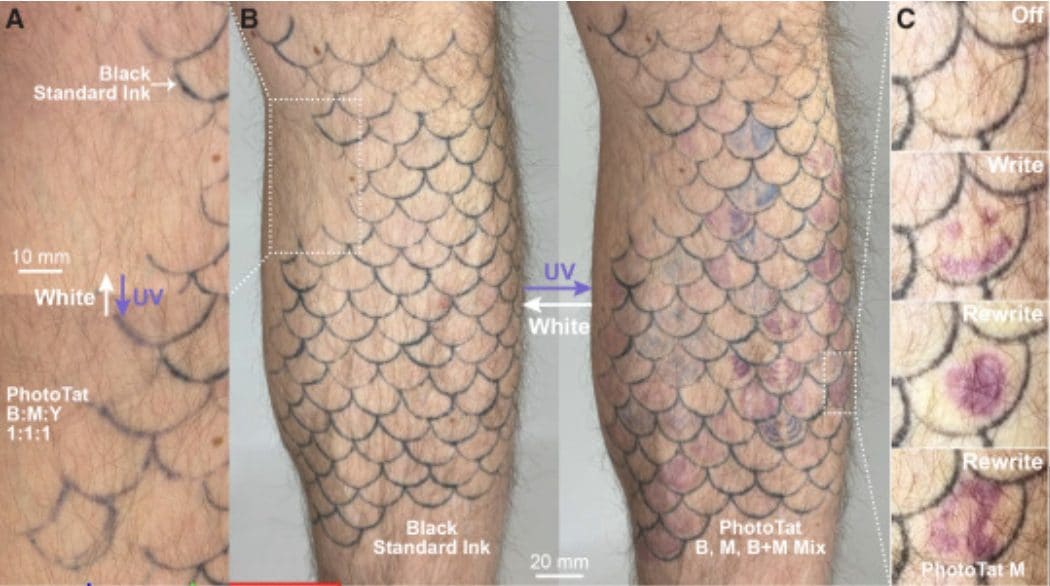
PhotoTat is a tattoo ink under study composed of photochromic molecules. Almost invisible, it colors in seconds with UV light and erases with intense white light. The new technology could be used for medical tattoos visible only in clinics, but it has only been tested on one person and safety has yet to be proven.
PhotoTat it’s a “rewritable” tattoo ink developed by the University of Colorado Boulder: 2-3 seconds of ultraviolet light are enough to make them go from almost invisible to blue, magenta and yellow, while an intense white light “erases” them. The principle is based on Three photochromic molecules (which change color by absorbing light) contained in polymeric nanoparticles. The study, published in the Cell Press journal – Matter & Lightis mainly a proof of concept: the safety of the formulations has not yet been tested. The authors hypothesize several applications for this technology not yet on the market: artistic tattoos, recolorable permanent makeup and above all, medical tattoos as reference points for radiotherapy or biopsy sites.
Photochromic pigments and the difference with traditional tattoos
A traditional tattoo deposits pigment particles in the dermis (the layer beneath the epidermis), where immune cells are unable to dispose of them and the colors remain there for decades. Chemist Carson Bruns’ group kept the principle but changed the pigment. In its place there are three diarylethene (a family of photochromic molecules) commercial, each dispersed in spheres of PMMA (the clear plastic known as plexiglass) approximately 100-500 nanometersdimensions similar to those of traditional pigments. PMMA has been used for decades in permanent implants such as bone cements, intraocular lenses and fillers, and here it isolates the dye from the tissues. The inks are applied with normal tattoo machines.
A diarylethene exists in two forms: an open colorless one and a closed ring that absorbs visible light and colours. But how does the transition from one conformation to another occur? Ultraviolet light causes the molecule to close (365 nanometer LED light was used in the study) while visible light reopens the ring and turns off the color.
The key point is that these molecules are “bistable“: unlike other photochromes they do not become colorless on their own in the dark. Thus, at home, under the weak light of the lamps, the drawing remains visible from hours to dayswhile with a very bright flashlight it disappears in a few seconds. The researchers mixed the three primary dyes that absorb in a different band of the spectrum and, with tests on silicone and pig skin, they prepared 16 inks.
The limitations of PhotoTat technology and the author’s leg test
Carson Bruns, author of the study and co-founder of the company that markets the technology, was the only subject tested in this phase, tattooing a series of scales on the leg. The results showed that, after almost two years, all three pigments maintained their ability to “turn on” and “turn off” intact. A reassuring test that follows in the footsteps of a previous monochromatic ink, developed by the same laboratory and tested on 11 volunteers for at least a year without any adverse events.
However, some practical limitations also emerged from the experimentation:
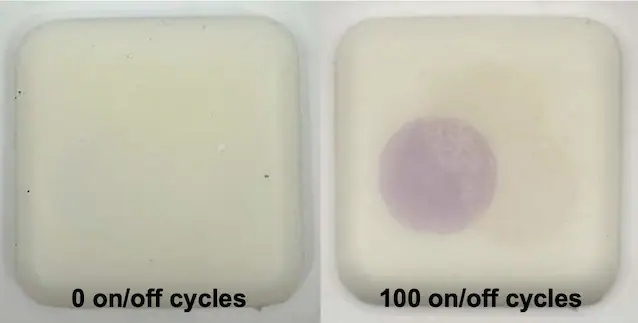
- The halo of blue: after 10-100 activation cycles, the blue pigment leaves a permanent purple tint, making the tattoo partially visible even “at rest”.
- Colors and skin tone: Colors like cyan and white are still missing from the palette. Furthermore, the darker the skin, the less visible the design is.
- Involuntary activation: Since sunlight contains UV rays, the tattoo is activated outdoors even when the sky is overcast. The only way to “hide” it is to apply sunscreen: a protection factor SPF 30 proved capable of shutting it down completely in a matter of minutes.
Use in medicine and safety
The most promising application for this technology is medical. Patients undergoing courses of radiotherapy are often given small permanent tattoos to align the radiation beam at each session: with PhotoTat they would only be visible in the clinic under UV light. The same goes for signs indicating the sites of a biopsy.
As far as safety goes, the light used to activate these designs (2-3 seconds) equates to approx 6-10 seconds of medium sun. The authors themselves specify that they are needed for each channel cytotoxicity test, sterility And purity before large-scale use. They also did not verify with biopsies where the particles end up in the skin. In Europe, from 2022 the REACH regulation limits dangerous substances in tattoo inks.
