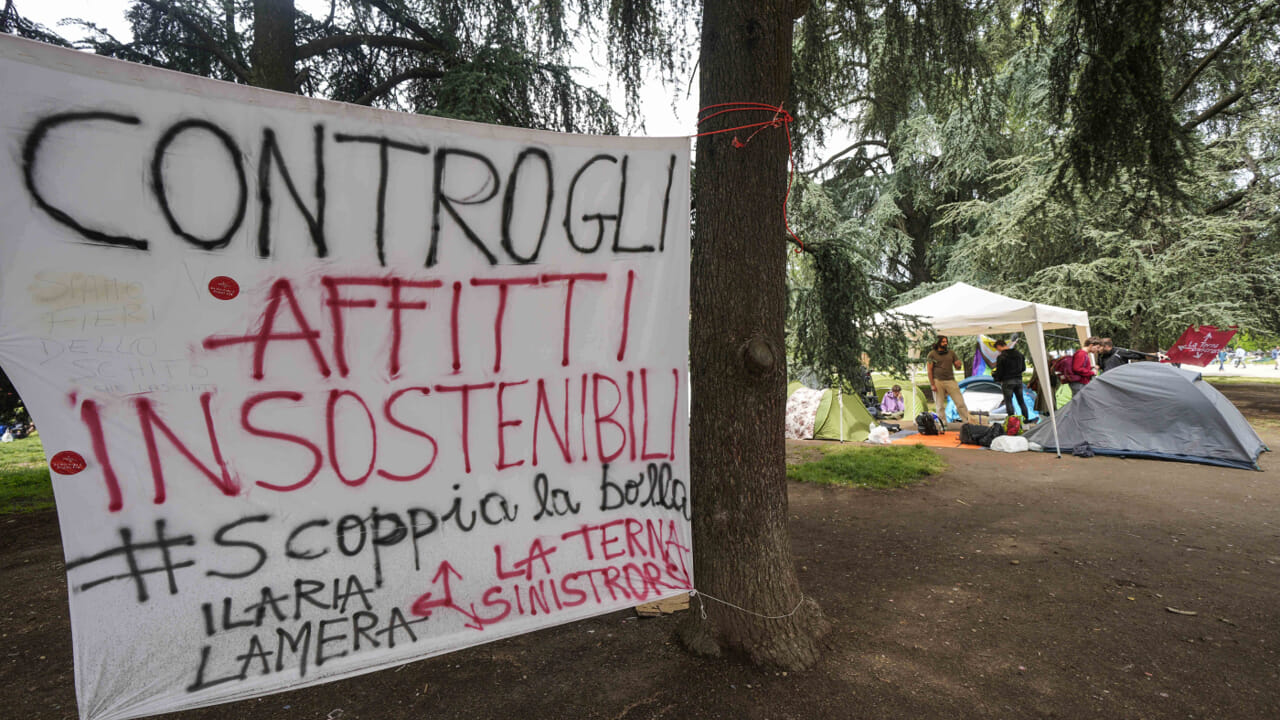
The cost of rent has grown by almost 29 percent in Europe from 2010 to today and house prices have increased by more than 60 percent. More than a million people sleep on the streets or in emergency facilities, and around 400 thousand of them are minors. These are the numbers of the European housing crisis, a crisis that is becoming increasingly serious.
To deal with this situation, the European Parliament has developed a plan that asks the European Commission for ambitious interventions that lead to making building permits issued within 60 days the norm, tax incentives for young people and low- and medium-income families, an adequate share of public and social housing in cities and new rules on short-term rentals.
The plan, drawn up by the special commission on the Housing Crisis (Hous), is contained in a communication approved in the Plenary with 367 votes in favour, 166 against and 84 abstentions.
House prices growing by 60% and rents by 20%: the housing crisis gripping Europe
The weight of the crisis
10.6 percent of the EU’s urban population spends more than 40 percent of their income to pay for a roof: this is the threshold beyond which we technically speak of “excessive burden”. Minimum wage workers fare even worse, spending an average of 8.6 percent more than other categories. And young people are the most in difficulty: the average age at which children leave their parents’ home is 26.3 years, and in some countries almost 70 percent of those under 34 have no alternative to family cohabitation.
The resolution identifies precise causes of the situation. The main ones include the structural lack of new buildings, the scarce public investments in recent decades, the costs of energy and materials which have risen after the pandemic and the war in Ukraine, the exhausting bureaucratic procedures to obtain building authorizations and the progressive “financialisation” of the real estate market, i.e. the purchase of properties by funds and institutional investors with speculative logics that take houses away from the ordinary market.
“The housing crisis has far-reaching consequences on the quality of life of Europeans, affecting health, social cohesion and access to economic opportunities. EU action is essential to restore balance and fairness in the real estate market, because everyone deserves a place to call home,” said the president of the special commission on the housing crisis, the Italian Irene Tinagli of the Democratic Party.
Build faster
Between 2021 and 2024, permits for the construction of new housing units dropped from around 1.99 million to 1.54 million per year in the EU, with procedures that in many cases lasting over a decade slow down not only new construction, but also the renovation of existing buildings. MEPs ask the Commission to propose a simplification package that introduces a 60-day limit for issuing permits, fully digitalised procedures and national one-stop shops to reduce administrative steps.
The text also requires the inclusion of the principle of “silence-consent”: if the public administration does not respond within the established deadlines, the license is considered automatically granted, except in cases that concern personal safety, environmental protection or cultural heritage.
Taxes
On the fiscal front, the text calls for measures “based on incentives” rather than constraints. MEPs ask Member States to reduce registration taxes for first-time buyers, to fiscally encourage long-term rental contracts and to possibly apply a super-reduced VAT rate to the construction of new social housing.
The question of financialization emerges in several points of the document. MEPs ask that the Commission analyze the “available evidence of potentially abusive speculation” and invite Member States (who have the competence over this) to adopt countermeasures, improving the transparency of real estate transactions and monitoring the interconnections between real estate funds and banking institutions.
The crux of short-term rentals
The proliferation of platforms like Airbnb has radically transformed the rental markets of many European cities. In some neighborhoods of Barcelona, Paris and Rome, according to data cited in the resolution, short-term rentals represent between 17 and 25 percent of all available housing units.
The deputies do not want to outlaw the sector, which contributes to tourism and generates income for many families, but they ask for a rebalancing. Commission President Ursula von der Leyen had already announced a legislative initiative on short-term rentals in September 2025. The resolution supports this path, but asks that the new legislation establishes common objectives at European level while leaving flexibility to the States, regions and municipalities, who are “in the best position to determine the necessary measures”.
Public, cooperative and social houses
The decline in investment in public construction after the 2008 financial crisis is considered one of the structural factors of the current crisis. In 2024, only 7 percent of the Recovery Fund, the approximately 724 billion euro program financed with common European debt after the pandemic, was spent on social housing and other social infrastructure. The resolution calls for redirecting the unused resources of this fund for the renovation of social, public, cooperative and affordable housing, entrusting its management to local and regional authorities.
The document also dedicates ample space to alternative models to private ownership: housing cooperatives, limited-profit housing, non-profit construction. These models, widespread in countries such as Austria, the Netherlands and Denmark, allow prices to be kept stable over time because they remove properties from the logic of the market. MEPs ask that the criteria for access to European public funding also be open to these entities, which “channel investments towards objectives of general interest”.
Squatting and tenant protection
The resolution also addresses the issue of illegal occupation of properties, defined with the English term “squatting”, in clear tones. The deputies “strongly condemn” the phenomenon and call for rapid legal mechanisms for the recovery of illegally occupied properties, including timely eviction measures.
But the resolution also protects tenants. MEPs call on states to strengthen legislation against disproportionate rent increases, to encourage long-term contracts and to improve the transparency of the rental market.
There is a shortage of workers
Building more housing also requires more skilled workers. The EU construction sector employs 18 million people directly, but companies report structural shortages of skilled labour. Difficult working conditions, precarious contracts and long subcontracting cycles make the sector unattractive to young people. MEPs are calling for investment in vocational training and apprenticeships, fair wages, stable contracts and stricter health and safety standards on construction sites.
Money, data and governance
According to the European Investment Bank (EIB), the investment gap in affordable housing amounts to €270 billion per year. There are much fewer public funds available. The EIB launched its first affordable housing action plan in June 2025, which includes loans, guarantee facilities and technical advice.
In addition to supporting this effort, the text insists on the need to have comparable and reliable data across the EU: on vacant housing, on prices, on renovations, on homelessness, recalling that in 2021 alone, 19.5 percent of European homes were unoccupied, with an increase of 23 percent compared to 2011. For MEPs, collecting and analyzing this data is the prerequisite for any effective housing policy.
The criticisms
Criticisms of the text, deemed not ambitious enough, came from the Greens and the radical Left. “The report fails to combat the real causes of the phenomenon, namely speculation and the financialisation of the real estate sector, the lack of public investment in social and accessible housing, the uncontrolled proliferation of short-term tourist rentals”, denounced the MEP of the Greens and Left Alliance Benedetta Scuderi, who voted against the communication.
Scuderi complains that “in the text there is no trace of the recognition of the fundamental right to live, of the prevalence of the public, non-profit and limited profit component and of useful rules to ensure that no family spends more than 30 percent of their income on housing costs”. On the contrary, he continues, “privatization is legitimized, the dangerous principle of ‘positive administrative silence’ is introduced for building permits without adequate safety and environmental assessments, and wild deregulation is encouraged”.
“The housing crisis requires political courage to address real estate and financial interests. Instead, this report protects investors, blames tenants, uses the crisis to justify deregulation and, worst of all, criminalizes the most vulnerable,” said Frenchwoman Leila Chaibi on behalf of the group The Left.
Criticisms of the text, aimed above all at the deregulation required to encourage construction, also came from Greenpeace. “Taking shortcuts on building standards and pollution might increase sales, but it would force people to live in inadequate housing that is expensive to heat and cool,” Ariadna Rodrig said on behalf of the NGO.
