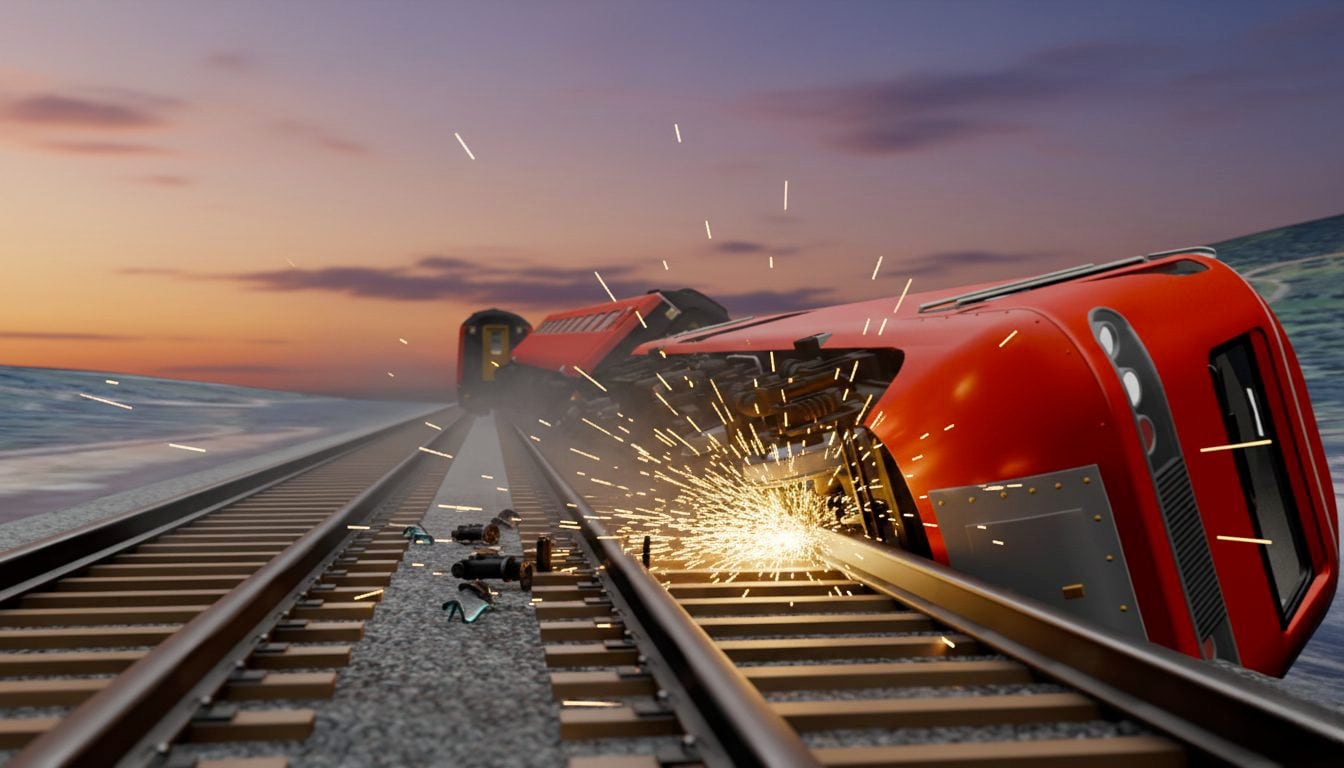
In Andalusia, in Spain, two trains derailed causing 41 victims and beyond 150 injured – even if the toll could worsen further in the coming hours. The accident occurred around 7.45pm on Sunday 18 January, at the height of Adamuznear Cordova: a first train of the company was involved in the disaster Iryodirect from Malaga to Madrid, and a second train of the service Alviawhich collided with the first convoy and then ended up in a four meter embankment.
At the moment the exact causes of this disaster are not yet known but, as we will see, it seems that the most plausible ones are due to failures of the train or railway infrastructure.
The reconstruction of the train accident in Adamuz
We’re in Spain, in Andalusia, more precisely at the height of Adamuza small town with less than 5000 inhabitants. To the north-west of this small village is the railway line, made up of two tracks: one for trains going north, and one for those going south. That evening, as we said, there were two trains on that stretch.
The first was a Iryo 6189a high-speed train that traveled from Rum raisin to Madrid with on board 284 people. The second train however was a Alvia 2384 started from Madrid and directed to Huelva, in southern Spain, with on board 187 people. It seemed like a quiet evening, like many others, but unfortunately at 7.45pm, disaster struck.
The passengers on board the Iryo feel a vibration, then suddenly darkness and a loud noise. Witnesses say they were thrown, without knowing what was happening. What they didn’t know yet was that it was the last carriage on their train derailedalso taking the previous two with it. But not only that. Unfortunately, during the derailment, this portion of the train crossed the opposite track. And at that moment, the vehicle headed for Huelva was about to pass through.
The impact was inevitable. The two trains hit each other forcefully, and this in turn caused the derailment of the first two carriages of the second train, which hit an embankment, worsening an already dramatic toll.
Clearly given the extent of the accident the railway section was suspended for at least 24 hours going to interest more than 200 trainsbut it is very likely that the rescue and removal operations of the trains will take much longer – also considering that the area is not easily reachable by cranes.
But what were the possible causes of this derailment?
The possible causes of the accident in Spain
This train crash is strange – and this is not me saying, but this is what Transport Minister Óscar Puente said. It is strange first of all because the two trains, at the time of the accident, were on one stretch straight. But not only that: a straight stretch that was renovated last May and therefore should not show signs of wear. On this stretch the maximum speed allowed had already been lowered in recent months 300 km/h to 250 km/h. And one might think that maybe the two trains or one of the two was exceeding the limits…. but in reality no. According to what was declared to a local radio by Álvaro Fernández Heredia, the president of Renfe, the two vehicles were traveling respectively at 205 And 210 km/h. So even from this point of view everything seems to be in order.
So what caused the derailment?
At the moment we don’t know for sure how a train ended up on the opposite track – or, to put it technically, how it managed to occupy the free transit gauge of the adjacent track. Actually this not even the authorities know involved in the investigation. In a few weeks we will certainly have more detailed information, but the question we can answer is: what could be the causes of a derailment in general, from a technical point of view?
How can a train derail
The causes of the derailment can be grouped into 3 large groups, as also reported by a technical report from ANSFISA, i.e. the National Agency for the Safety of Railways and Road and Motorway Infrastructures.
The first group is the one relating to a broken down al material rolling stockthat is, a failure in one or more mechanical parts of the train. I am referring for example to the suspensions, the undercarriage, the braking system or the wheels. These failures can be linked to wear and tear, poor maintenance or perhaps even design defects.
The second group is the one relating to errors operationalwe could say to human error. In fact, here we are talking, for example, about irregular management of railway exchanges, about wagons being overloaded, or about conditions of excessive speed – which is dangerous, especially when cornering.
The third group is that of faults infrastructural: and this includes any breakages of rails, sleepers, switches, or if these have geometric defects that can reduce contact between the wheel and the rail. Here too the causes are to be found in the wear of the material, in incorrect maintenance or in design defects
To these must be added a fourth group relating to factors externalsuch as obstacles on the tracks, or natural phenomena such as earthquakes, floods or landslides.
And in the case of Spain?
The broken joint hypothesis: what happened
We still don’t know the causes with certainty and this is information to be taken with a pinch of salt, however according to what was stated by the president of Renfethe tragedy could have been caused by – and I quote – “a failure of the rolling stock or infrastructureSo essentially we fall into the first and third categories that we have seen, that is, that of train or railway infrastructure failure.
Do you remember that I told you that last May the network was renovated? Well, this choice was not made by chance: the Madrid-Seville line is in fact the longest running of the high-speed railway network in Spain, having entered service in 1992 with six daily high-speed services operated by Renfe. However, this traffic has multiplied with the entry of competitors (such as Iryo) into the state operator, following the liberalization of the market in 2019. So it wasn’t just a network now old but also very busy that needed fixing.
Nonetheless Adif, the railway infrastructure manager, has reported over the last few months 8 accidents. We are therefore talking about technical problems that occurred precisely at that point after the renewal of the tracks last May and were mainly linked to the signaling system. The latest report – as reported by the newspaper El Pais – would just date back to December 23, 2025when Adif reportedly reported a fault in the exchanges between Adamuz and Cordoba.
Among other things, it was news from a few hours ago that the authorities – as reported by Reuters – they would have found a broken joint, and this may have caused a progressive widening of the tracks, until the last carriage derailed. Even in this case we do not know whether this caused the accident or whether the joint broke due to the derailment. Furthermore, it is “strange” that no train before this one and no periodic inspection has noticed a joint damaged to the point of being close to breaking.
In short, we repeat, it is still early to be sure what happened, but as often happens in these cases it is likely that the cause is not just one but rather a mix of many different ones.
