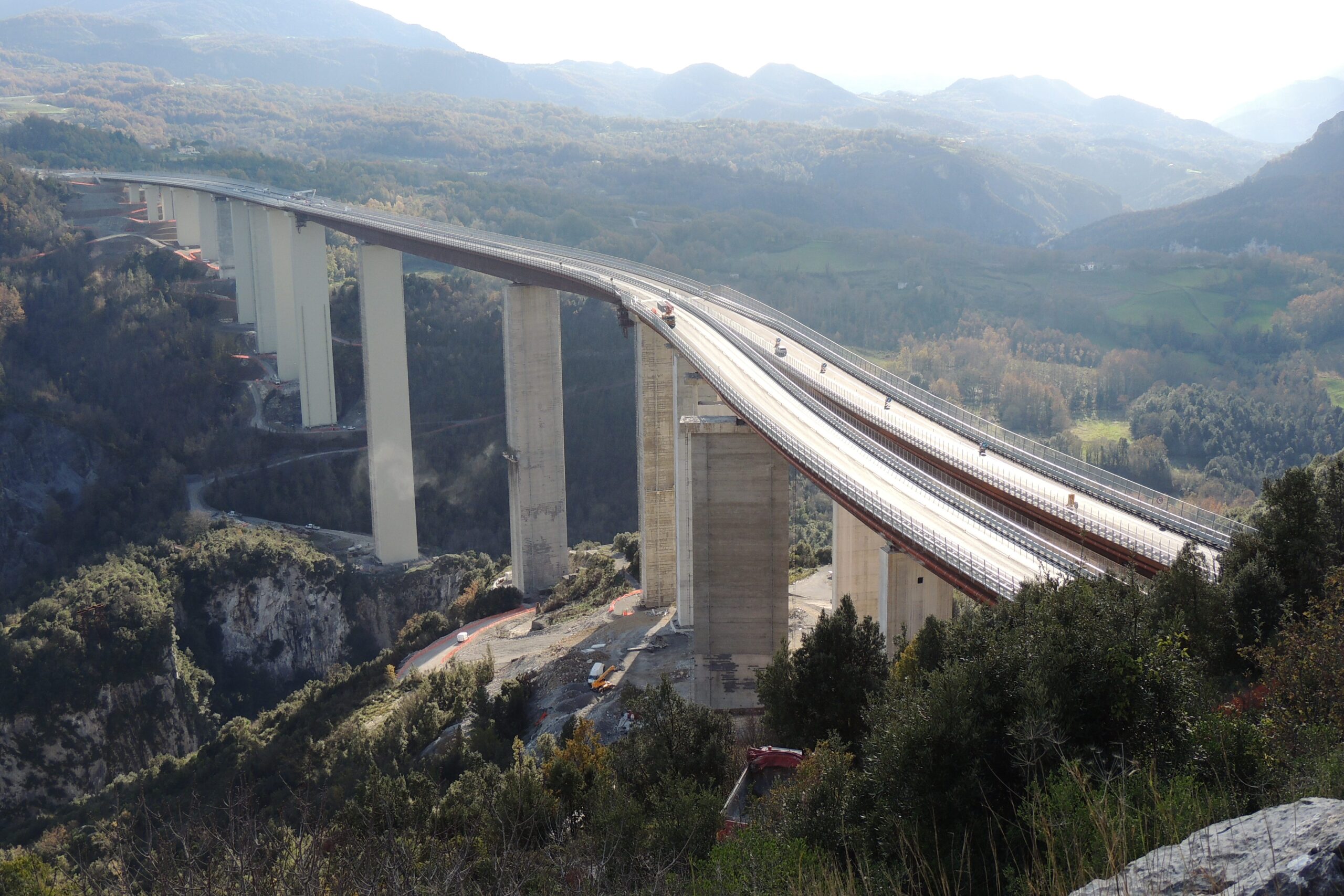
With beyond 120,000 bridges and viaducts above 6 metres, Italy boasts a world record for the number of infrastructures present in the area, a direct consequence of its complex orography. Among the impressive works that connect plains and mountainous reliefs together, guaranteeing the mobility of approx 60 million peoplehere’s what they are five longest in the country.
Here are the main bridges and viaducts by length in Italy
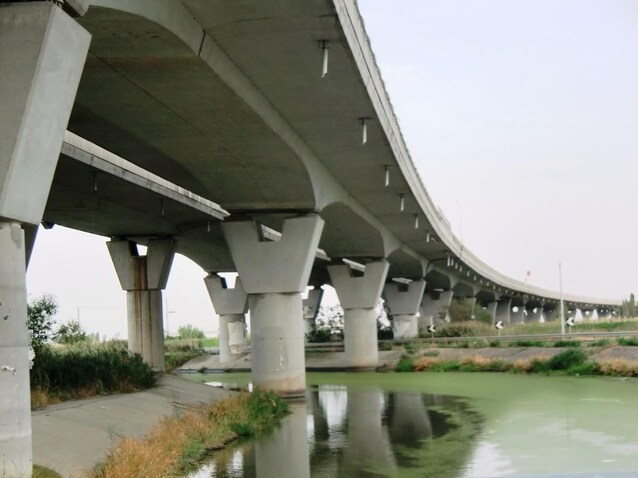
Coltano Viaduct (1993) – 9.86 km
It is considered the longest viaduct bridge in Italy in terms of overall extension. Unlike the classic viaducts, that of Coltano is immediately recognizable for its “V” stacks. It is made entirely in prestressed reinforced concretetypical of the great Italian engineering school of the post-war period and curiously does not cross a gorge or a valley but a flat and marshy area. Due to the extremely soft soil, characterized by alluvial sediments typical of the Coltano area, the viaduct is a valid alternative to common road embankments.
Fichera Viaduct (1972) – 7 km
In second place we have the most famous viaduct of the A19 Palermo-Catania motorway, built in the seventies by the brilliant engineer Silvano Zorzi. The work adopts a static scheme a continuous plate and innovative solutions on the top of the pillars in order to effectively compensate for any ground subsidence. The structural aesthetics faithfully follows the load distribution: the cross section and the longitudinal profile have variable geometries, with minimum thicknesses in the span and which progressively increase towards the support points.
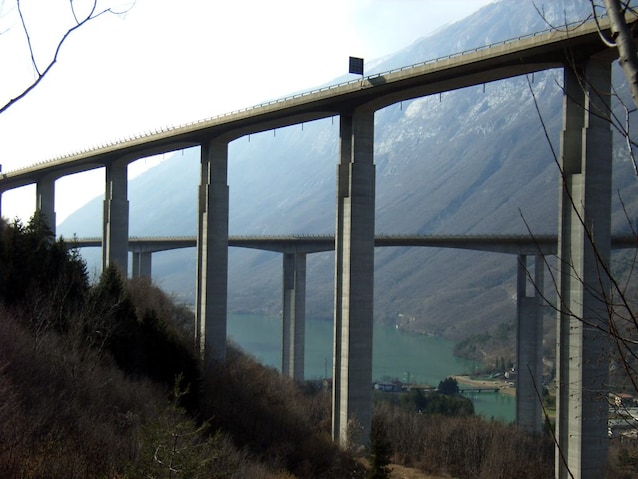
Fadalto Viaduct – (1995) – 3.7 km
Inaugurated in 1995 after 23 years of work, the Fadalto viaduct extends for almost 4 km on the A27 and holds the record for longest elevated bridge in Italy. Divided into two independent carriageways, for the first 2.2 kilometers it has standard spans of 55 meters in both directions; in the northern terminal section, however, the routes diverge: the southern carriageway crosses the deepest part of the Tesa river valley thanks to ten special spans of 115 meters each, while the structure in the north direction reaches a maximum height of 70 meters.
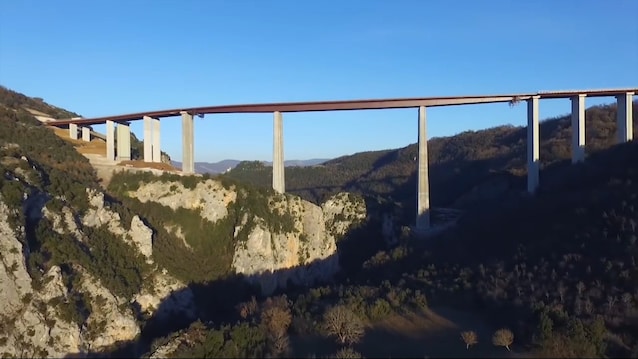
Viaduct Italy (1974) – 1.16 km
The Viaduct Italythe work of great structuralists Fabrizio de Miranda And Carlo Cestelli Guidiis one of the symbols of Italian road engineering. The infrastructure is located along the A2 Mediterranean Motorway and is among the most impressive works on the peninsula. Created between the end of the 1960s and the beginning of the 1970s, it maintained the primacy of for decades highest viaduct in Europethanks to his 260 meters high on the valley floor, a record surpassed only in 2004 by Millau Viaductin France. The structure extends for just over a kilometer and is made up of two carriageways with separate decks. There are three main sections: the central section with a large span, made up of three metal spans which cross the Lao River, and the two access sections to the North and South built in prestressed reinforced concrete.
Bridge over the Adige river (2014) – 1.09 km
Along the A31 motorway, crossing the river Adige is entrusted to an imposing cable-stayed bridge which, unlike the structures listed above, has a central span of 310 m (the longest in Italy at the time of construction) and two shore spans of 135 m. Featuring ‘A’ shaped pylons‘ is a system of fan stays arranged on the median axis, the bridge uses a 30 m wide multicellular metallic monocaisson deck. Among the peculiarities of the work, the upper concrete slab stands out, pre-stressed transversally: an engineering choice adopted to counteract horizontal and wind actionsand consequently guarantee high flexural and torsional stiffness.
