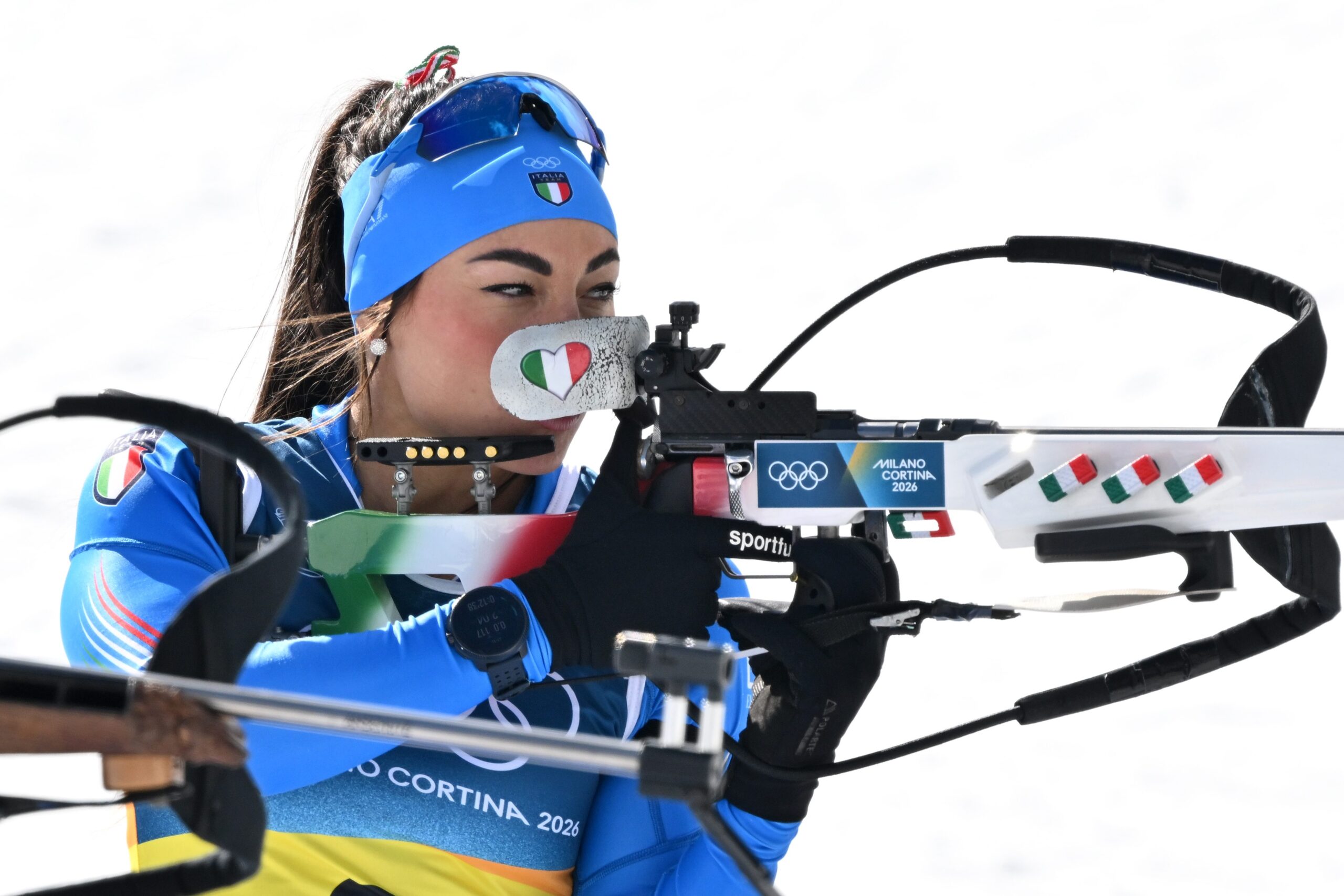
The biathlon it is one of the most fascinating winter ski sports disciplines and is certainly among those in which the physiological components involved are greatest. Just think about the motor control Of precision necessary for shooting after intense physical exertion and under pressure. Its roots are very ancient: many think that it derives from some hunting activities of which evidence has been found in rock engravings dating back to 3000 BC
All the techniques of this discipline are on stage at the Milan-Cortina Winter Olympics: individual, sprint, pursuit, mass start And relay (Also mixed). It is precisely in the latter that Italy won the silver medal with Dorothea Wierer, Lisa Vittozzi, Tommaso Giacomel and Lukas Hofer. The requirements underlying this sport are different and complex given that the athlete must be able to combine speed and skill, typical of cross-country skiingto the precision and calm that characterize the precision shooting with the rifle. The difficulty underlying biathlon is therefore due to various factors that influence performance: biomechanical, physicists, psychic And environmental.
The history of biathlon
The first traces of this activity date back to some rock finds depicting men hunting while wearing skis. However, for the real arrival of this sport as we know it today we have to wait until 1912. In that year, in fact, the Norwegian army organized the Forvarsrennet, the first biathlon race we have witnessed: 17km of cross-country skiing routes alternating with stations shot to the target.
The Olympic debut of this discipline took place in 1924 to Chamonix in an ancient form of biathlon. Afterwards, it remained exclusively demonstrative for Three non-consequential editions and then definitively inserted in its current form ai Squaw Valley Olympic Games (USA) In the 1960. As for the races feminine we had to wait for the event of Albertville of 1992. The various existing techniques, which we have mentioned, were introduced gradually, the latest in 2006 to Turin when there was the first men’s and women’s mass start of the games (a race that brings together the best 30 athletes of the World Cup).
Biathlon is a sport of resistencewhich then combines components aerobic And anaerobic. The key factor of this discipline is the timemeasured based on the route taken by the athletes during the cross-country skiing sections and the minutes it took to finish the shooting sequences. These can be performed either in position erect That pronedepending on the type of competition you are taking part in. In fact, for each technique and based on sex, we find both distances That shooting sequences different. THE targets they are always distant 50 m from the shooting position and have a diameter of 11.5cm for shots fired while standing and 4.5cm for those shot in the prone position. In case of mistake individual races involve a penalty of 1 minute for a missed shot on the total time, while all the other races include a long supplementary lap 150 m (which, obviously, affects the final time, on average by about 25″).
How much does the rifle weigh? The complexity of the technical gesture
Biathlon is classified as an endurance sport but, compared to other disciplines belonging to this category, it is characterized by peculiar characteristics that make it unique in its kind. To provide a clear picture of the complexity of this sport, various aspects must be explored in greater depth.
The first is represented by rifle which, although it is fundamental for performance, can sometimes negatively influence part of it: the fact of carrying a weight of approximately 3.5kg not perfectly balanced, favors the increase of oxygen consumptionfrom the heart rate and, of course, it affects the biomechanics of skiing. Aware of the importance of stability and of thepostural balanceathletes train this aspect a lot in order to create as few oscillations as possible while skiing and find the correct position in a few seconds.
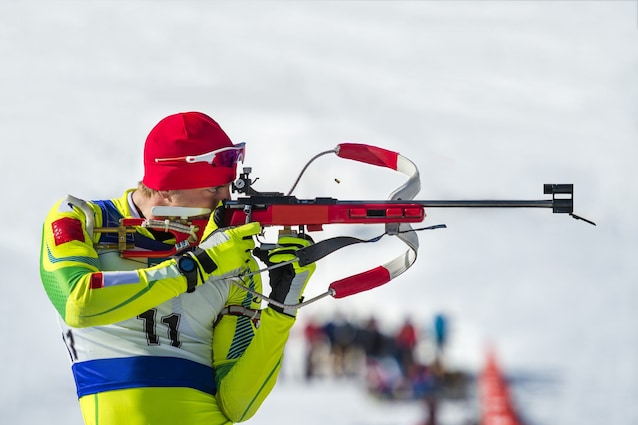
Precision shooting, by nature, is an action that involves the human body stability, calm and absence of movements that can vary the optimal position for aiming. All this is compromised, and not a little, by the enormous effort physical that biathlon athletes do before each shooting session.
First, the effort increases by 50% the support movements especially in the standing position: only techniques tightness-relaxation And breathing strategies can comply with this problem. Likewise, the strength in the shoulder muscles and the finger stability of the hand, essential for the correct grip of the rifle, are reduced by tiredness and fatigue. Another factor to take into consideration is the change in heart ratewhich naturally is high during the shot due to the previous skiing. To be precise, during skiing the heart rate reaches approximately 90% of its maximum value, while in shooting it drops to around 70-60% (especially in the prone position). It is enough just to imagine firing a precision shot with such a high pulse rate to understand how complex this technical gesture can be and this is why, often, the shot is carried out during the diastole (relaxation), so as to avoid movements due to cardiac contraction.
Ultimately there are many psychological aspects to take into consideration: first of all the pressure induced by the public, the time and the competition with other athletes. A widely used technique to try to increase facial-motor control and the level of attention is the strategy of “quiet eye” or “quiet eye“. This consists of staring at the target for a longer time immediately before shooting, a sort of improved visual perception that allows the athlete to eliminate various distractions while visualizing the target.
Sources
Olympics Olympics Laaksonen, M. S., Finkenzeller, T., Holmberg, H. C., & Sattlecker, G. (2018). The influence of physiobiomechanical parameters, technical aspects of shooting, and psychophysiological factors on biathlon performance: A review. Journal of sport and health science, 7(4), 394–404.
