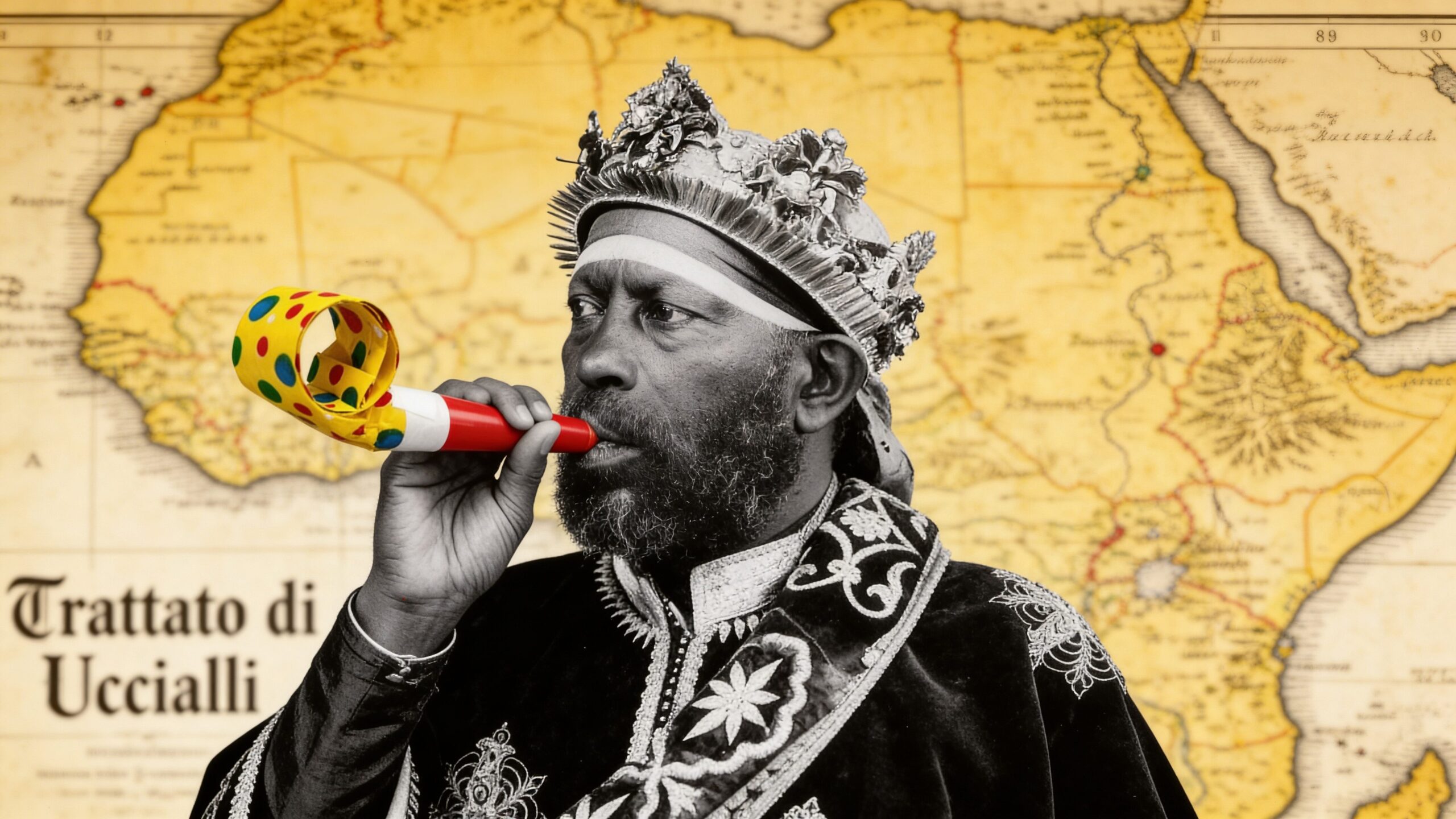
Who has never blown one Menelik language? Also known as “Menelicche’s tongue” or “mother-in-law’s tongue”, we are talking about the sound tongue (or trumpet-whistle) that can be seen almost everywhere during the carnival, the one in which by blowing inside a long colored paper tube it unrolls and suddenly lengthens making an annoying noise and then curls up again.
The rather curious name of this object derives from the colonial era, and was born from a denigrating intent towards Menelik IINegus (“king of kings”) of Ethiopia from 1889 to 1913. In fact, it was said that the Ethiopian king had the long tongue (annoying just like the trumpet whistle) and was very little disciplined in words.
But how much of this story is true?
This rumor it spread following a historical episode that actually happened on May 2, 1889, which dates back to the signing of the Treatise of Uccialli (the latter was a location in northern Ethiopia) between Italy and the Horn of Africa country. It was a treaty of friendship and trade between the two, which the Negus would have signed with the count Ugo Antonelli.
In the document there were several articles which had the task not only of regulating the relationship between the two States, but also of putting on paper the territorial acquisitions Italians in Eritrea, which Negus himself recognized as Italian colony.
The treaty had been drawn up in Italian and Amharicbut article 17 was different in the two languages: in Italian, in fact, the Negus delegated his choices in foreign policy to Italy, thus making Ethiopia one of his protectorate. In the Ethiopian text, Italy appeared solely as a diplomatic representative. Even today, we cannot know whether it was a translation error or whether Italy behaved unfairly to induce Ethiopia to sign the contract, although the first hypothesis is more likely. What we know, however, is that for the Negus it would have been unthinkable to make his country an Italian protectorate, and when in 1893 he learned of the difference in translation, he immediately renounced the entire treaty.
This affair damaged relations between the two countries, and was among the main causes of War of Abyssiniawhich began in December 1895 and ended on 1 March 1896, when more than 14 thousand Italian soldiers commanded by General Oreste Baratieri were attacked and defeated at Adua by the 120 thousand soldiers commanded by Negus Menelik. Precisely at the end of that very bloody war there was the famous Addis Ababa peace treaty (26 October 1896), which replaced that of Uccialli.
From this whole story, in the eyes of the Italians the Negus turned out to be a rather unpleasant character, whose tongue “was capable of changing shape” just like the carnival trumpet.
