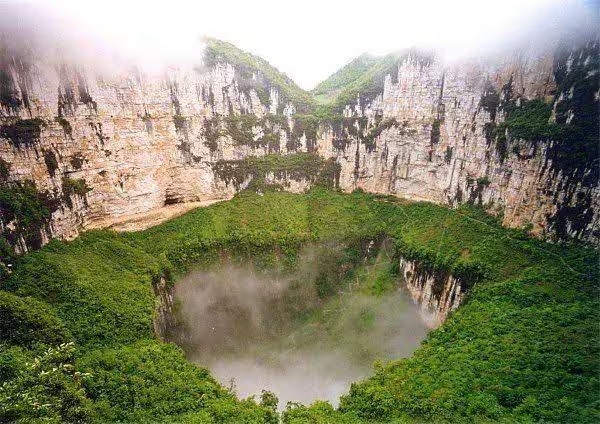
Among the many global records that characterize the territory of People’s Republic of China could not miss that of deepest sinkhole on the planet: in the municipality of Chongqingin the south-west of China, one of the largest is opening karst depressions known to date, lo Xiaozhai Tiankeng. We are talking about an enormous chasm of natural origin (called tiankengin Chinese “heavenly well”) which opens into the ground to a depth of 662 meterswhich it could easily accommodate five Shanghai Tower placed side by side and of which, in theory, we would not even see the top emerge if we found ourselves walking along the edge.
What is a sinkhole and how is it formed
Let’s start with the basics: one sinkhole is a deep depression in the ground that typically originates in territories karstwhere, that is, the underlying rocks, above all calcareousare slowly dissolved by the water chemical action (water, especially if it contains carbon dioxide (CO₂), becomes slightly acidic and slowly dissolves limestone) and for action physics (as the water flows, it erodes the rock and carries the debris away, contributing to widening basins and fractures). The continuous action of water generates cavity which, over time, also expand due to collapse progressive. Sinkholes can have very different shapes and sizes, reaching depths ranging from a few to several hundred metres, as in our case.
The Chinese term tiankengwhat does it mean “celestial well”, is widely used to describe a particular collapse sinkhole: when, as we were saying, the water excessively erodes the karst cavities, the overlying material can give way to the point of suffering a heavy collapse.
A record hole: up to 662m deep
The Xiaozhai Tiankeng is nestled in a environment mountain characterized by a lush sub-tropical and very humid karst landscape. Right in the center of this great green expanse our record-breaking gorge opens up: a great depression of form elliptical wide over 600 meters which sinks with steep walls to a first level, approximately 320 meters deep. Below this first level there is a second great depressionwhich drops by others 342 metersfor a total depth of 662 meters. At the bottom of the sinkhole flows a river undergroundwhich is part of a larger system hydrogeological of the region and which contributed significantly to eroding the underlying cavity, giving rise to the collapse responsible for the birth of Xiaozhai Tiankeng.
World Heritage Site since 2007
Clearly, being born in karst territory, sinkholes are almost never isolated phenomena, but are instead part of systems karst more or less extensive and characterized by tunnels, cavities, valleys and sinkholes.
Xiaozhai Tiankeng is certainly not an exception, so much so that UNESCO recognizes it South China Karstthe karst landscape of southern China of which our sinkhole is part, as one of the sites World Heritage Site since 2007, for its important value geological and for the enormous biodiversity which inhabits the entire region.
