
In China the fossil of a new species of jurssical herbivorous dinosaur, the Pulaosaurus qinglong. His larynx It is so well preserved that it has allowed researchers of hypothesize what the verse was of the animal: they emitted a sound very similar to that of modern birds. The discovery of the almost complete skeleton took place by a team of researchers from theChinese Academy of Sciences In the north-east of China. It is a very important discovery, which clashes with the collective imagination of “roar” of dinosaurs, made iconic films such as Jurassic Park and from his fearsome T. Rex.
The discovery of the dinosaur fossil
The fossil belongs to a 72 cm long herbivorous dinosaur Excellently preserved: even some teeth and the remains of the last meal have been preserved in its intestine, in addition to most of the bones.
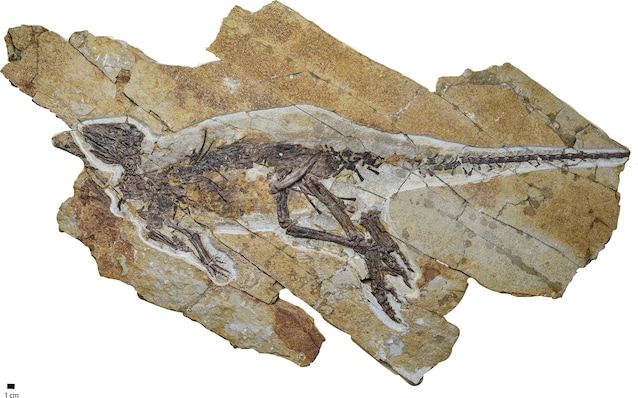
The characteristics of his skeleton testify that it is probably a young individual of il Pulaosaurus qinglong.

The discovery of the true verse of the dinosaurs and its implications
Among the various structures of the organism found intact there are the cartilage ones of the larynx. It is only the second time that the mineralized larynx of a dinosaur is found in a good condition of conservation, perhaps also because of a failure to identify (the first discovery concerns an armored herbivorous experienced in the late Cretaceous). The structures of the fossil larynx are such as to allow to modulate the sounds and remember those of the organ called siringa sort of balloon located between trachea and bronchi that birds use to sing. This should not be surprised, since the first birds have evolved in the jurssic precisely starting from a group of dinosaurs. For this analogy, researchers have attributed the name of Pulaosaurus qinglongfrom “Pulao”, a small dragon of Chinese mythology that is told to emit strong references.

The structure of the fossil larynx allows you to hypothesize that the dinosaurs of the Jurassic emitted Acute sounds similar to the calls of birds. Despite this, it is not said that this was a characteristic common to all dinosaurs. Unfortunately at the moment It is not possible to reproduce the verse emitted by this dinosaur, since its jaw is compressed and does not allow to evaluate it precisely with width and length, which affect the modulation of the sounds. In the future, however, it is not excluded that new remains preserved remains and that new studies allow to reconstruct the verse of the dinosaurs.
