
You’re watching Growing brains Don’t miss out on more content from Geopop
THE children they have some extraordinary abilities: they can learn very complex things, such as speaking and walking, with impressive speed. There is a reason for all this: in the first thousand days, from conception to age two, the brain creates an incredible amount of over one million connections per second. In the first two years of life, the child’s brain is shaped byinitial explosion of sensory connections to help him move in the new environment, to an efficient network pruned by the “synaptic pruning“, which eliminates unused connections and strengthens those constantly activated, to the point of transferring its operational control units towards the areas of complex thinking and emotional self-regulation.
In the first thousand days of life an explosion of neural connections: neuroimaging studies
From the day the newborn comes into the world, his brain begins to interface with a totally new environment, initiating a period of unprecedented plasticity. Dr. Mine Conkbayir explains this very well in her book “The Neuroscience of the Developing Child“. At birth, almost all neurons are already formed, but we witness a spectacular post-natal phenomenon known as “synaptic bloom“: the infant brain begins to form more than a million new connections (synapses) per second to capture as many stimuli as possible, up to the two or three years with approx 15,000 synapses per neuronalmost the double that of an adult. Therefore, the difference compared to adults is not in the number of neurons, but in the connections which are generated and then cut, and in the progressive development of brain regions.
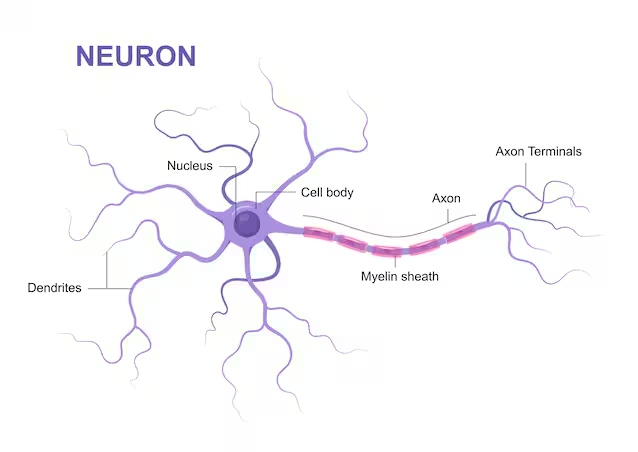
Neuroimaging research published on Trends in Neuroscience And NeurImage they tell us that this development follows a rigorous evolutionary hierarchy: the primary areas related to bodily senses (such as the visual and auditory cortex) and movements basically they ripen firstallowing the newborn to immediately process the vital stimuli for its survival. For information to travel rapidly between cells, the brain needs to build a network of efficient “highways” through the myelination. This process consists of covering the nerve fibers with a sheath made of lipids and proteins (myelin), which accelerate exponentially the transmission of brain electrical signals.
To support this monumental wiring work, nourishment plays an absolute leading role. In her 2021 doctoral thesis, Dr. Peetri Kar demonstrated, through the use of MRI, that thebreastfeeding in the first few months of life it has a measurable and positive impact on the microstructure of the white matter, strengthening in particular the traits linked to language and visual processing. Breast milk and adequate infant nutrition provide indeed crucial structural nutrients. Among these, essential fatty acids (such as DHA) and choline stand out, which acts as a real biological building block that is essential both for form protective cell membranesboth to produce acetylcholinea neurotransmitter fundamental for communication in memory and learning circuits, and whose importance in the first 1000 days of a child’s life is also strengthened by a systematic review published in 2020 in the journal Nutrients.
Around the year: the reorganization of the brain network and the impact of the environment
As the baby approaches his first birthday, he learns to crawl, manipulate objects and formulate words first complex vocalizations. On a biological level, the chaotic overproduction of synapses of the first months begins to be refined through an ecological and efficient mechanism called “synaptic pruning” (synaptic pruning). The infant brain begins to operate according to the principle ofuse it or lose it: le connections that are constantly activated from everyday experience, voice interaction and gaming they strengthenWhile unused ones are eliminatedmaking the transfer of brain information much faster and more precise (Conkbayir, 2022). In their 2017 work, Cao, Huang and He highlight how, in this specific time window, the brain makes a leap in qualitymoving from a purely local organization to a globally interconnected network, developing the long-range connections that unite different and distant brain regions.
However, this very plasticity makes the child’s brain extremely permeable and vulnerable to the environment in which it grows. The large global multicenter study conducted by Alex and colleagues reveals a surprising fact: already around 18 months of age, socio-economic factorssuch as maternal education level and family income, are starting to show a tangible impact on brain size and growth trajectories. Children raised in advantaged and stimulating environments tend to develop larger volumes in vital subcortical structures such as thehippocampus (the nerve center for long-term memory and learning) andamygdala (the control unit that processes emotions). Conversely, environmental deficiencies, less stimulation or disadvantaged conditions are reflected in reduced brain volumes and a measurable gap in visual receptive skills and language development. This confirms us unequivocally, as also highlighted in a recent review by Fernandez published on Annals of Nutrition and Metabolism, that a peaceful family environment, attentive care and constant access to stimulating resources are not mere “extras” but actual physical determinants that sculpt infant neural architecture.
Around age two and beyond, the structural revolution and the dawn of complex thinking
As the child approaches and surpasses the threshold of the second year of life, his skills make a further leap forward: his vocabulary expands, greater self-awareness emerges and his thoughts become more structured. From a physical and functional point of view, the brain is undergoing organizational restructuring. While in the first few months of life development focuses mainly on short-range connections, useful for specializing local communities of neurons, approaching the age of two we witness a spectacular growth and strengthening of long-range connections (Cao et al., 2017; Li et al., 2024). These new biological highways allow different areas of the brain to communicate over greater distances, making the entire neural architecture globally interconnected and efficient.
The most fascinating change highlighted by recent research published on Cell Reportshowever, concerns the movement of the actual “control units” of the brain, technically defined hubs. Through functional magnetic resonance imaging investigations, it was discovered that, in the neonatal period, these information sorting centers are concentrated almost exclusively in the primary areas of the sensorimotor and visual system, i.e. those essential for immediate survival (Li et al., 2024). Around the age of two, however, a massive spatial transition occurs: The hubs move towards higher order cortical regionsin particular in the prefrontal areas and in the so-called default mode network (the basic network of the brain), territories responsible for logical reasoning, behavioral control and complex cognitive functions. In practice, the child’s control room shifts from “senses” to “thought”.
Such rapid and sophisticated cabling requires an incredible waste of resources. At the molecular level, the expansion of this infrastructure is tightly driven by the expression of genes linked to neural development and a process known as “aerobic glycolysis“, which breaks down glucose to obtain energy, guaranteeing the growing brain the immense quantities of metabolic energy necessary to form and consolidate new synapses. This structural-functional reorganization of the first thousand days is so precise and solid that scientists, by mathematically analyzing these connections in the neonatal period, are today able to foresee with a good percentage what the future will be linguistic and cognitive skills of the child.
Sources
Gonzalez-Fernandez et al., 2024, Early Growth and Impacts on Long-Term Neurodevelopment and Human Capital Ouyang et al., 2019, Delineation of early brain development from fetuses to infants with diffusion MRI and beyond Alex et al., 2023, A global multicohort study to map subcortical brain development and cognition in infancy and early childhood Derbyshire and Obeid, 2023, Choline, Neurological Development and Brain Function: A Systematic Review Focusing on the First 1000 Days Cao et al., 2017, Developmental Connectomics from Infancy through Early Childhood Preeti, Kar, 2021, Early Influences on Brain Development in Preschool Children Conkbayir, 2022, The neuroscience of developing child Li et al., 2024, Development of segregation and integration of functional connectomes during the first 1,000 days
