A group of researchers from the Free University of Bolzano has “engineered” plants by equipping them with nanoparticles (i.e. particles with a size between 1 and 100 nanometers) of a synthetic polymer, able to increase their ability to absorb sunlight and photosynthesize: the results were described in the study Conjugated polymer nanoparticles boosting growth and photosynthesis in biohybrid plantspublished in the journal Materials Horizons. These plants, defined “biohybrid”, thanks to the increase in photosynthesis power, they are also capable of absorbing up to 11% more carbon dioxide (CO2) from the atmosphere, compared to non-hybridized plants. An important aspect is that they are not the result of genetic engineering or manipulation of their DNA, but the polymer particles were made assimilated by plants directly from the roots. The experiment is completely innovative, in fact, for the first time were produced plants hybridized with a synthetic componentcapable of modifying and enhancing a biochemical process: it will be able to open new frontiers in the field of applied bioengineering and in the search for solutions for the sequestration of carbon dioxide from the atmosphere, helping us in the fight against climate change, and the production of oxygen (O2).
How biohybrid plants were obtained: the study
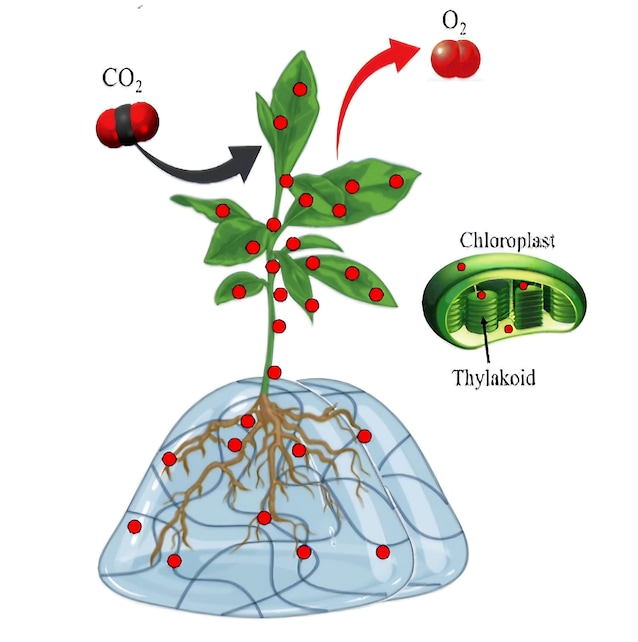
In the laboratories of the Free University of Bolzano, seeds of the annual plant common arab (Arabidopsis thaliana) were germinated on Petri dishes containing a culture hydrogel enriched with Poly 3-Hexylthiophene nanoparticles (P3HT-NP)a polymer non-toxic for the plant and the environment, with a large capacity for absorbing light and with an absorption peak around 500-600 nanometers. After two weeks, hybrid seedlings were born that have absorbed the polymer nanoparticles through the rootsthus distributing them up to the leaves. Using special instruments, the photosynthetic activity and CO2 absorption rate of these plants and a group of control plants without nanoparticles were measured, obtaining very interesting results.
The properties of biohybrid seedlings
Plants in Petri dishes treated with P3HT-NPs showed a increase in shoot biomass by 42% compared to those in control plates without polymer nanoparticles, thus demonstrating a greater growth capacity than other plants. Furthermore, biohybrid common arabetta seedlings showed an 11% increase in net CO assimilation capacity2.
The researchers explain that the nanoparticles act as a kind of “photonic antennas” inside the leaves, capable of increase light absorption in a wider range of wavelengths, thus generating more electrons inside the chloroplasts and improving the efficiency of photosynthesis.
Biotechnology to support carbon sequestration and energy production
The experiment of the Free University of Bolzano is based on already consolidated assumptions given that for over 20 years work has been done on the development of polymers capable of conducting electrical energy and on “electronically enhanced” plants, as also demonstrated by the existence of EU research projects. We know that the concentration of CO2 in the atmosphere has reached record levels and the carbon sequestrationi.e. the process of capturing and storing CO2 atmospheric, must be favored with every strategy: from forestation interventions, to the reduction of emissions, to the use of biotechnology. At the same time, research is working to make renewable energy more efficient and reduce dependence on fossil fuels.
In this area, various research groups are experimenting around the world with technological applications based on the use of photosynthetic organisms to develop biohybrid systems. There chlorophyll photosynthesis it is in fact at the center of the attention of scientists and researchers precisely because, thanks to this biochemical process, plants, algae and bacteria are able to transform solar energy into chemical energy and, at the same time, they sequester atmospheric carbon (CO2), representing an important future ally in reducing carbon dioxide concentrations in the atmosphere.
