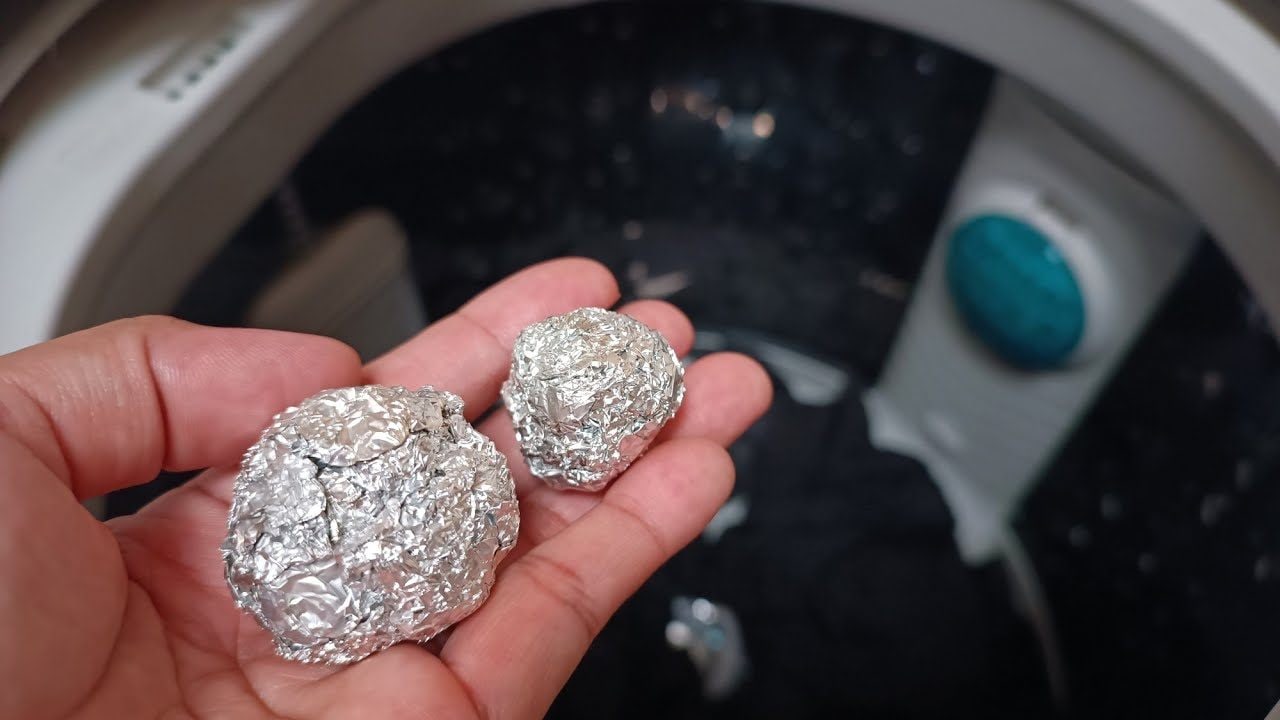
It is one of the most discussed “home tricks” ever: you will surely have heard someone – or you will have come across some videos on social media – swear that inserting two or three balls of tin foil of a diameter of a few centimeters in the washing machine or dryer works wonders for eliminate static electricity and make garments softer and easier to iron, effectively acting as a green alternative to fabric softener.
Foil is the protagonist of numerous “Grandma’s tricks” and, more recently, “social media tricks”: some simply don’t work, others are bizarre to say the least, others have a certain effectiveness. But does the aluminum ball in household appliances work? In summary: it can be effective in the dryer, while It’s practically useless in the washing machine.
What is the aluminum ball used for in the washing machine?
The basic idea goes something like this: while our clothes are in the washing machine, they rub against each other vigorously, charging itself electrically by friction. After washing, as the clothes dry, these accumulated electrostatic charges act on the arrangement of the fibers, sometimes giving the fabrics a rough or wrinkled sensation to the touch. The tinfoil ball, rubbing with the fabrics it would prevent the formation of electrostatic charges. In fact, the aluminum in tinfoil, being a good electrical conductor, is able to take with it these excess electrical charges, making the fabrics return neutral. In short, the action of the aluminum ball is purely electrostatic: this metal in fact has no detergent properties and the mechanical action on the garments is completely negligible.
In reality, however, as we will see later, the accumulation of electrostatic charges is more of a problem with drying than with washing. In the washing machine, in fact, the clothes are essentially immersed in water, which It contains electrolytes and is therefore an electrical conductor capable of moving part of the accumulated electrostatic charges. The addition of one, two or three aluminum balls then appears mostly redundant and their usefulness in most cases will be marginal.
Furthermore, just as aluminum can take charges from one end, in the same way, again by rubbing, it can also give them to another, given that there is no system for discharging the electric charges to the ground.
Last but not least, even without taking all this into account, it remains to be demonstrated that two or three balls of foil are sufficient to dispose of the static electricity that can accumulate in several kilograms of clothes.
The action of fabric softeners, however, is very clear. These in fact contain chemical compounds that they electrostatically attract the fibers of the fabricnot only neutralizing them but making them stay well separated, a bit like when we place a hand on an electrostatic ball and our hair stands on end. These chemical compounds then adhere to the bristled fibers, acting as a kind of lubricant. In short, fabric softener is a bit like the “conditioner” of clothes in the washing machine.
The effectiveness of foil in the dryer
The situation is different if we talk not about washing but about drying. It is precisely in the hot and dry environment of the dryer that rubbing, especially of synthetic fabrics (which unlike natural ones absorb less water), leads toaccumulation of static electricity in our heads. In fact, as the clothes dry, the fibers are always in contact with the air more than with the water, e.g air is an excellent insulator which keeps the electrostatic charges “trapped” in the fibers.
Here the foil balls can have anon-negligible utility: aluminum can act as conductor bridge and, like a sort of “mini-lightning rod”, take on the excess electrical charges, thus reducing the formation of creases and the feeling of roughness. The effectiveness can naturally vary depending on numerous specific factors, but there is an effect at least in principle, especially for synthetic garments.
