
The Giant Panda (Ailuropoda melanoleuca) is one of the most iconic and loved species in the world. Mammal native to China and belonging to the Ursid family, with its unmistakable coat black and whiteis to all intents and purposes a “carnivore” that has evolved to adopt a herbivorous diet. Precisely today, March 16th, we celebrate the World Panda Day: an opportunity to remember the importance of the conservation of this species, which has been threatened for years by destruction of their habitator the bamboo forests. This plant is vital for their survival, as it represents almost all of their diet (they devour 12 to 40 kg per day).
Historical symbol of animals at risk of extinction, the Giant Panda, contrary to what one might think, since 2016 it is classified by the IUCN (International Union for Conservation of Nature and Natural Resources) as a species “vulnerable” And no longer “in danger”. However, while this is excellent news, there is still a lot of work to do to permanently safeguard these peaceful giants.
Characteristics of the giant panda and dimensions
The Giant Panda or “big cat bear” – daxióngmāo in Chinese – is a medium-sized solitary animal that weighs from 70 to 150 kgwith a height of approximately 1 meter and a length of 1.5 meters. Famous for its unmistakable black and white fur, it is part of the family of Ursidsthe same as other polar bears or grizzlies.
Although it retains the simple digestive tract typical of its ancestors carnivoresthis animal evolved to feed strictly herbivorous: its diet is made up exclusively of bamboo, a food low in protein and high in fibre.
Because it doesn’t produce the enzymes needed to digest cellulose or lignin, it has a hard time assimilating essential nutrients. To survive it must therefore eat huge quantities of food (over 12 kg per day) and expel most of what he ingests through his feces, reaching the point of defecating between 50 and 100 times in a single day. With so few daily calories, the panda has developed a very slow metabolismcomparable to that of a sloth or a reptile.
Being biologically a carnivore, it does not have a true opposable thumb like primates, which would be essential for grasping bamboo leaves and canes. However, evolution leaves nothing to chance: pandas have developed a “false thumb” (an elongated radial sesamoid bone located on the heel of the forelimb) that allows them to grasp food securely with a single paw.

Once widespread throughout southern China, the current range of the giant panda – that is, the habitat in which the species is present today – is made up of mountain forests, from 1,900 to 4,100 meters above sea level, rich in bamboo, located in three Chinese provinces: Sichuan, Gansu And Shaanxi. Unfortunately, these environments and the historical range of the species have shrunk dramatically over the years due to rapid demographic expansion and human activities.
Conservation status of the panda: IUCN classification
Giant pandas are no longer considered a species”in danger“, but they moved to the “vulnerable” category already in 2016. This achievement is the result of conservation work carried out by the Chinese government, supported by international organizations such as WWF. The fourth national census (conducted between 2011 and 2014) identified 1,864 specimens throughout the distribution area. This data has certified a population growth of 17% and confirmed that the decline has stopped. Supporting this recovery there is also a clear environmental improvement: the habitat occupied by pandas, as reported by the IUCN, has increased by11.8%while suitable (but not yet inhabited) forest areas increased by 6.3%.
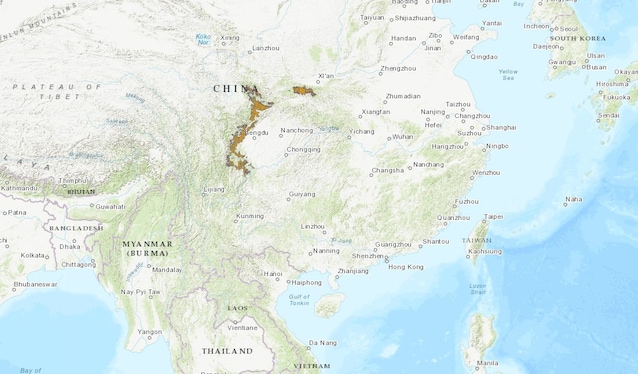
Although the current trend is positive, it is predicted that climate change could wipe out more than the 35% of bamboo forests over the next 80 years, causing a further decline of the species.
If current protection measures (such as the expansion of reserves envisaged by the Chinese government) are not maintained and strengthened to deal with climate emergencies, the progress of recent years risks being in vain.
Main threats to pandas
The decline in the Giant Panda population in China until the last decade is due to several causes. All except one, as is easy to imagine, are due to human activities which have led to the fragmentation of habitats. Forest destruction has divided pandas into small, isolated populations, increasing the risk of extinction. As reported by the IUCN, the main threats to the species are:
- Infrastructure and industrial projects: construction of roads, railways, hydroelectric dams and mining continue to divide the habitat.
- Agriculture and animal husbandry: agricultural expansion (crops and wood plantations) and increasing livestock grazing reduce the living space available to pandas
- Residential and tourist development: the expansion of urban, commercial and recreational areas brings stress to the ecosystem.
- High altitude confinement: the panda is dependent on the synchronized mass blooms and die-offs of bamboo. Today, being relegated to high altitudes by human expansion, pandas struggle to migrate to find alternative bamboo species.
- Climate change and extreme phenomena: Drought and extreme temperatures could cause further bamboo habitat loss by the end of the century.
- Diseases and parasites: Dogs, livestock and other pets can introduce new pathogens that are lethal to pandas.
- Pollution: Air and water contaminants represent a potential hazard, although little studied.
- Poaching and accidental hunting: Although direct poaching has decreased thanks to severe penalties, pandas remain accidental victims of traps intended for other animals.
- Natural geological events: ecosystem changes due to earthquakes and tsunamis, the only threat not attributable to man.
Sources
IUCN WWF
1. Swaisgood RR, McShea WM, Wildt D, et al. Giant panda (Ailuropoda melanoleuca). In: Penteriani V, Melletti M, eds. Bears of the World: Ecology, Conservation and Management. Cambridge University Press; 2020:63-77.
FWS IBA
