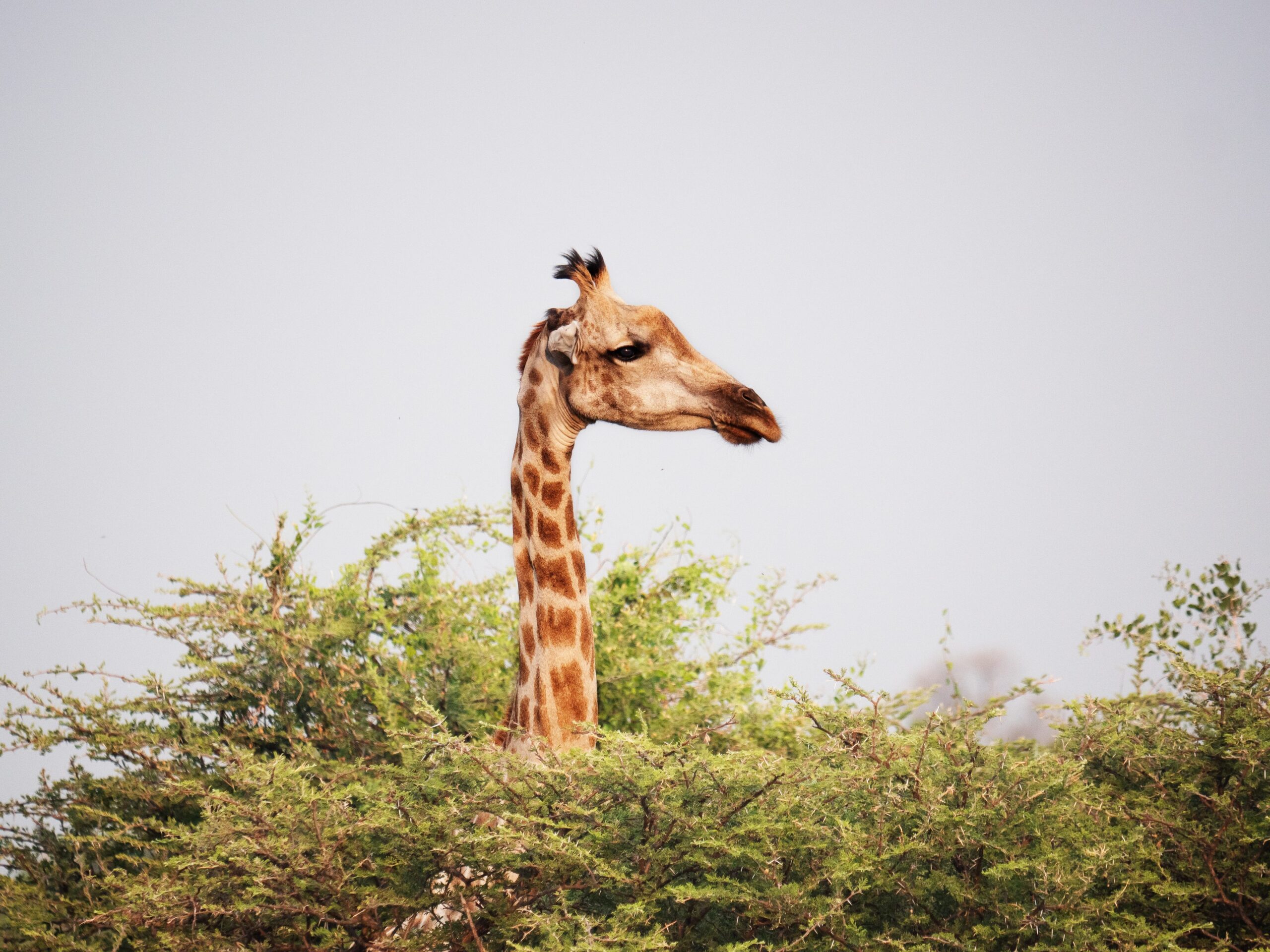
Before Charles Darwinthe theory of the most popular evolution had been proposed at the beginning of the nineteenth century by the French naturalist Jean-Baptiste de Lamarck and was based on the so -called inheritance of the characters acquired: For example, the giraffes have a long neck because their ancestors, in the dint of lengthening the neck to reach the highest leaves, have “passed” to the offspring a longer neck. Today we know that the Lamarckian evolution is wrong: the theory of current evolution, developed by Darwin a few decades later, is based on the natural selection: In summary, the characters suffer random changes and those most suitable for the survival of the species are selected and transmitted to the subsequent generations. These are two substantially different theories, but for various reasons we still tend to confuse them.
The “giraffes of Lamarck” and the mistake of his evolutionary theory
In the beginning the giraffes had a short neck. Over time, however, someone sensed that, lengthening the neck, it was possible to get to eat the freshest sprouts, those placed at the top, on the tops of the trees, to which few other animals had access. In doing so, by striving every day more, some giraffes grew a very long neck that, subsequently, He was inherited by his children and by the children of these. According to Lamarck, the reason why giraffes have a long neck would be precisely to be attributed to this inheritance of the characters acquired.
Let’s clarify immediately: if you seem to have just read a little solid story from a scientific point of view, you are right. The theory proposed by Jean-Baptiste de Lamarck in his Philosophie Zoologiquein 1809, And wrong. We can become the best dives or the best rugby players in the world, but our children and daughters will not inherit the physical skills or muscles that we have trained, with constancy and sacrifice, over the years.
To date, the inheritance of the acquired characters He has not found enough evidence in his favor. It should be remembered, however, that Lamarck’s publications still marked a Important moment and change for the history of science. Finally, after centuries of fixism and theories based on the immutability of living organisms, the idea that the biological diversity It could be the result of a long history, made of changes and changes also occurred in relation to the environment. In short, Lamarck was the first to propose a real theory that would try to explain the phenomenon of evolution.
Natural selection
There natural selection It is the main mechanism on which the evolution theory Proposed by Charles Darwin in 1859 and still considered valid, albeit magazine and updated. At the basis of natural selection, and the entire theory of Darwin’s evolution, there is a simple concept which, however, for centuries was completely neglected. We are talking about the great variety of living and, more specifically, of the intraspecific variabilitythat is, of the fact that each individual, although belonging to a certain species, is unique, different from all the others. Clearly, it is random variationsnot produced by the surrounding environment, as erroneously proposed by Lamarck. These differences, or variants, or not favor the survival and reproduction of an individual, compared to others, in a given environment. Just at the beginning of chapter IV, in The origin of the species, Darwin wrote: “Could we ever doubt (keeping in mind that many more individuals are born than they can survive) that those who have any advantage over others, albeit the smallest, have the best chances of surviving and propagating their descent?“In this sense, we can imagine natural selection as a force capable of acting on populations and promoting those individuals who, among many, have more” suitable “variants to the environment.
Bibliography
Manzi Giorgio. The great story of human evolution. Bologna, 2013, Il Mulino.
Darwin, Charles. 2016. The origin of the species. Newton Compton publishers. Rome
