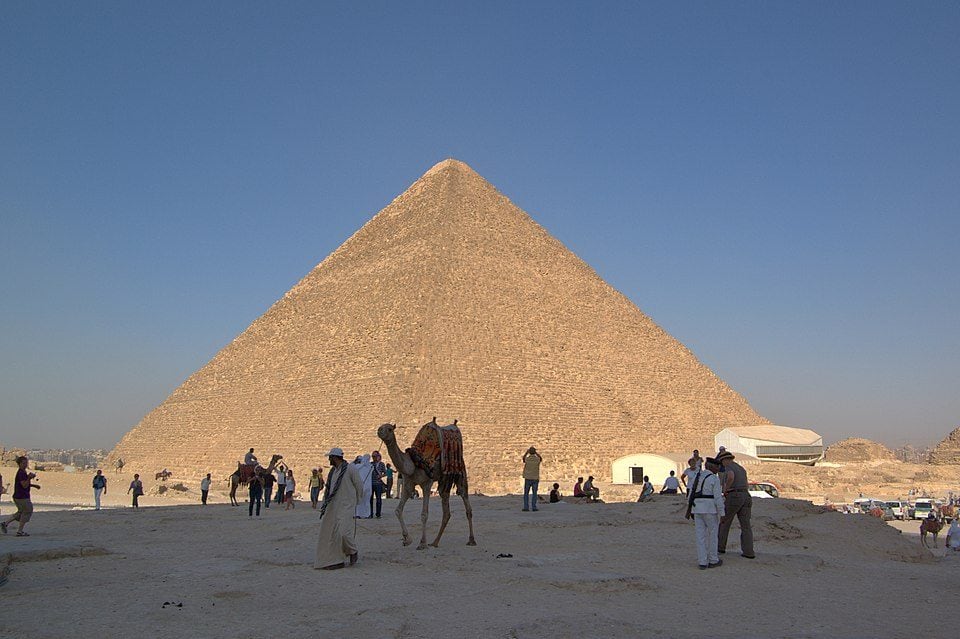
In recent weeks, news of one has been circulating new amazing dating for the Great Pyramid of Giza, in Egypt, which is based on a study published byeng. Alberto Donini on Zenodoa platform Open Access for various types of items. According to Donini, the construction of the Pyramid of Cheops (located about 18 km from Cairo and officially dated around 2,600 BC) would have occurred much earlier, between 37,000 and 9,000 BC. C.
But is it really like that? Let’s clarify for a moment the method used and the reliability of the study.
Let’s start by saying that the publication of the engineer. Donini it has not undergone any review and verification process (peer review), of specialized magazines, and was published only on a free platform, consequently it cannot be considered a scientific article. The new dating method used for the pyramid, developed by Donini himself, is called “Relative Erosion Method” (“REM”). This method should determine the relationship between the erosion of the same type of rock, starting from the assumption that it progressively deteriorates at the same speed under the same conditions.
The dating proposed by Donini was estimated using the “Relative Erosion Method” which, in reality, immediately presents some problems: does not consider how the climatic conditions that generate the erosion of the stone – such as wind and rain, but also the sedimentation of debris and dust – are extremely variable over timeeven more so over a period of more than 4,500 years. Today’s climate is not the same as it was 150 years ago, let alone 4,500.
A criticism made by Donini of the current datings – which, we remember, they are the result of at least two centuries of rigorous studiesbased on archaeological, historical and epigraphic sources, also supported by methods such as radiocarbon – concerns the fact that the radiocarbon dating used recently – carried out starting from some organic samples present in the Malta of construction of the pyramid – are unreliable because, at the time of Pharaoh Cheops, it was simply restored using the mortar, which the elusive original builders, thousands of years earlier, they did not own.
Archaeological and architectural studies on the pyramid have instead highlighted how it has never been restoredbut rather, let it be a single constructive effort operated over the course of several decades. Donini then questions the fact that the pyramids were gods gravesalthough the architectural evolution of these structures is well known explicitly funerarylasting half a millennium, from the mastabas (earlier truncated cone tombs, dated from 3100 BC) to the stepped pyramids and finally to those of Giza.
