
Today it is the largest and most inhospitable desert on the planet, but thousands of years ago the Sahara it was one luxuriant savannahfurrowed by rivers and populated by elephants, hippos and crocodiles. During the so -called African wet period (between 14,000 and 5,000 years ago), ancient populations of hunters-cacogliers They lived in this environment, leaving behind extraordinary testimonies such as the rock paintings and ancient boats. Then, about 5,000 years ago, a rapid climate change broke the region, forcing its inhabitants to migrate: many of them concentrated along the banks of the Nile, bringing with them a cultural background that contributed to laying the foundations for the birth of the great Egyptian civilization.
Prehistoric settlements and fauna of the “Green Sahara”
During the African wet periodthe landscape of the Sahara was completely different Compared to how we know it. The environment was made up of one Great and luxuriant Savanawith numerous plant species and large quantities of waterincluding considerable lakes. This is because, following a change in the orbit of the earththere was an increase in theinsolation which, causing a greater contribution of humidity from the Atlantic Ocean, he brought more intense and frequent rainfall in northern Africa. Because of this climate, a lot more humid and rainy of how much it is today, the Saharan region was characterized by the presence of lakes and riverswho contributed to revive considerably the landscape, making it very similar to that of the current savannah Central subtropical Africa. Near the main sources of water were real and its own forestscompletely unimaginable in what is now one of the most arid places in the world.
Scholars managed to reconstruct the landscape of “Sahara Verde“of the African wet period thanks to the contribution of different scientific disciplineslike the geologythe botany el‘archeology. Geologists’ studies in some areas of the Sahara have made it possible to identify burial river valleys For millennia in the sands, while the botanical studies performed on samples of sediments dated to this wet period have found i pollen of the different plant species that grew in the area. Archaeologists have dealt with instead of identifying and studying some prehistoric settlements who have returned faunal remains that allow us to reconstruct which animal species populated this environment, coming Prend and consumed from human groups. They were typical animals of theSavana ecosystemlike crocodiles, elephants, gazelles, hippos. Given the presence of numerous mirrors of water, the ancient inhabitants of the Sahara also fed on Fish and molluscs.
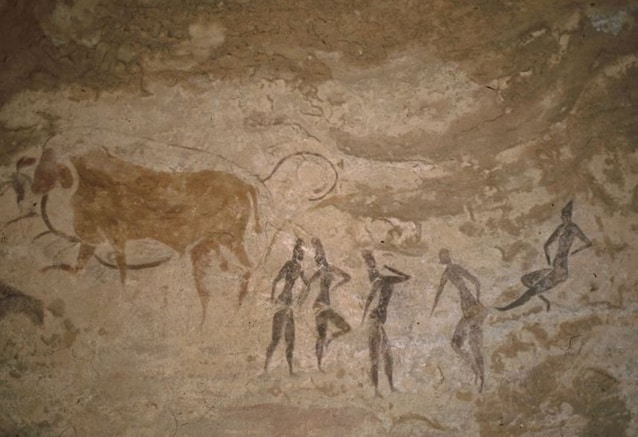
In this phase of prehistory, the groups of hunters-cacogliers They left numerous traces of their presence in the Green Sahara environment. Archaeologists have identified cover and camps that highlight the lifestyle seminomadic of these populations. Subsequently, around the 8000-7000 years agothe great Neolithic revolution He just touched this territory, Agriculture did not take particular rootedperhaps because of the exploitation of other resources and the purely seminomad lifestyle of these ancient human groups. THE’animal breedingabove all sheep, instead, is certified, together with the collection of wild cereals.

The populations who lived in “Green Sahara” left obvious traces of their passage. In the V Millennium BC The processing of the ceramicand the processing of Lancia and arrow tips Suitable for the hunt for the fauna of this particular ecosystem, by these ancient hunters. THE’importance of water In this environmental context and in the exploitation of resources it emerges from numerous cultural data: in the state of Yoube, in NigeriaIn the 1987 The Dufuna canoethe Second oldest boat in the worlddated to the radiocarbon between 8500 and 8000 years ago. This area of Nigeria, today part of the arid region of Sahelin fact it was lapped by the waters of the Lake Chad which, during the African wet period, was 200 times more extended today.

The artistic expressions of the African wet period
The artistic expressions prehistoric of the African wet period are quite known, and are made up of Rapper engravings and paintingsmade of caves and shelters under rock. These representations bring out the vitality and richness of the cultural expressions of the ancient civilizations that populated the “green Sahara”. Some of the best known sites are the Cave of swimmers in Egyptthe massive of Tadrart Acacus in LibyaOf Taxes N’Ajjer in Algeriaand of Tibesti In the Chad.

The African wet period ended between 6000 and 5000 years ago. The quantity of rainfall suddenlyhelping to make more arid and dry The Sahara area. With the decrease of water, the vegetation retiredyielding their place to sands. Lakes and rivers drafted themselves, some disappearing completely, while others reducing their scope enormously. The seminomad populations that populated the green Sahara, due to the desertificationconcentrated in specific areas: Some groups migrated northon the coasts of Mediterranean, while others southin the present Sahel.

In conditions of great aridity, many groups concentrated along the banks of the only watercourse that had maintained a certain flow in the region, namely the Nile river. These populations, heirs of the great prehistoric cultural richness of the Green Sahara, they will give rise to the great Egyptian civilization.
Sources
Peter de Menocal, Joseph Ortiz, Tom Guilderson, Jess Adkins, Michael Sarnthein, Linda Baker and Martha Yarusinsky, Abrupt Onset and Termination of the African Humid Period, in Quaternary Science Reviews, vol. 19, 1–5, January 2000, pp. 347-361
Eustathios Chiotis, Reconstructure The Environment As A Scenny of Human History and Civilization, in Eustathios Chiotis (edited by), Climate Changes in the Holocene: Impacts and Human Adaptation, 1st ed., Boca Raton, CRC Press, 15 November 2018
Julie Watrin, Anne-Marie Lézine and Christelle Hély, Plant Migration and Plant Communities at the time of the “Green Sahara”, in Comptes Rendus Geoscience, vol. 341, 8–9, August 2009, pp. 656-670
J. Quade, E. Dente, M. Armon, Y. Ben Dor, E. Morin, O. Adam and Y. Enzel, Megalakes in the Sahara? A review, in Quaternary Research, vol. 90, n. 2, 14 June 2018, pp. 253-275
Mauro Cremaschi, Andrea Zerboni, Christoph Spötl and Fabrizio Felletti, The Calcareous Tufa in the Tadrart Acacus Mt. (SW Fezzan, Libya), in Palaeogeography, Palaeoclimatology, Palaeeecology, vol. 287, 1–4, March 2010, pp. 81-94
Andrea Zerboni and Kathleen Nicell, Enhanced Zoogeomorphological Processes in North Africa in Thehuman-Impacted Landscapes of the Anthropocene, in Geomorphology, vol. 331, April 15, 2019, pp. 22-35
Savino di Lernia, Stefano Biagetti, Kathleen Ryan, Silvia Bruni, Lucy Cramp, Mélanie Salque, Richard P. Evershed and Julie Dunne, First Dairying in Green Saharan Africa in The Fifth Millennium BC, in Nature, vol. 486, n. 7403, June 2012, pp. 390-394
Anne Pirie, Salvatore Garfi, Joanne Clarke and Nick Brooks, The Archaeology of Western Sahara: Results of Environmental and Archaeological Reconnaissance, in Antiquity, vol. 83, n. 322, 2009, pp. 918-934
Gumnior, Maren; Thiemeyer, Heinrich (2003). “Holocene river Dynamics in the ne Nigerian Savanna”. Quaternary International. 111: 54.
