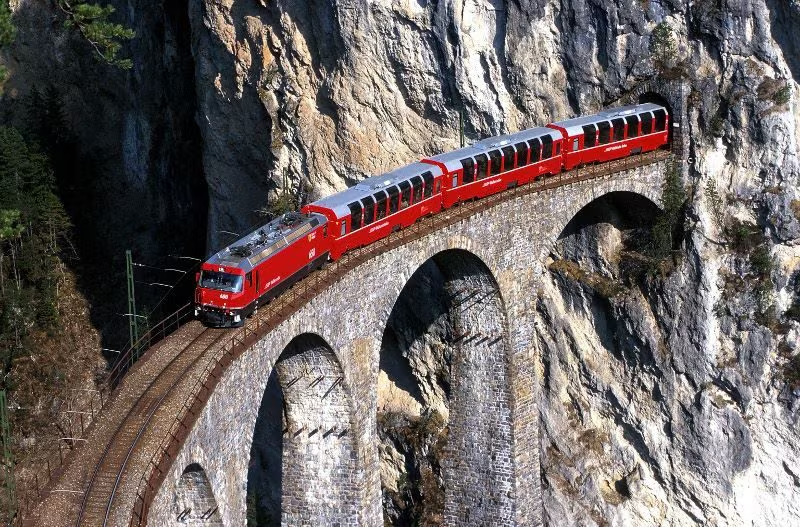
The highest railway station in Europe is at Jungfraujoch (also known as the “Top of Europe”), located in 3,454 meters altitude in the Bernese Oberland, in southern Switzerland: it is one of the most difficult engineering works to carry out, despite the railway line covering a distance of only 9.34 km. The train covers a net vertical difference in altitude of almost 1400 metres, starting from the station Kleine Scheidegg (at 2061 meters above sea level) and reaching its final destination at almost 3500 meters above sea level.
Among the various engineering challenges of this project, the maximum slope of 25% of the route represented one of the main obstacles: let’s see this interesting project in more detail.
The highest railway project in Europe in Switzerland
The Jungfraujoch railway (Jungfraubahn) represents one of the greatest expressions of railway engineering in the world, conceived by the Swiss entrepreneur Adolf Guyer-Zeller and built over a period of sixteen years, between 1896 and 1912. This railway was developed on a metric gauge (1,000 mm) for a total length of 9.34kmcovering a net vertical difference of 1,393 meters starting from the interchange station of Kleine Scheidegg (2,061 m above sea level) to the summit of the Jungfraujoch, located at 3,454 meters above sea level. The route has a maximum gradient of 25% for much of its development, a value that made it impossible to rely on simple wheel-rail adhesion alone, making this obstacle one of the major challenges.
In order to successfully face this challenge the designers adopted the Strub rack system. This patent involves the installation of a third hot-profiled central rail with constant pitch teeth, on which the cogged driving wheels of the trains mesh. The choice of the Strub system proved to be successful right from the start thanks to the mechanical resistance to shear stress and the ease of joining the modules, crucial elements for resisting the dynamic stresses induced by axial loads on steep slopes.
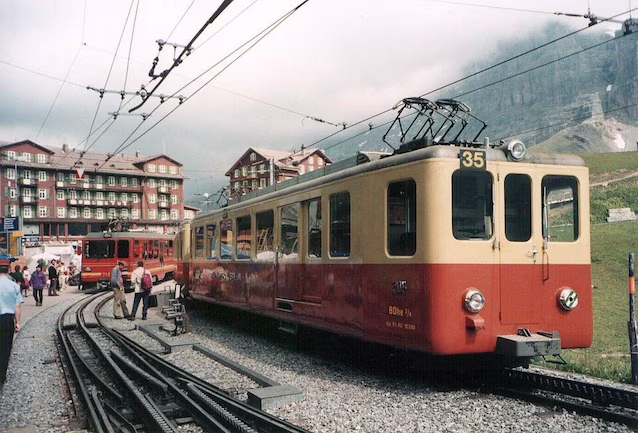
The most extraordinary aspect of the work lies in its plano-altimetric configuration: good 7.6 km of the route develop undergroundwithin one gallery dug into the rocky bowels of the Eiger and Mönch. The excavation of the rock mass represented another important and complex engineering challenge, as it was carried out in an era before modern mechanization with TBM (Tunnel Boring Machine). This operation was in fact conducted entirely with the use of manual drilling techniques or, at most, through the use of pneumatic perforators, and thanks to a massive use of quarry explosives, first and foremost dynamite.
From a geotechnical and geomechanical point of view, the designers and workers were forced to dig inside of compact limestone formations (Eiger limestone) and transition zones towards the gneiss and mica schists of the Aare crystalline mass. This geological transition led to sudden changes in the rock’s modulus of elasticity and in the mass-covering stress state. The water inside the rock mass, due to the temperatures constantly below freezing, caused cryoclastic phenomena (i.e. when “cracks” form due to the freezing and thawing cycles of the water) thus leading to a constant destabilization of the tunnel vault before the installation of the definitive lining.
In order to manage and, above all, dispose of the resulting stone material and guarantee ventilation of the excavation faces, the designers had to create a series of transversal service tunnels which flowed directly onto the vertical walls of the mountain. These openings, known as the Eigerwand and Eismeer stations, served as technological windows for thedebris evacuation by gravity and for the supply of cementitious materials, overcoming the structural logistical limits of the single track line.
The socio-economic impact of the Jungfraujoch
The construction of the Jungfraujoch railway in 1912 involved a series of profound changes in the socio-economic landscape in the Bernese Oberlandwith a major transformation of what was, essentially, a rural area linked to subsistence sheep farming, into a tourist and scientific hub of global importance.
The transition from elite tourism to mass flow – which today surpasses million passengers per year – led to an effect that effectively multiplied the regional GDP, also leading to the creation of hotel complexes, commercial networks and satellite ski lifts in the logistics hubs of Grindelwald and Wengen.
This infrastructural expansion has brought with it a great advantage in terms of demographic stability to the Alpine valleys, thanks also to the creation of new qualified and permanent jobs in mechanical maintenance, railway automation and safety management in critical contexts. In addition to the impact and advantage in purely commercial terms, the line took on a fundamental social and scientific role thanks to the construction, in 1931, of the International Research Station and subsequent Sphinx Observatory.
The rack railway solved the logistical problem of transporting heavy and sensitive instruments (such as spectrometers and chemical laboratories) at high altitude, allowing scientists and Nobel Prize winners to operate stably at 3,450 metres. Today the Jungfraujoch is a global nerve center for atmospheric monitoring inserted into the network Global Atmosphere Watcha socio-cultural and scientific goal impossible to achieve without the support of the railway carrier.
The environmental impact
Like any great work, the analysis of the environmental impact it has had appears to be of fundamental importance. The inclusion of a work of this magnitude within a fragile ecosystem, included in the UNESCO world heritage site, has required cutting-edge environmental engineering solutions to mitigate the impact on the landscape and glaciers. The design choice to develop almost 80% of the route in tunnels avoided the need to intervene with massive excavation works of the Eiger and Mönch slopes, eliminating the visual impact and reducing hydrogeological risk superficial linked to landslides or avalanches.
In the operational phase, the Jungfraubahn stands out for its thermodynamic efficiency due to the regenerative braking system: during the descent, the electric motors of the trains reverse polarity acting as alternators and transforming kinetic energy into high voltage electricity. This energy, once produced, is reintroduced into the two-wire overhead line and consumed directly by the uphill convoys, with a drastic and advantageous reduction in the overall energy withdrawal from the Swiss network according to a circular economy model.
Currently, the main environmental challenge is represented by global warming, which causes the thermal degradation of permafrost, i.e deep ice that seals the fractures of the rock mass ensuring the structural stability of the tunnel vaults. In order to preserve the work, engineers monitor the rock with fiber optic sensors and operate with high-resistance pre-compressed steel tie rods, injected with special cement mixtures with low hydration heat.
